






SurveysFeb 29, 2024
Want Insight Into Industry Salaries? Check Out This Careers Guide SurveysMar 27, 2024
Consumer Confidence Held Steady in March
Optimism about the current state of the economy was offset by anxiety around inflation and the political environment.


The Conference Board’s consumer confidence index slid down to 104.7 in March as consumers expressed concerns about inflation and anxiety about the future economy.
New York—U.S. consumer confidence was mostly unchanged in March as optimism about the current economy was offset by anxiety about the future, including the political environment.
The Conference Board’s consumer confidence index slipped to 104.7 in March, down slightly from a downwardly revised 104.8 in February.
Confidence rose among consumers aged 55 and over but fell for those under 55.
Consumers in the $50,000 to $99,999 income range reported lower confidence in March, while confidence improved slightly in all other income groups.
Dana Peterson, chief economist at The Conference Board, noted that over the last six months, “confidence has been moving sideways with no real trend to the upside or downside either by income or age group.”
“Consumers remained concerned with elevated price levels, which predominated write-in responses. March’s write-in responses showed an uptick in concerns about food and gas prices, but in general complaints about gas prices have been trending downward,” said Peterson.
The average 12-month inflation expectations came in at 5.3 percent, relatively unchanged from February’s four-year low of 5.2 percent.
Recessions fears were trending downward, said the Conference Board, both in write-in responses and by its own measure.
The “Consumers’ Perceived Likelihood of a US Recession Over the Next 12 Months” returned to its downward trajectory after a brief uptick last month.
“Meanwhile, consumers expressed more concern about the U.S. political environment compared to prior months,” said Peterson.
The Present Situation Index, which measures consumers’ current view of business and labor market conditions, rose to 151 in March from 147.6 in February.
Consumers’ view of current business conditions was mixed in March, with the percentage of respondents who said current business conditions are “good” mostly flat at 20 percent, while those who said conditions are “bad” decreased to 17 percent from 18 percent.
Consumers’ view of the labor market was more positive in March.
The percentage of respondents who felt jobs were plentiful was flat at 43 percent, while 11 percent said jobs were “hard to get,” down from 13 percent last month.
Related stories will be right here …
The Conference Board’s consumer confidence index slipped to 104.7 in March, down slightly from a downwardly revised 104.8 in February.
Confidence rose among consumers aged 55 and over but fell for those under 55.
Consumers in the $50,000 to $99,999 income range reported lower confidence in March, while confidence improved slightly in all other income groups.
Dana Peterson, chief economist at The Conference Board, noted that over the last six months, “confidence has been moving sideways with no real trend to the upside or downside either by income or age group.”
“Consumers remained concerned with elevated price levels, which predominated write-in responses. March’s write-in responses showed an uptick in concerns about food and gas prices, but in general complaints about gas prices have been trending downward,” said Peterson.
The average 12-month inflation expectations came in at 5.3 percent, relatively unchanged from February’s four-year low of 5.2 percent.
Recessions fears were trending downward, said the Conference Board, both in write-in responses and by its own measure.
The “Consumers’ Perceived Likelihood of a US Recession Over the Next 12 Months” returned to its downward trajectory after a brief uptick last month.
“Meanwhile, consumers expressed more concern about the U.S. political environment compared to prior months,” said Peterson.
The Present Situation Index, which measures consumers’ current view of business and labor market conditions, rose to 151 in March from 147.6 in February.
Consumers’ view of current business conditions was mixed in March, with the percentage of respondents who said current business conditions are “good” mostly flat at 20 percent, while those who said conditions are “bad” decreased to 17 percent from 18 percent.
Consumers’ view of the labor market was more positive in March.
The percentage of respondents who felt jobs were plentiful was flat at 43 percent, while 11 percent said jobs were “hard to get,” down from 13 percent last month.
The Expectations Index, which measures consumers’ outlook for income, business, and labor market conditions in the near future, fell to 73.8 from 76.3 in February.
Notably, an Expectations Index reading below 80 often signals a recession ahead, said the Conference Board.
Expectations for the next six months slipped to the lowest level since October 2023, it said.
Looking at short-term business conditions, respondents’ outlooks were more pessimistic, with 14 percent of respondents expecting business conditions to improve, flat from February, while the number of respondents that expect them to worsen was up to 18 percent from 17 percent.
Consumers’ assessment of the short-term labor market outlook in March was essentially unchanged from February.
The percentage of respondents who expect more jobs to be available was flat at 14 percent, while the number of respondents who expect fewer jobs to be available was also flat at 18 percent.
Consumers’ assessment of their short-term income prospects was also more pessimistic in March.
The number of respondents who expect their incomes to increase was up slightly to 17 percent from 16 percent in February. However, more respondents (14 percent) expect their incomes to decrease, up from 12 percent.
Respondents also were more pessimistic about their family financial situation over the next six months, a measure not included in the Expectations Index.
Consumers had a more positive view of stock prices throughout the year, but concerns about interest rates remained.
The percentage of consumers expecting an increase in interest rates over the year ahead rose above 50 percent for the first time since November 2023, said the Conference Board.
On a six-month basis, plans to buy automobiles, homes, and big-ticket appliances, all purchases that can be subject to interest rates, were down again.
Planned spending for services in 2024 increased relative to the same time last year, it said, noting consumers plan to spend more on healthcare, motor vehicle services, and lodging for personal travel, while spending less on entertainment.
The Conference Board is scheduled to release its results for April on April 30.
Editors' Picks
Sponsored by


More on Surveys


The Latest

CrimeOct 22, 2026
Jeweler Shot and Killed in His Suburban Cincinnati Store Tara Sinchuri was the owner of Everest Jewels in Fairfield, Ohio, and a father of three. He was found dead in his store on Tuesday.


MajorsOct 22, 2026
Neiman Marcus Has Gifts for the Jewelry Lover Who Has EverythingBespoke experiences from Buccellati and Verdura are on the retailer’s 2026 “Fantasy Gifts” list.

Events & AwardsOct 22, 2026
JIS Fall 2026 Reports Record-Breaking Attendance The number of participants at the fall show was up 12 percent.


Brought to you by
A Diamond Is Forever Launches 2026 Holiday Campaign Championing Natural DiamondsA Diamond Is Forever's holiday campaign reimagines natural diamond icons for a new generation celebrating individuality.


CollectionsOct 22, 2026
Billie Eilish, Finneas Co-Design Collection for John HardyThe Academy and Grammy award-winning siblings have collaborated with John Hardy on a new jewelry line inspired by their personal style.

Weekly QuizOct 22, 2026
This Week’s QuizTest your jewelry news knowledge by answering these questions.


PodcastsOct 21, 2026
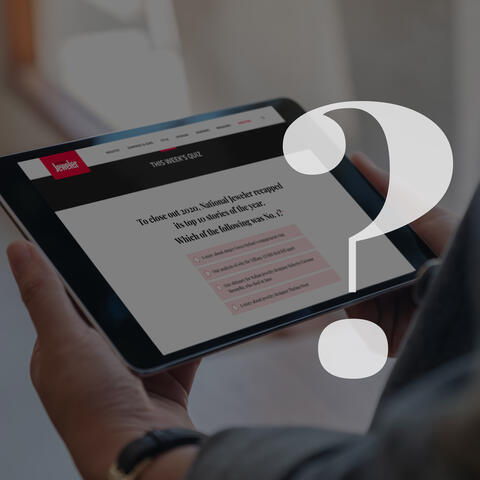
Episode 10: This Episode Is Haunted Diana Singer shared the stories of two “cursed” diamonds on this month’s podcast, which was inexplicably riddled with technical issues.


IndependentsOct 21, 2026
Gardner-Collier Jewelry to Close After 9 Decades in BusinessThe family-owned jeweler has three locations across Missouri and Iowa.

Brought to you by
Open an Account, Get $50 Off Your First Order. No Code Needed.Built on Relationships. Refined by Craft.


SourcingOct 21, 2026
Venetia Mines Final Carats Ahead of 2-Year ShutdownThe De Beers-owned diamond mine in South Africa is being put on ice as part of a round of previously announced cost-cutting measures.

CollectionsOct 21, 2026
Helzberg, Nordstrom Carrying New Jewelry Collection From Off-WhiteThe collection centers designs with clean geometric lines, chunky sculptural pieces, and recognizable details from the luxury fashion brand.

SourcingOct 21, 2026
Gemfields’ Mixed-Quality Ruby Auction Earns $52MThe miner said it saw particularly strong prices for larger, fine-quality rubies at the sale.

CrimeOct 20, 2026
Security Guard Charged With Murder in Shooting at Texas MallThe guard opened fire on a man who was smashing a jewelry display case at La Gran Plaza in Fort Worth last week, police said.

IndependentsOct 20, 2026
David Gardner’s Jewelers Unveils Newly Expanded, Revamped ShowroomThe Texas jeweler added 2,000 square feet to its reimagined showroom, complete with a new design studio and an event space.

SourcingOct 20, 2026
The $50M Victoria’s Secret ‘Fantasy Bra’ By The NumbersJacob & Co.'s diamond masterpiece is the most expensive Fantasy Bra ever worn on the Victoria’s Secret Fashion Show runway.

CollectionsOct 20, 2026
Mignon Faget’s Collection Chooses Handmade Over AIThe “Atelier” collection was inspired by the tools, rituals, and objects in an artist’s studio as a quiet rebuttal to an automated world.
MajorsOct 19, 2026
The Knot to Acquire Rival Wedding Planning Platform ZolaThe pending acquisition is an “exciting opportunity” for wedding vendors to grow their business, said The Knot Worldwide’s CEO.

SourcingOct 19, 2026
Jewelry Design Competition Show Airs in Thailand"The Secret Gems" features eight Thai jewelry brands paired with a team of young craftspeople who create jewelry together to win challenges.

CollectionsOct 19, 2026
John Hardy Enters the Medallion Chat With Talisman Collection The brand’s “Modern Talisman” capsule collection introduces pendants inspired by the mythology, natural world, and spiritual ethos of Bali.

IndependentsOct 19, 2026
The Stories of 5 Jewelers Celebrating Their Centennials in 2026Independent jewelers from New Mexico to New Jersey answer the question: What has kept your store in business for 100 years?
CollectionsOct 16, 2026
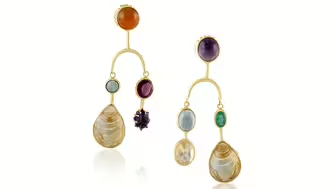
Christina Puchi’s Earrings Hold the UniverseOur Piece of the Week gathers the planets, represented by a variety of colored gemstones, in a pair of 14-karat yellow gold earrings.

IndependentsOct 16, 2026
Reeds Jewelers Expands, Relocates FlagshipThe New York-based jeweler is moving its Amherst flagship store to a larger location in nearby Snyder.

MajorsOct 16, 2026
Katy Chen Appointed Executive Vice President of Graff USA Chen, who worked at Cartier and Tiffany & Co., will lead retail sales and operations for the luxury jeweler’s 11 U.S. stores.

IndependentsOct 15, 2026
Retailer Hall of Fame 2026: Amy and Elise Greenberg For 40 years, sisters Amy and Elise Greenberg have helmed their 126-year-old family business, leading with appreciation and integrity.

ColumnistsOct 15, 2026
Peter Smith: What Is the Culture REP?It’s a term Smith coined and felt compelled to share following a bad experience with an aborted flight and an unfeeling flight attendant.


WatchesOct 15, 2026
Stephanie Gottlieb’s New Movado Watches Are Made for Your Wrist StackMovado teamed up with the New York-based fine jewelry designer on a new collection of Movado Museum Velura watches.

SourcingOct 15, 2026
Signet Jewelers, Richemont May Join Bidder for De Beers, Report SaysThe two companies are reportedly in talks to join the Global Diamond Consortium, led by former De Beers CEO Gareth Penny, as per Bloomberg.
CollectionsOct 15, 2026
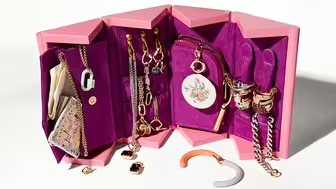
Wolf x Marla Aaron's New Jewelry Box Is for Some (Not All) of Your ThingsThe “Some of the Things” box follows the two larger “Everything” box designs with the look and function of antique sewing and toolboxes.