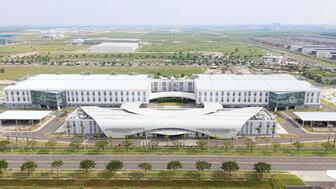
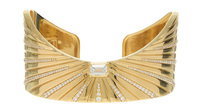
Among the trends National Jeweler’s India contributor Stephen Rego is tracking in the diamond industry this year is the expected push in marketing for natural diamonds in the United States and other countries, including India. Pictured is the recently opened flagship Forevermark store in Mumbai, India, the brand’s largest in the world.
Mumbai--We are just two months into 2026, and it has been a roller coaster ride already.
The unpredictability unleashed by continuing political and economic turbulence globally has reached new heights. This uncertainty could not come at a worse time for the diamond industry, which is in recovery mode following a prolonged slump.
Sudden shifts and changes can upset years of careful planning in the blink of an eye.
So, what do the remaining months of 2026 hold for the diamond industry? How should it navigate in these uncertain times, and what are the main developments that bear watching?
National Jeweler spoke to a cross-section of senior diamantaires, leaders from trade bodies, and industry analysts in India to get their perspectives on the year ahead.
Combining their insights with published data and analysis, we have outlined the top seven trends that diamond businesses should make note of as they plan ahead.
1. The recovery is uneven. In 2025, diamond demand was up in the world’s top two markets, the United States and India.
There were positive signals from many other markets too. China continued to be the exception, though manufacturers believe the country’s decline in demand may have bottomed out.
While this larger picture gives manufacturers in India a reason for optimism, there is a catch. This is not a uniform recovery; there are major variations across different segments.
At the retail end, it is the high end that is shining, while the picture at the midstream level varies across three different segments.
Russell Mehta, managing director of Rosy Blue India, said, “Demand for larger goods (above 2 to 3 carats) is fairly stable and prices have begun to firm up.”
He also noted that there is some improvement in the market for smaller goods (below 0.18 carats).
“Prices have improved but continue to be soft, signs that stability is on the horizon,” Mehta said.
However, the mid-tier segment of the market—meaning diamonds sized from 20 points to about 2 carats—remains “stressed and difficult” and is unlikely to see any significant change in 2026, he said.
“China, which was a large consumer of such goods, remains subdued, and in the U.S., synthetic diamonds have grabbed a substantial share of the market,” he explained.
2. Tariffs, sanctions and trade deals are here to stay. Tariffs: here today, gone tomorrow, back the day after. This could well be the storyline that defines the fast-changing contours of the trade in rough and polished.
Concerns over sanctions on Russian diamonds took a back seat in 2025 as tariffs and trade deals, especially the India-U.S. negotiations, dominated discourse.
In early February, it seemed that a settlement between the two countries was near and rough and polished natural diamonds and gemstones would be exempt while the tax on diamond and gemstone jewelry would return to significantly lower rates.
The news provided much-needed relief to the industry, but it was a short-lived high.
Tariffs are back and will remain at 10 percent (possibly increasing to 15 percent) for the next few months.
While that does provide relief for importers of diamond and gemstone jewelry (the import tax will be 10-15 percent instead of 18 percent), it was not immediately clear as of press time if loose natural diamonds and gemstones will still be exempt from tariffs or taxed at 10 percent.
Meanwhile, Indian diamantaires are welcoming the smaller boosts that the country’s trade deals with the United Kingdom, European Union, Oman, Australia and other countries will provide.
3. Supply side equilibrium will depend on miners and the mid-stream. A relatively stable balance between supply and demand seems to be returning to the diamond pipeline. Industry analyst Pranay Narvekar believes that it would have happened earlier, but the high U.S. tariffs complicated matters.
He now expects a semblance of equilibrium to return by mid-2026.
Narvekar, however, pointed out that this is not on account of rising demand, but more tightly controlled supply.
“Rough production for the market is now way below the peaks of the past,” he said, predicting that it will hover around 100 million carats for the next few years.
Global diamond production peaked in 2005, reaching almost 177 million carats.
“Major mining companies have significantly reduced their guidance for this year, and some smaller mines have been put on maintenance for now, while others have shut,” he said.
Empirical evidence suggests the midstream also has restructured over the past few years and overall capacity is now well below the post-COVID peaks of 2022.
Many smaller players have either shifted to cutting lab-grown diamonds or have moved out of the sector due to the prolonged downturn.
Frenzied buying at unrealistic prices is a thing of the past.
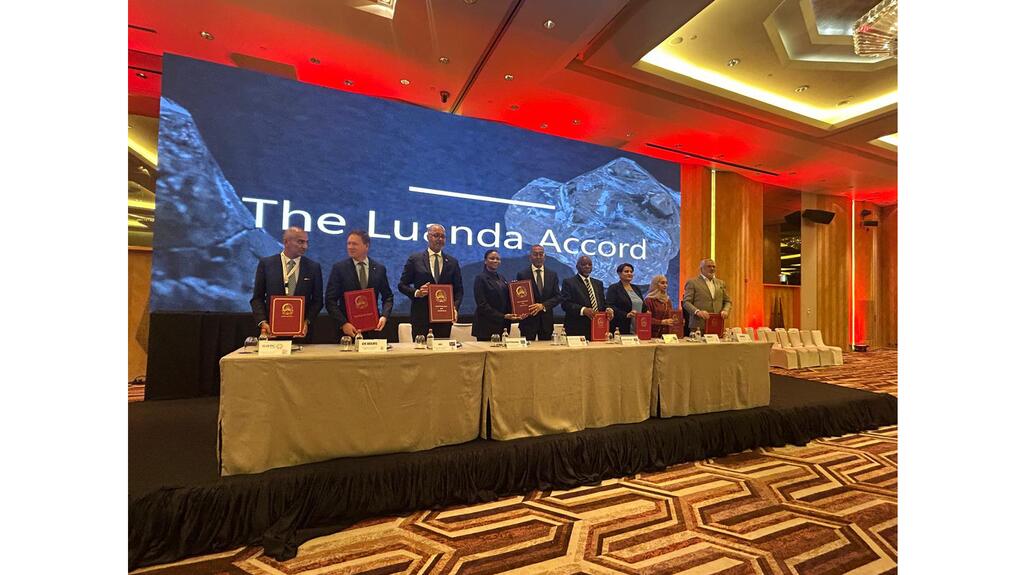
Signed in Angola in June 2025, the Luanda Accord is a commitment by diamond-producing countries and key industry organizations to contribute money to the Natural Diamond Council for marketing. The agreement has gained momentum in early 2026, which means there could be a global generic marketing campaign for natural diamonds in place for the holiday season.
4. A big marketing push for natural diamonds seems imminent. “The Luanda Accord on generic marketing was an important turning point for the industry,” said Shaunak Parikh, vice chairman of India’s Gem & Jewellery Export Promotion Council (GJEPC), which was one of its signatories.
He believes it marked the start of a new phase and the emergence of a new coalition of forces within the diamond pipeline.
“Now, some of the governments of the mining countries as well as a few organizations from the midstream are joining hands with the Natural Diamond Council and have pledged to contribute resources to boost the generic promotion,” he said.
The NDC, through which the resources will be channeled, likely will unleash a marketing and promotional blitz in key markets across the world during the major selling seasons in 2026.
In India, the market is already seeing the positive impact of sustained marketing campaigns led by De Beers Group, Titan, and GJEPC, with support from smaller retailers too.
Not only has growth in diamond jewelry sales been steady, but demand is on track to almost double by 2030.
5. Governments’ role in the industry will continue to increase. Beginning with the advent of beneficiation a couple decades ago, the role governments of diamond-producing countries play in the industry has steadily grown larger.
Now, in addition to their involvement in marketing natural diamonds, there is the possibility of another dramatic turn: that a coalition of diamond mining countries could emerge as new owners of, or majority stakeholders in, De Beers.
The diamond miner and marketer’s parent company, Anglo American, confirmed in May 2024 that it was looking to offload its stake in De Beers as part of a broader restructuring that would allow it to focus on “green” energy.
When asked about the sale during Anglo American’s Q4 earnings call, held Feb. 20, CEO Duncan Wanblad said the company is “in the advanced stages of discussions with a select group of interested parties,” while also revealing that some of the consortiums bidding for De Beers include governments, and some do not.
“All of these parties are strategic, and we are at the back end of our formal processes,” he said.
“We continue to have very constructive discussions with the government of Botswana, who, of course, are going to be crucial in the determination of the endpoint of this process.”
It remains to be seen what the final outcome of the sale will be and how it will alter dynamics on the supply side.
On another note, India heads the Kimberely Process this year and the country envisions new possibilities for the chain of custody mechanism created more than two decades ago.
“We will aim to create a new awareness about KP,” GJEPC Executive Director Sabyasachi Ray said, who is involved in developing a plan dubbed the C-3 initiative.
“KP aided the creation of legitimate pipelines in many diamond-producing countries, boosted socio-economic development and aided the transition of countries being rocked by civil wars to some form of democratic governance,” he said.
Ray said while the system is not perfect, its achievements should not be ignored.
“KP’s chain of custody has given the industry credibility (C2) and ushered in an era of compliance (C3). If projected properly, they can help boost consumer confidence (C1),” he said.
Related stories will be right here …
6. Have lab-grown diamond sales peaked? It seems likely that the rising wave of lab-grown diamonds that swept through the markets and became fierce competition for natural diamonds has reached, or soon will reach, its peak.
Prices at the wholesale level have declined drastically over the past two years and though growth continued due to an increase in number of pieces sold, even that has begun to level out.
Retailers now need to sell larger and larger volumes to maintain their profit levels.
An industry insider did this back-of-the-envelope calculation as an example—a 50 percent margin on a sale of $100 adds less to the bottom line than 30 percent earned on a sale of $300.
As U.S. retailers feel this pinch, he believes more sales of lab-grown diamonds will migrate to large chains over the next few years
Narvekar is of the view that the lab-grown diamond segment is going to reach an inflection point sooner or later as the drop in prices cuts into retail margins.
A recent report from data analytics firm Tenoris shows that unit sales of loose lab-grown diamonds declined in January.
While the decline is likely a correction coming on the heels of a blockbuster 2025, Tenoris co-founder Edahn Golan wrote that it is noteworthy milestone and could be a signal that the lab-grown diamond market is transitioning into a “much more sober, mature phase.”
7. How will artificial intelligence impact the industry? A wide cross-section of diamantaires believe that the current wave of AI technology is impacting their offices more than their factories.
Vinit Jogani of Diatech.AI agreed that in the loose diamond segment, the greatest impact over the past year lies within the business planning and trading layers.
“AI-driven pricing intelligence, inventory optimization, and demand/supply analytics are live and in daily use,” he said.
Jogani added that in the future, the Generative AI (GenAI) wave could impact manufacturing planning in areas like yield optimization and plan selection.
Currently, the immediate impact of GenAI is mainly seen in the jewelry segment, particularly in product development, manufacturing, retail and consumer marketing, he said.
Looking ahead, he noted that the upstream segments of the industry, like mining and rough manufacturing, have longer adoption cycles, and so need not be factored in just yet.