

Sherry Smith unpacks independent retailers’ January performance and gives tips for navigating the slow-growth year ahead.
Trillion Cuts Make a Comeback in Jewelry Design
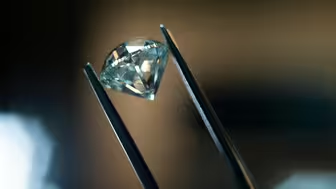
Once relegated to side-stone status, jewelry designers have recently started featuring trillion-cut diamonds and gemstones center stage.

New York--Once relegated to side-stone status, trillion-cut diamonds and gemstones have recently begun taking center stage in jewelry design as a host of talented designers find inspiration in the triangle-shaped cut.
Designer Eva Fehren of “X-ring” fame focused on trillion-cut diamonds in her latest collection, setting them in her signature blackened gold, adorned with diamond pavé or featuring a single inverted trillion-cut diamond in a simple, geometric rose-gold necklace. The trillion-cut’s geometry suits Fehren’s meticulous design sensibility.
“I love the symmetrical composition that an equilateral triangle captures so effortlessly,” said Fehren. “It’s a traditional cut that can add a geometric accent to any shape or style, but it can also stand alone to create a piece that incorporates a classic-cut diamond set in a way that feels more modern and unexpected. Trillions add a tough, sharp edge to more feminine pieces, and I think that because they’re such balanced shapes, these stones can absolutely be the focus of a piece.”
Several designers noted the geometric appeal of trillion cuts. Shahla Karimi observed that the shape “is clean, graphic and feels both modern and timeless at the same time.”
Conversely, Todd Pownell, the designer of TAP by Todd Pownell, cited the off-kilter effect that can be achieved with a triangular stone as the reason it’s earned his affection.
“I like the idea of movement or direction related to the points of the cut,” he said. “When set askew in a design, the trillion tends to keep the viewer engaged in movement and mysticism, rather than in the geometry and structure. I'm drawn to the trillion because of the ‘magic’ in the three sides.”
Halleh Amiralai of jewelry brand Halleh explained that she “was drawn to the trillion shape because of its symbolism towards the feminine and the masculine.”
Traditionally, the triangle has been said to hold connotations of female or male energy, depending on which way the triangle is oriented. The shape has also been noted as representing a balance between both energies.
Amiralai continued, “Using the trillion as a center stone is pushing the envelope and moving beyond the traditional.”
Amiralai’s statement is at the heart of why designers seem to have adopted the cut as of late. While round-cuts overwhelmingly dominate the bridal market, fashion-oriented fine jewelers (for lack of a better term) have utilized fancy-cut shapes to push boundaries and fulfill their unique design visions.
“One of the
Chicco has been implementing trillion-cut diamonds in her layering-centric line of everyday, attainable fine jewelry, adorning lariats, pendants and cuffs with the cut. She’s also made it the focal point of more extravagant pieces.
“Our clients seem to really like it,” she said. “I am really happy with the response and am planning to add more pieces using trillion-cut stones to the collection next season.”
British designer Rachel Boston, a member of the British Fashion Council’s Rock Vault initiative, explained that she “felt very limited by round or oval stones.”
As a motif, triangles feature heavily in Boston’s designs and not only through the use of trillion cuts. She also depicts triangles through her metalwork and utilizes square-cut stones set on a 90-degree angle to accentuate the cut’s triangular edges.
“I think millennials are keen to experiment with their stone cut choices,” Boston noted. “I feel there is a growing demand for people wanting more unusual-cut stones. A lot of my customers are bored of brilliant-cut diamonds and want something edgier and more modern, and I think the trillion is a great remedy for that.”
Boston noted that trillion cuts haven’t always made fiscal sense for her brand, though that is changing--at least in London’s diamond district.
“Finding trillions was very difficult in the sizes I needed for my designs, and I had to get everything specially cut in Hatton Garden, which became expensive,” she explained. “But now there is more of a demand so finding the stones already polished has become much easier, and I’ve been able to make a few engagement rings using trillions in larger sizes as well.”
Boston wasn’t the only jeweler to mention the trillion cut’s engagement ring possibilities; the cut is trickling into the bridal market, albeit the alternative category. Brooklyn-based Teresa Kahres of line T. Kahres noted that her trillion-cut engagement ring is her most popular style.
“I think (customers) are responding well to this ring and cut of diamond because it has a modern twist from a traditional engagement ring,” Kahres explained.
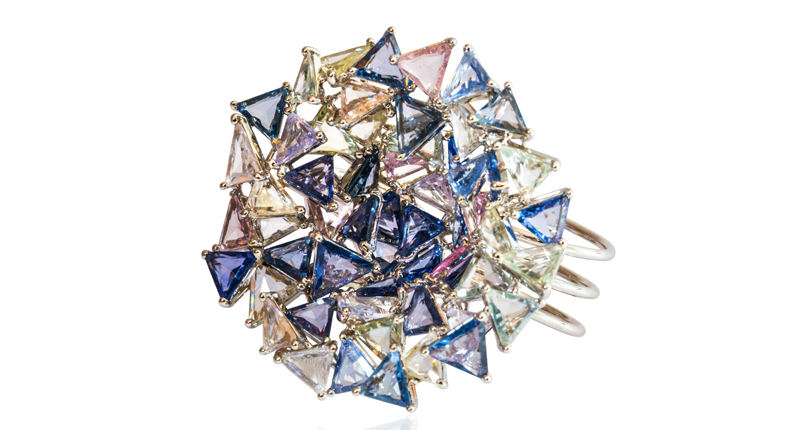
Korean designer Inhwa Yu of new brand Comme de Musee, which launched in the U.S. market at this year’s Couture show, touched upon the difficulty of finding the quality of trillions that she desires. In Las Vegas, Yu showed a cocktail ring composed entirely of a myriad of multi-colored trillion-cut sapphires, a piece that, ultimately, she wasn’t sure was worth the effort.
“It took me months to build it. I don’t think I will ever try to make this again,” she said, laughing.
The ring’s eventual owner can take pleasure in knowing it’s truly one-of-a-kind.
Khai Khai designer Haim Medine is pushing the trillion-cut envelope with his latest collection, which is full of what Medine calls “arrow cuts.” His arrow-cut diamonds are a visually arresting, thin, isosceles type of triangle-cut.
“It's a modern spin on the classic trillion-cut diamond,” Medine said. “The reason why I am so attracted to this particular cut is because it’s unlike anything I've seen in the market.”
While trillion-cuts have become more prevalent over the past year, the trend is still in its infancy and will likely endure for the brands who feel it authentically resonates with their design identity.
“The trillion cut diamond is becoming an essential part of the collection for us,” Fehren said, “and we are enjoying using it in new, innovative ways. I feel like our customer is really responding to that.”
The Latest

From how to get an invoice paid to getting merchandise returned, JVC’s Sara Yood answers some complex questions.

The Italian jewelry company appointed Matteo Cuelli to the newly created role.

Launched in 2023, the program will help the passing of knowledge between generations and alleviate the shortage of bench jewelers.

The manufacturer said the changes are designed to improve speed, reliability, innovation, and service.


President Trump said he has reached a trade deal with India, which, when made official, will bring relief to the country’s diamond industry.

The designer’s latest collection takes inspiration from her classic designs, reimagining the motifs in new forms.

Criminals are using cell jammers to disable alarms, but new technology like JamAlert™ can stop them.

The watchmaker moved its U.S. headquarters to a space it said fosters creativity and forward-thinking solutions in Jersey City, New Jersey.

The company also announced a new partnership with GemGuide and the pending launch of an education-focused membership program.

IGI is buying the colored gemstone grading laboratory through IGI USA, and AGL will continue to operate as its own brand.

The Texas jeweler said its team is “incredibly resilient” and thanked its community for showing support.

From cool-toned metal to ring stacks, Associate Editor Natalie Francisco highlights the jewelry trends she spotted at the Grammy Awards.

The medals feature a split-texture design highlighting the fact that the 2026 Olympics are taking place in two different cities.

From tech platforms to candy companies, here’s how some of the highest-ranking brands earned their spot on the list.

The “Khol” ring, our Piece of the Week, transforms the traditional Indian Khol drum into playful jewelry through hand-carved lapis.

The catalog includes more than 100 styles of stock, pre-printed, and custom tags and labels, as well as bar code technology products.

The chocolatier is bringing back its chocolate-inspired locket, offering sets of two to celebrate “perfect pairs.”

The top lot of the year was a 1930s Cartier tiara owned by Nancy, Viscountess Astor, which sold for $1.2 million in London last summer.

Any gemstones on Stuller.com that were sourced by an AGTA vendor member will now bear the association’s logo.

The Swiss watchmaker has brought its latest immersive boutique to Atlanta, a city it described as “an epicenter of music and storytelling.”

The new addition will feature finished jewelry created using “consciously sourced” gemstones.

In his new column, Smith advises playing to your successor's strengths and resisting the urge to become a backseat driver.

The index fell to its lowest level since May 2014 amid concerns about the present and the future.

The new store in Aspen, Colorado, takes inspiration from a stately library for its intimate yet elevated interior design.

The brands’ high jewelry collections performed especially well last year despite a challenging environment.

The collection marks the first time GemFair’s artisanal diamonds will be brought directly to consumers.