




SurveysJan 09, 2026
U.S. Holiday Retail Sales Up 4%, Visa, Mastercard SayColumnistsJan 13, 2026
2025 Was a ‘Price Up, Units Down’ Year, Here’s What That Signals for 2026
In a market defined by more selective consumers, Sherry Smith shares why execution will be independent jewelers’ key to growth this year.


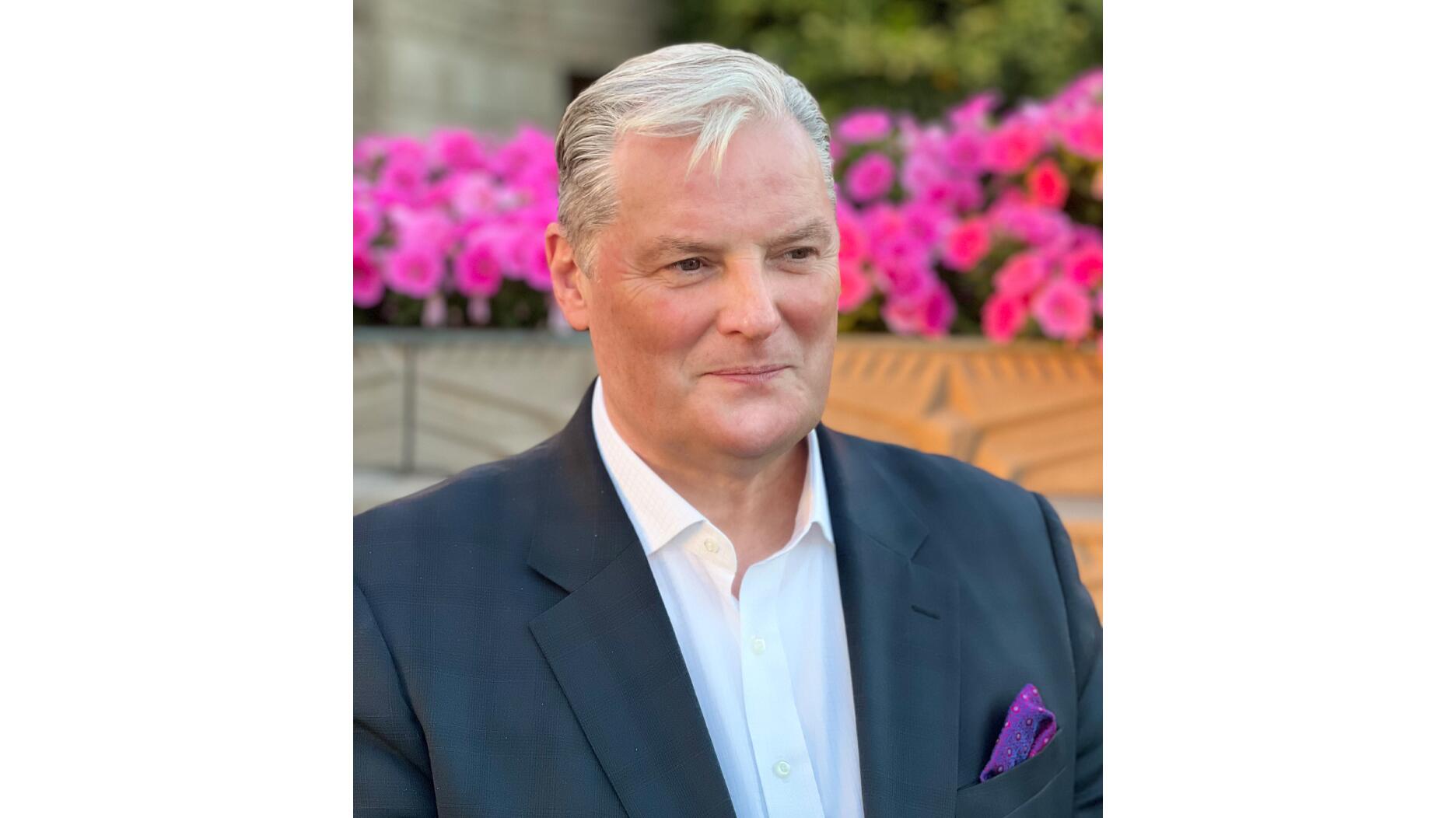
Sherry Smith is vice president of coaching strategy and development at the Edge Retail Academy, the leading jewelry business consulting and data aggregation firm. She can be reached at sherry@edgeretailacademy.com.
At first glance, 2025 appeared to be a solid year for independent jewelers.
According to aggregated Edge Retail Academy (ERA) data, gross sales increased 4.7 percent year over year, and gross profit also rose, signs of continued resilience in a challenging retail environment.
But when we move beyond the headline figures and examine how those results were achieved, a more nuanced and instructive story emerges, one that matters greatly as jewelers plan for 2026.
The truth beneath the headlines: Growth in 2025 was price driven, not demand driven.
Over the full year, ERA data shows the following.
• Gross sales: +4.7 percent
• Units sold: −5.6 percent
• Average retail sale (ARS): +10.9 percent
• Gross profit: +5.5 percent
• Gross margin: Modestly higher year over year
This combination of sales dollars rising while units fall is a classic indicator of growth driven by pricing and product mix, not by increased transaction volume or store traffic.
Consumers did not disappear in 2025, but they did become more selective. Retailers often had to work harder for each sale.
Importantly, unit declines were not isolated to one or two weak periods throughout the year. Units trended lower across much of 2025, including the fourth quarter, traditionally the strongest period for transaction volume.
That consistency reinforces that this was not a temporary disruption, but a structural shift in buying behavior.
Traffic pressure adds context to declining units.
Independent jewelers were not operating in isolation. Broader retail indicators point to ongoing pressure on physical store traffic.
Sensormatic Solutions projected U.S. in-store holiday traffic to finish flat to down roughly 3 percent and noted that traffic was already trending modestly lower for much of the year.
When fewer shoppers are walking through the door, performance depends less on volume and more on conversion, average ticket, and repeat visits. The unit trends in ERA’s data align closely with that reality.
Category performance reinforces the same theme.
Across major jewelry categories, a consistent pattern emerged in 2025. Unit volume declined broadly while average ticket increased, reinforcing the theme of price-driven growth rather than demand-led expansion.
Here’s a category-by-category breakdown of what ERA data shows for the year.
• Diamonds overall finished the year essentially flat in dollar sales (down less than 1 percent) even as units declined more than 6 percent and average ticket increased nearly 5 percent.
• Bridal diamond categories experienced greater softness, with sales down nearly 3 percent. This performance appears consistent with price compression across both natural and lab-grown diamonds throughout the year, which weighed on dollar results even where unit declines were more moderate.
• Non-bridal diamond categories managed modest growth (just over 1 percent) despite units declining nearly 8 percent, supported by a meaningful increase in average ticket.
• Colored stone jewelry stood out, with sales up just over 4 percent and average ticket rising nearly 12 percent even as units declined close to 8 percent. This suggests that when consumers did purchase, they gravitated toward more expressive, higher-value pieces rather than entry-level items.
• Precious metal jewelry without stones delivered one of the clearest examples of price-driven growth. Sales increased nearly 5 percent while units declined close to 17 percent, and average ticket jumped more than 20 percent, reflecting higher metal prices and mix shift.
• Watches were among the few categories where unit volume held relatively steady. Sales increased nearly 5 percent, though gross margins compressed year over year, underscoring that revenue growth does not automatically translate to profit growth.
• Repairs and services remained a bright spot, with sales up more than 14 percent, reinforcing the stabilizing role service revenue plays when discretionary purchasing softens.
Here’s a closer look at the diamond market.
• Natural diamond categories declined approximately 2 percent in gross sales and 10 percent in units, despite a nearly 9 percent increase in average retail sale.
• Lab-grown diamond categories posted strong top-line growth, with sales up roughly 13 percent and units up 19 percent, even as average retail declined by about 5 percent.
• Completed bridal rings showed clear divergence by diamond type. Natural diamond engagement rings were down roughly 4 percent in sales and 2 percent in units, with average retail also declining.
Meanwhile, lab-grown engagement rings significantly outperformed, with gross sales up approximately 31 percent, units up 30 percent, and average retail modestly higher (just under 1 percent).
According to aggregated Edge Retail Academy (ERA) data, gross sales increased 4.7 percent year over year, and gross profit also rose, signs of continued resilience in a challenging retail environment.
But when we move beyond the headline figures and examine how those results were achieved, a more nuanced and instructive story emerges, one that matters greatly as jewelers plan for 2026.
The truth beneath the headlines: Growth in 2025 was price driven, not demand driven.
Over the full year, ERA data shows the following.
• Gross sales: +4.7 percent
• Units sold: −5.6 percent
• Average retail sale (ARS): +10.9 percent
• Gross profit: +5.5 percent
• Gross margin: Modestly higher year over year
This combination of sales dollars rising while units fall is a classic indicator of growth driven by pricing and product mix, not by increased transaction volume or store traffic.
Consumers did not disappear in 2025, but they did become more selective. Retailers often had to work harder for each sale.
Importantly, unit declines were not isolated to one or two weak periods throughout the year. Units trended lower across much of 2025, including the fourth quarter, traditionally the strongest period for transaction volume.
That consistency reinforces that this was not a temporary disruption, but a structural shift in buying behavior.
Traffic pressure adds context to declining units.
Independent jewelers were not operating in isolation. Broader retail indicators point to ongoing pressure on physical store traffic.
Sensormatic Solutions projected U.S. in-store holiday traffic to finish flat to down roughly 3 percent and noted that traffic was already trending modestly lower for much of the year.
When fewer shoppers are walking through the door, performance depends less on volume and more on conversion, average ticket, and repeat visits. The unit trends in ERA’s data align closely with that reality.
Category performance reinforces the same theme.
Across major jewelry categories, a consistent pattern emerged in 2025. Unit volume declined broadly while average ticket increased, reinforcing the theme of price-driven growth rather than demand-led expansion.
Here’s a category-by-category breakdown of what ERA data shows for the year.
• Diamonds overall finished the year essentially flat in dollar sales (down less than 1 percent) even as units declined more than 6 percent and average ticket increased nearly 5 percent.
• Bridal diamond categories experienced greater softness, with sales down nearly 3 percent. This performance appears consistent with price compression across both natural and lab-grown diamonds throughout the year, which weighed on dollar results even where unit declines were more moderate.
• Non-bridal diamond categories managed modest growth (just over 1 percent) despite units declining nearly 8 percent, supported by a meaningful increase in average ticket.
• Colored stone jewelry stood out, with sales up just over 4 percent and average ticket rising nearly 12 percent even as units declined close to 8 percent. This suggests that when consumers did purchase, they gravitated toward more expressive, higher-value pieces rather than entry-level items.
• Precious metal jewelry without stones delivered one of the clearest examples of price-driven growth. Sales increased nearly 5 percent while units declined close to 17 percent, and average ticket jumped more than 20 percent, reflecting higher metal prices and mix shift.
• Watches were among the few categories where unit volume held relatively steady. Sales increased nearly 5 percent, though gross margins compressed year over year, underscoring that revenue growth does not automatically translate to profit growth.
• Repairs and services remained a bright spot, with sales up more than 14 percent, reinforcing the stabilizing role service revenue plays when discretionary purchasing softens.
Here’s a closer look at the diamond market.
• Natural diamond categories declined approximately 2 percent in gross sales and 10 percent in units, despite a nearly 9 percent increase in average retail sale.
• Lab-grown diamond categories posted strong top-line growth, with sales up roughly 13 percent and units up 19 percent, even as average retail declined by about 5 percent.
• Completed bridal rings showed clear divergence by diamond type. Natural diamond engagement rings were down roughly 4 percent in sales and 2 percent in units, with average retail also declining.
Meanwhile, lab-grown engagement rings significantly outperformed, with gross sales up approximately 31 percent, units up 30 percent, and average retail modestly higher (just under 1 percent).
There were macro forces behind higher tickets; here’s why they matter for 2026.
Many jewelers attribute 2025’s higher average tickets to rising costs and pricing realities, particularly around gold. That interpretation aligns with the broader macro narrative.
The World Gold Council’s outlook for 2026 highlights ongoing economic and geopolitical uncertainty as factors likely to keep gold elevated and volatile rather than reverting quickly to historical norms.
Reuters has reinforced this view, reporting that Morgan Stanley forecast that gold price could reach $4,800 per ounce by late 2026, underscoring how mainstream the “higher-for-longer gold” thesis has become.
Tariff-related uncertainty also remains part of the business-planning environment.
Jewelers of America has cautioned that broad tariffs can materially affect jewelry supply chains, pricing structures, and competitiveness.
Even without definitive outcomes, uncertainty itself creates operational pressure, particularly around inventory commitments, sourcing strategies, and margin protection.
“Consumers may still spend, but they are likely to do so more selectively.” — Sherry Smith
The final and perhaps most important driver is consumer psychology.
Deloitte’s U.S. outlook expects real consumer spending growth to slow to approximately 1.6 percent in 2026, restrained by inflation, a weakening labor market, and slower asset price growth.
In practical terms, consumers may still spend, but they are likely to do so more selectively.
Retailers will feel that selectivity show up in store traffic, closing rates, and item count per transaction.
2026 will be a “sorting year” that rewards execution.
The most realistic base case for 2026 is not a collapse, but it is also not a return to easy growth.
With consumer spending expected to moderate (per Deloitte) and traffic pressure still part of the retail landscape (per Sensormatic), 2026 is shaping up to be a “sorting year.”
The winners will be the retailers who treat fundamentals as non-negotiable.
1. Conversion rate becomes the growth engine.
When units are down, conversion is the fastest and most controllable lever. Improving conversion rates by even a few points can materially offset traffic declines without increasing marketing expenses.
2. Clienteling shifts from “nice-to-have” to a business model.
If customers are visiting less frequently, proactive outreach, appointment-setting, and reactivation strategies are essential to protect sales frequency and lifetime value.
3. Inventory discipline matters more in a higher-cost world.
In a high-gold, cost-volatile environment, aged inventory becomes an expensive risk. Clean assortments, faster turns, and tighter open-to-buy strategies protect both cash flow and margin.
4. Services and repairs are strategic, not secondary.
Repair performance in the data reinforces an important truth—service revenue can stabilize results when discretionary units soften and can also seed future sales through trust, repeat visits, and deeper relationships.
Execution, not optimism, will define 2026.
If 2025 proved anything, it’s that independent jewelers can grow in a constrained environment, but the formula is changing.
With traffic under pressure and consumer growth expected to moderate, the retailers who outperform in 2026 will be the ones who move from hope-based retail to precision retail—better conversion, stronger follow-up, disciplined buying, and service culture that drives repeat visits.
The opportunity is real. When customers are selective, they gravitate toward trust, expertise, and meaning, and independents own that space.
The takeaway for 2026 is simple. Planning should emphasize the controllables: conversion, clienteling, and inventory discipline.
In a selective-demand environment, execution isn’t a tactic. It’s the strategy.


More on Columnists
The Latest

MajorsOct 23, 2026
PGI USA Set to Close at Year’s EndThe closure is part of a global restructuring that also includes PGI winding down its operations in Japan, South Korea, and Hong Kong.


SourcingOct 23, 2026
Rachel Chalchinsky’s ‘Survivor Tribute’ RingThe ring, our Piece of the Week, was designed by eight-year breast cancer survivor Rachel Chalchinsky of Color Source Gems.


TechnologyOct 23, 2026
JA Unveils New Website, LogoThe website offers enhanced member benefit access, industry directories, educational resources, a job board, and access to the MJSA Journal.

Brought to you by
A Diamond Is Forever Launches 2026 Holiday Campaign Championing Natural DiamondsA Diamond Is Forever's holiday campaign reimagines natural diamond icons for a new generation celebrating individuality.


FinancialsOct 23, 2026
Kering’s Jewelry Sales Up Double Digits in Q3Boucheron and Pomellato had a strong third quarter, with Kering looking at jewelry as an increasingly important part of its portfolio.

Weekly QuizOct 22, 2026
This Week’s QuizTest your jewelry news knowledge by answering these questions.


CrimeOct 22, 2026
Jeweler Shot and Killed in His Suburban Cincinnati Store Tara Sinchuri was the owner of Everest Jewels in Fairfield, Ohio, and a father of three. He was found dead in his store on Tuesday.

MajorsOct 22, 2026
Neiman Marcus Has Gifts for the Jewelry Lover Who Has EverythingBespoke experiences from Buccellati and Verdura are on the retailer’s 2026 “Fantasy Gifts” list.

Brought to you by
Open an Account, Get $50 Off Your First Order. No Code Needed.Built on Relationships. Refined by Craft.


Events & AwardsOct 22, 2026
JIS Fall 2026 Reports Record-Breaking Attendance The number of participants at the fall show was up 12 percent.

CollectionsOct 22, 2026
Billie Eilish, Finneas Co-Design Collection for John HardyThe Academy and Grammy award-winning siblings have collaborated with John Hardy on a new jewelry line inspired by their personal style.


PodcastsOct 21, 2026
Episode 10: This Episode Is Haunted Diana Singer shared the stories of two “cursed” diamonds on this month’s podcast, which was inexplicably riddled with technical issues.

IndependentsOct 21, 2026
Gardner-Collier Jewelry to Close After 9 Decades in BusinessThe family-owned jeweler has three locations across Missouri and Iowa.

SourcingOct 21, 2026
Venetia Mines Final Carats Ahead of 2-Year ShutdownThe De Beers-owned diamond mine in South Africa is being put on ice as part of a round of previously announced cost-cutting measures.

CollectionsOct 21, 2026
Helzberg, Nordstrom Carrying New Jewelry Collection From Off-WhiteThe collection centers designs with clean geometric lines, chunky sculptural pieces, and recognizable details from the luxury fashion brand.
SourcingOct 21, 2026
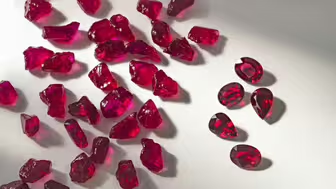
Gemfields’ Mixed-Quality Ruby Auction Earns $52MThe miner said it saw particularly strong prices for larger, fine-quality rubies at the sale.

CrimeOct 20, 2026
Security Guard Charged With Murder in Shooting at Texas MallThe guard opened fire on a man who was smashing a jewelry display case at La Gran Plaza in Fort Worth last week, police said.
IndependentsOct 20, 2026
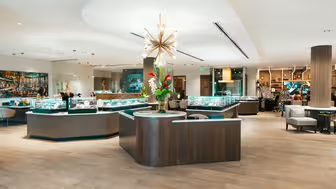
David Gardner’s Jewelers Unveils Newly Expanded, Revamped ShowroomThe Texas jeweler added 2,000 square feet to its reimagined showroom, complete with a new design studio and an event space.
SourcingOct 20, 2026
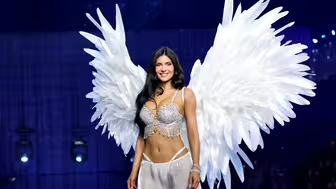
The $50M Victoria’s Secret ‘Fantasy Bra’ By The NumbersJacob & Co.'s diamond masterpiece is the most expensive Fantasy Bra ever worn on the Victoria’s Secret Fashion Show runway.

CollectionsOct 20, 2026
Mignon Faget’s Collection Chooses Handmade Over AIThe “Atelier” collection was inspired by the tools, rituals, and objects in an artist’s studio as a quiet rebuttal to an automated world.
MajorsOct 19, 2026
The Knot to Acquire Rival Wedding Planning Platform ZolaThe pending acquisition is an “exciting opportunity” for wedding vendors to grow their business, said The Knot Worldwide’s CEO.

SourcingOct 19, 2026
Jewelry Design Competition Show Airs in Thailand"The Secret Gems" features eight Thai jewelry brands paired with a team of young craftspeople who create jewelry together to win challenges.

CollectionsOct 19, 2026
John Hardy Enters the Medallion Chat With Talisman Collection The brand’s “Modern Talisman” capsule collection introduces pendants inspired by the mythology, natural world, and spiritual ethos of Bali.
IndependentsOct 19, 2026
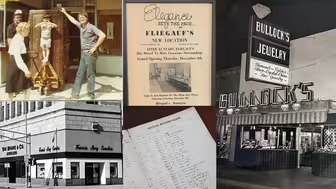
The Stories of 5 Jewelers Celebrating Their Centennials in 2026Independent jewelers from New Mexico to New Jersey answer the question: What has kept your store in business for 100 years?

SurveysOct 16, 2026
How Inflation, Gas Prices Will Affect Holiday Sales The NRF is expecting holiday sales to increase this year, but consumers and retailers alike are facing Grinch-like headwinds.
CollectionsOct 16, 2026
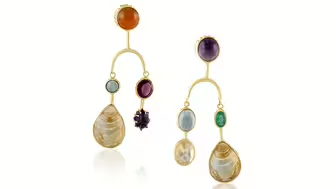
Christina Puchi’s Earrings Hold the UniverseOur Piece of the Week gathers the planets, represented by a variety of colored gemstones, in a pair of 14-karat yellow gold earrings.
IndependentsOct 16, 2026
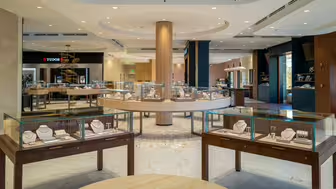
Reeds Jewelers Expands, Relocates FlagshipThe New York-based jeweler is moving its Amherst flagship store to a larger location in nearby Snyder.

MajorsOct 16, 2026
Katy Chen Appointed Executive Vice President of Graff USA Chen, who worked at Cartier and Tiffany & Co., will lead retail sales and operations for the luxury jeweler’s 11 U.S. stores.