






ColumnistsJul 07, 2026
Peter Smith: Diamond Branding and the Origin ParadoxColumnistsJul 14, 2026
Sherry Smith: What Today’s Jewelry Consumer Is Telling Us
Rising revenue does not automatically mean a healthy business, particularly in the current economic landscape, Smith writes.


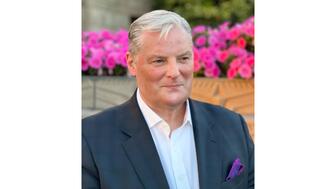
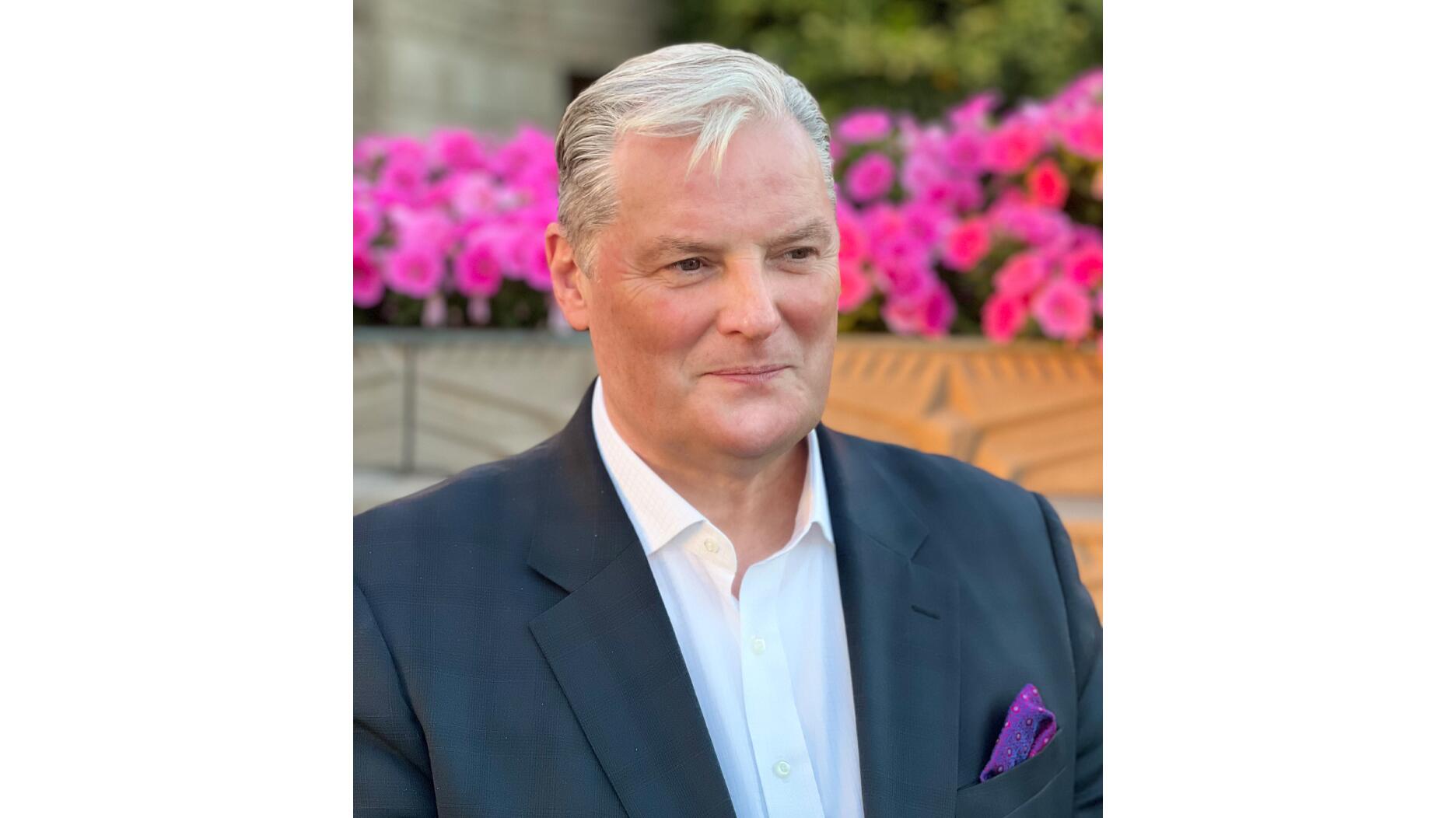
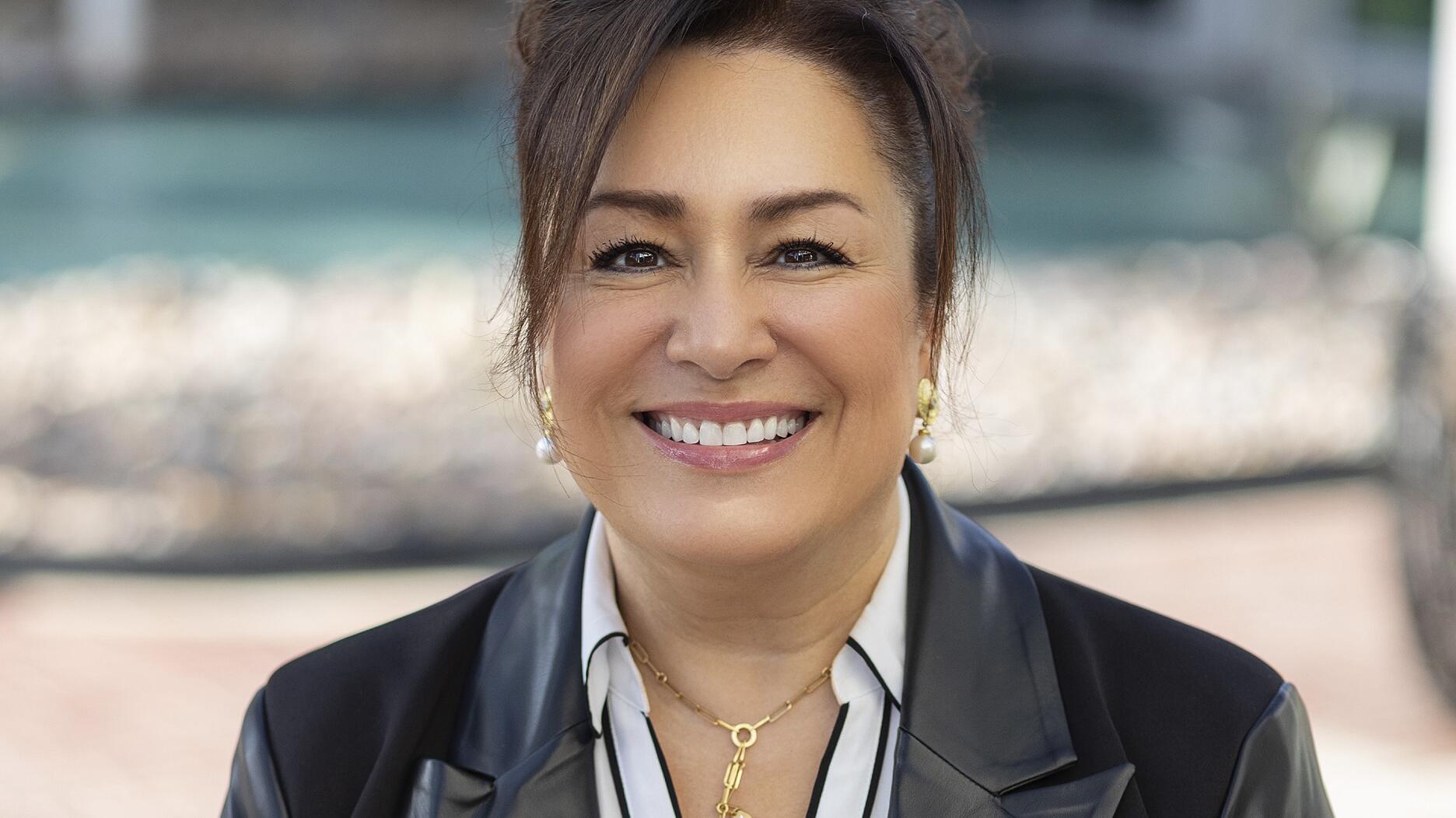
Sherry Smith is a principal partner at The Retail Smiths, a consultancy for retailers and vendors. She can be reached at sherrytrs@gmail.com.
There is a number independent jewelers should be paying attention to: 35 percent.
According to Statista, independent jewelry stores accounted for approximately 35 percent of U.S. jewelry sales in 2025, making them the largest individual sales channel in the industry.
Chains represented 28 percent, online retailers 22 percent, and department stores the remaining 15 percent.
At first glance, that sounds like good news, and it is.
But it also tells a much bigger story about where our industry is headed.
The jewelry industry is not disappearing. In fact, Statista estimates U.S. jewelry sales reached approximately $85.4 billion in 2024, up from $81.3 billion in 2023.
The dollars are still there. The more important question is where they’re going.
For decades, specialty jewelers controlled a much larger share of the market.
Historical analyses published by IDEX Online Research and industry analyst Edahn Golan show that specialty jewelers once accounted for more than 70 percent of U.S. jewelry sales before gradually losing share to chains, department stores, online retailers, and other retail channels.
Today’s 35 percent share remains significant, but it should not be viewed as permanent.
Consumer behavior is changing, competition is changing and perhaps most importantly, the customer who is driving industry growth is changing.
Revenue alone can create a false sense of security.
Across much of the industry, average retail sale (also known as average transaction value, or ATV) continues to rise, but much of that increase reflects record gold prices, tariffs, and higher replacement costs rather than stronger consumer demand.
Because most jewelry sold in the United States is imported, retailers have had little choice but to pass rising costs on to consumers.
When the metrics of units sold, transaction counts, and store traffic are declining while average tickets climb, retailers must be careful not to mistake pricing pressure for growth.
In many cases, the industry is selling fewer units at significantly higher prices.
According to Statista, independent jewelry stores accounted for approximately 35 percent of U.S. jewelry sales in 2025, making them the largest individual sales channel in the industry.
Chains represented 28 percent, online retailers 22 percent, and department stores the remaining 15 percent.
At first glance, that sounds like good news, and it is.
But it also tells a much bigger story about where our industry is headed.
The jewelry industry is not disappearing. In fact, Statista estimates U.S. jewelry sales reached approximately $85.4 billion in 2024, up from $81.3 billion in 2023.
The dollars are still there. The more important question is where they’re going.
For decades, specialty jewelers controlled a much larger share of the market.
Historical analyses published by IDEX Online Research and industry analyst Edahn Golan show that specialty jewelers once accounted for more than 70 percent of U.S. jewelry sales before gradually losing share to chains, department stores, online retailers, and other retail channels.
Today’s 35 percent share remains significant, but it should not be viewed as permanent.
Consumer behavior is changing, competition is changing and perhaps most importantly, the customer who is driving industry growth is changing.
Revenue alone can create a false sense of security.
Across much of the industry, average retail sale (also known as average transaction value, or ATV) continues to rise, but much of that increase reflects record gold prices, tariffs, and higher replacement costs rather than stronger consumer demand.
Because most jewelry sold in the United States is imported, retailers have had little choice but to pass rising costs on to consumers.
When the metrics of units sold, transaction counts, and store traffic are declining while average tickets climb, retailers must be careful not to mistake pricing pressure for growth.
In many cases, the industry is selling fewer units at significantly higher prices.
“Are consumers buying more jewelry, or are they simply paying more for the jewelry they buy?” – Sherry Smith, The Retail Smiths
The challenge for many retailers is that higher average tickets do not automatically translate into healthier cash flow.
When it costs substantially more to replace the inventory that just sold, open-to-buy dollars can disappear quickly.
Strong revenue numbers can mask growing pressure on inventory investment, making margin management and cash flow discipline more important than ever.
According to Tenoris, U.S. jewelry sales revenue increased 5.6 percent in 2025 while number of units sold declined 5.6 percent.
Higher average selling prices, influenced by rising precious metal costs, tariffs, and a 14 percent increase in average spending per item, were the main driver of revenue growth.
That distinction matters because it changes how we interpret the health of the market.
Are consumers buying more jewelry, or are they simply paying more for the jewelry they buy?
Part of the answer may lie in a broader economic trend extending well beyond our industry.
Analysis by Moody’s Analytics using Federal Reserve and U.S. Census Bureau data found that the highest-earning 10 percent of American households now account for nearly half of all consumer spending, up from 37 percent in 1990.
While many consumers continue to feel pressure from inflation, housing costs, and higher interest rates, affluent households have largely benefited from rising home values, strong stock market performance, and accumulated wealth.
This creates what economists often describe as a K-shaped economy, where affluent consumers continue spending while many middle-income households face increasing financial pressure.
The jewelry industry is experiencing that divide firsthand.
Many retailers are reporting strong demand for high-ticket merchandise while simultaneously seeing resistance in traditional middle-market price points.
The customer purchasing a $10,000 bracelet may still be buying. The customer considering a $1,500 fashion purchase may be hesitating, delaying the purchase, trading down, or leaving the category altogether.
That divide is reshaping our industry. It is also reshaping luxury.
“The watch industry’s success illustrates the power of scarcity, storytelling, craftsmanship, and exclusivity. Those same principles can be applied to custom jewelry, rare gemstones, limited collections, and other high-value offerings.” – Sherry Smith, The Retail Smiths
One of the most fascinating developments over the past decade has been the rise of luxury watches as a dominant force within discretionary luxury spending.
According to the annual “Swiss Watcher” report produced by Morgan Stanley and LuxeConsult, Rolex, Cartier, Audemars Piguet, and Omega accounted for approximately 55 percent of Swiss watch industry sales in 2025. Rolex alone represented roughly one-third of the entire Swiss watch market.
Even more striking, watches priced above approximately $60,000 represented only 1.4 percent of industry volume while generating 37 percent of export value and 89 percent of the industry’s growth.
Consider what that means: less than 2 percent of the units generated nearly 90 percent of the growth.
That is not simply a watch story. It is a luxury consumer story.
The lesson for independent jewelers is not necessarily that they need to become watch retailers.
Rather, the watch industry’s success illustrates the power of scarcity, storytelling, craftsmanship, and exclusivity. Those same principles can be applied to custom jewelry, rare gemstones, limited collections, and other high-value offerings that create emotional and perceived value beyond the product itself.
Affluent consumers are increasingly concentrating their spending on fewer, higher-value purchases.
A customer with $15,000 to spend today may be deciding between a luxury watch, a diamond bracelet, a designer handbag, a luxury vacation, or a home renovation project. The competition for discretionary luxury dollars has never been greater.
This is one reason watches have become an increasingly important contributor to revenue for many independent jewelers. Consumers continue to view certain luxury timepieces as symbols of achievement, craftsmanship, exclusivity and in some cases, assets that can retain value over time.
Jewelry remains firmly in that conversation, but it must compete for those luxury dollars more intentionally than ever before.
At the same time, the next generation of luxury buyers is emerging.
Research indicates that affluent consumers under 40 are purchasing luxury jewelry more frequently than their older counterparts. However, they shop, discover brands, and engage with retailers differently than previous generations.
Many begin their shopping journey online. They seek recommendations through social media, consume content before they visit stores, and often arrive more informed than previous generations.
They also arrive with higher expectations.
This means independent jewelers should not view digital channels solely as e-commerce platforms. For many younger luxury consumers, social media, online reviews, and website content serve as the digital front door to the store.
They are often validating expertise, trust, and brand credibility long before they ever walk through the door.
Ironically, this shift may represent one of the greatest opportunities for independent jewelers.
“Customers may begin their journey online, but they still want confidence before making meaningful purchases.” – Sherry Smith, The Retail Smiths
Despite years of predictions about the death of physical retail, consumers continue to demonstrate the importance of in-person experiences for high-consideration purchases.
On an episode of The Retailistic Podcast titled “Gen Z, Migration, and Malls: The New Rules of Retail Real Estate,” industry experts challenged the long-standing narrative that physical retail is dying, arguing instead that stores are evolving into experience centers, brand-building assets, and relationship hubs.
That should sound familiar to independent jewelers.
After all, we have never simply sold products.
We sell celebrations, anniversaries, engagements, milestones, and memories. Customers may begin their journey online, but they still want confidence before making meaningful purchases.
They want expertise. They want trust. They want someone who can guide them through an emotional decision.
No algorithm can fully replace that, and no website can completely replicate that.
That remains the independent jeweler’s greatest advantage.
Over the next decade, success is unlikely to come from carrying more inventory, discounting more aggressively, or relying on strategies that worked in the past.
The retailers who gain market share will be those who deepen client relationships, tell compelling stories, demonstrate expertise, and create experiences that cannot be replicated online.
A 35 percent market share is still meaningful, but it also should be viewed as a warning.
Market leadership today does not guarantee market leadership tomorrow, and retailers who rely on past success rather than evolving consumer behavior risk losing relevance over time.
The jewelry industry is not disappearing. The dollars are still there. But the consumers driving growth, the products capturing discretionary spending, and the retailers winning market share are changing.
The independent jewelers who recognize these shifts, adapt their strategies, and evolve with today’s consumers will be the ones defining the industry’s next decade.


More on Columnists
The Latest

MajorsOct 23, 2026
PGI USA Set to Close at Year’s EndThe closure is part of a global restructuring that also includes PGI winding down its operations in Japan, South Korea, and Hong Kong.


SourcingOct 23, 2026
Rachel Chalchinsky’s ‘Survivor Tribute’ RingThe ring, our Piece of the Week, was designed by eight-year breast cancer survivor Rachel Chalchinsky of Color Source Gems.


TechnologyOct 23, 2026
JA Unveils New Website, LogoThe website offers enhanced member benefit access, industry directories, educational resources, a job board, and access to the MJSA Journal.

Brought to you by
A Diamond Is Forever Launches 2026 Holiday Campaign Championing Natural DiamondsA Diamond Is Forever's holiday campaign reimagines natural diamond icons for a new generation celebrating individuality.


FinancialsOct 23, 2026
Kering’s Jewelry Sales Up Double Digits in Q3Boucheron and Pomellato had a strong third quarter, with Kering looking at jewelry as an increasingly important part of its portfolio.

Weekly QuizOct 22, 2026
This Week’s QuizTest your jewelry news knowledge by answering these questions.


CrimeOct 22, 2026
Jeweler Shot and Killed in His Suburban Cincinnati Store Tara Sinchuri was the owner of Everest Jewels in Fairfield, Ohio, and a father of three. He was found dead in his store on Tuesday.

MajorsOct 22, 2026
Neiman Marcus Has Gifts for the Jewelry Lover Who Has EverythingBespoke experiences from Buccellati and Verdura are on the retailer’s 2026 “Fantasy Gifts” list.
Brought to you by
Open an Account, Get $50 Off Your First Order. No Code Needed.Built on Relationships. Refined by Craft.


Events & AwardsOct 22, 2026
JIS Fall 2026 Reports Record-Breaking Attendance The number of participants at the fall show was up 12 percent.

CollectionsOct 22, 2026
Billie Eilish, Finneas Co-Design Collection for John HardyThe Academy and Grammy award-winning siblings have collaborated with John Hardy on a new jewelry line inspired by their personal style.


PodcastsOct 21, 2026
Episode 10: This Episode Is Haunted Diana Singer shared the stories of two “cursed” diamonds on this month’s podcast, which was inexplicably riddled with technical issues.

IndependentsOct 21, 2026
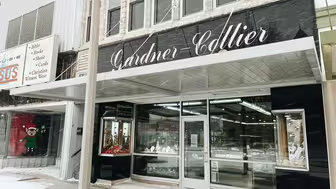
Gardner-Collier Jewelry to Close After 9 Decades in BusinessThe family-owned jeweler has three locations across Missouri and Iowa.

SourcingOct 21, 2026
Venetia Mines Final Carats Ahead of 2-Year ShutdownThe De Beers-owned diamond mine in South Africa is being put on ice as part of a round of previously announced cost-cutting measures.

CollectionsOct 21, 2026
Helzberg, Nordstrom Carrying New Jewelry Collection From Off-WhiteThe collection centers designs with clean geometric lines, chunky sculptural pieces, and recognizable details from the luxury fashion brand.
SourcingOct 21, 2026
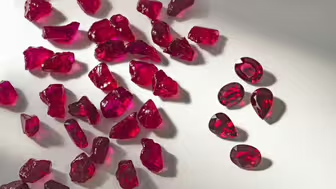
Gemfields’ Mixed-Quality Ruby Auction Earns $52MThe miner said it saw particularly strong prices for larger, fine-quality rubies at the sale.

CrimeOct 20, 2026
Security Guard Charged With Murder in Shooting at Texas MallThe guard opened fire on a man who was smashing a jewelry display case at La Gran Plaza in Fort Worth last week, police said.
IndependentsOct 20, 2026
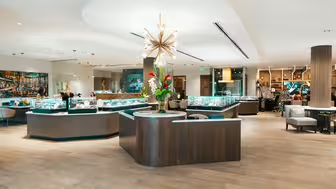
David Gardner’s Jewelers Unveils Newly Expanded, Revamped ShowroomThe Texas jeweler added 2,000 square feet to its reimagined showroom, complete with a new design studio and an event space.
SourcingOct 20, 2026
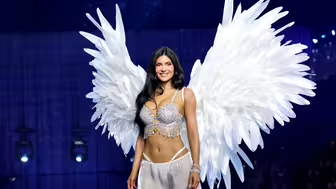
The $50M Victoria’s Secret ‘Fantasy Bra’ By The NumbersJacob & Co.'s diamond masterpiece is the most expensive Fantasy Bra ever worn on the Victoria’s Secret Fashion Show runway.

CollectionsOct 20, 2026
Mignon Faget’s Collection Chooses Handmade Over AIThe “Atelier” collection was inspired by the tools, rituals, and objects in an artist’s studio as a quiet rebuttal to an automated world.
MajorsOct 19, 2026
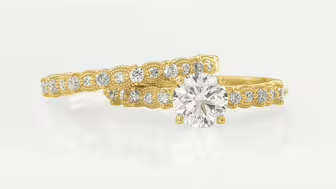
The Knot to Acquire Rival Wedding Planning Platform ZolaThe pending acquisition is an “exciting opportunity” for wedding vendors to grow their business, said The Knot Worldwide’s CEO.

SourcingOct 19, 2026
Jewelry Design Competition Show Airs in Thailand"The Secret Gems" features eight Thai jewelry brands paired with a team of young craftspeople who create jewelry together to win challenges.

CollectionsOct 19, 2026
John Hardy Enters the Medallion Chat With Talisman Collection The brand’s “Modern Talisman” capsule collection introduces pendants inspired by the mythology, natural world, and spiritual ethos of Bali.
IndependentsOct 19, 2026
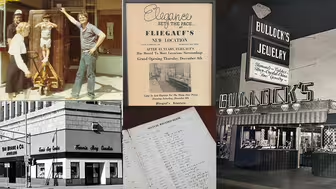
The Stories of 5 Jewelers Celebrating Their Centennials in 2026Independent jewelers from New Mexico to New Jersey answer the question: What has kept your store in business for 100 years?

SurveysOct 16, 2026
How Inflation, Gas Prices Will Affect Holiday Sales The NRF is expecting holiday sales to increase this year, but consumers and retailers alike are facing Grinch-like headwinds.
CollectionsOct 16, 2026
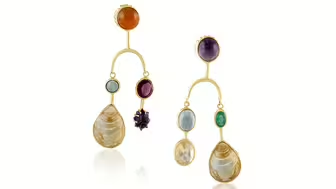
Christina Puchi’s Earrings Hold the UniverseOur Piece of the Week gathers the planets, represented by a variety of colored gemstones, in a pair of 14-karat yellow gold earrings.
IndependentsOct 16, 2026
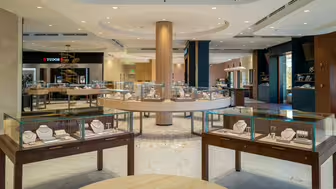
Reeds Jewelers Expands, Relocates FlagshipThe New York-based jeweler is moving its Amherst flagship store to a larger location in nearby Snyder.

MajorsOct 16, 2026
Katy Chen Appointed Executive Vice President of Graff USA Chen, who worked at Cartier and Tiffany & Co., will lead retail sales and operations for the luxury jeweler’s 11 U.S. stores.