





EditorsJun 09, 2026
Q&A: Al Cook on the Lab-Grown ‘Bubble,’ Dwindling Diamond Supply ColumnistsJul 07, 2026
Peter Smith: Diamond Branding and the Origin Paradox
A podcast prompted Smith to share his views on where origin fits into the natural diamond story and the viability of branded diamonds.


Peter Smith is an industry consultant, speaker, sales trainer, and author. He can be reached via email at TheRetailSmiths@gmail.com.
I listened to an interesting podcast recently featuring diamond journalist, Avi Krawitz, and Sean Dunn, president of J.R. Dunn Jewelers in Florida.
The two engaged in a thoughtful and spirited debate about diamonds and they raised some important questions in their conversation, some of which I agreed with, and others that had me talking back to the video.
The two topics that captured my imagination were the relevance of a diamond’s origin and the question of diamond branding.
The two engaged in a thoughtful and spirited debate about diamonds and they raised some important questions in their conversation, some of which I agreed with, and others that had me talking back to the video.
The two topics that captured my imagination were the relevance of a diamond’s origin and the question of diamond branding.
“Origin can be a powerful factor—it can make us feel good about our choices and about helping communities—but it should never be what we lead with when making the case for natural diamonds.” - Peter Smith, The Retail Smiths
With respect to origin, and not intending to be flippant, I was reminded about how when I grab a banana for breakfast in the morning, I don’t care where it was grown.
If it’s a Chiquita or Dole, and you tell me that it comes from Guatemala, and my purchase helps kids go to school, I’ll be delighted to hear that news, but it’s not why I buy bananas.
Origin can be a powerful factor—it can make us feel good about our choices and about helping communities—but it should never be what we lead with when making the case for natural diamonds.
In fact, I believe we have the origin story backwards.
The psychology is clear in establishing that we buy emotionally and we rationalize after the fact.
And while origin feels like an emotion because it concerns other human beings it is, moreover, a rationalization.
While origin can be a celebrated exclamation point on a customer’s decision to buy a diamond, it is not a compelling enough reason to have done so, and it should never be used to start that conversation.
For instance, people buy Rolexes for emotional reasons. Those reasons might include the construction of their own personal brand story, or to mark a touchstone occasion.
Perhaps it is no more complicated than their hedonistic enjoyment of spending money on themselves, or, as is likely true with many buyers, they want to be members of that exclusive Rolex tribe.
Whatever the reason, we buy emotionally and rationalize after the fact.
When we lead with country of origin, and the myriad philanthropic benefits that can come from making such purchases, that’s rationalization dressed up as emotion.
Expecting people to be influenced by something as profoundly rational as origin turns the psychology of consumer behavior on its head and it just doesn’t fit with research on the topic.
“The best thing we can do for any producer country we support is to position natural diamonds so they have the very best opportunity to be successful and that is all about emotion, not origin rationalizations.” - Peter Smith, The Retail Smiths
In “Thinking, Fast and Slow,” Nobel Prize-winning psychologist Daniel Kahneman posits that we make decisions on what he calls “system 1,” which is to say our intuitive, reptilian brain, and then we rationalize those decisions after the fact with “system 2,” our rational brain.
Origin, no matter how compelling, is and always will be system 2. It can matter, but only after our reptilian brain has already made the decision to buy.
In fact, I would suggest that we do an unintended disservice to the causes we proclaim to support by misattributing origin to the lead story.
The best thing we can do for Botswana, or any other producer country we support, is to position natural diamonds so they have the very best opportunity to be successful and that is, paradoxically, all about emotion, not origin rationalizations.
This brings me to my second point: the viability of diamond branding itself.
In my decades of experience as both an executive and consultant in the branded diamond space, there are two things of which I am certain.
1) That efforts to date in creating a diamond brand have been woefully inept.
2) There has never been a better time to create a diamond brand than now.
I see diamond branding as the successful creation of a full suite of finished diamond products, from engagement rings through jewelry for any and all occasions thereafter.
Whether loose diamonds are part of that offering is a reasonable topic for debate (how many loose diamonds do Tiffany & Co. and Cartier sell?) but it certainly should include center stones and continue through the entire collection of bridal, core, and fashion offerings.
The reason we should do the entire suite is because of both the psychology and the annuity that comes from selling a brand.
Once a customer makes the choice to enter a relationship with a brand, they will continue to buy that brand (psychological loyalty) as long as it serves the evolution of their life stages and meets or exceeds their quality and experience expectations.
When customers don’t know a lot about a product (like diamonds), they use price as a proxy for quality.
If they choose to spend their money on a diamond brand, it holds that we ought to be able to service their ongoing diamond jewelry needs with that brand thereafter.
Doing so reduces the cognitive load for those customers. The brand becomes a safe choice, and they don’t have to think too terribly hard about potential regrets over their decision to buy that brand.
For those arguing that diamonds cannot be branded, look at the history and psychology of branding and ask yourself, why must diamonds be the exception?
We buy branded water, which is designed evolutionarily to taste like nothing.
We have branded wine, with researchers proving that some of the most celebrated sommeliers have failed to identify even well-known brands when the labels have been removed.
We have favorite brands of streaming sites, shirts, sneakers, and just about everything else.
And let’s not forget those branded bananas.
“As illogical as it may seem, the same color, clarity, cut, and carat weight diamond is going to ‘taste’ better at Tiffany than it will at the local pawn shop.” - Peter Smith, The Retail Smiths
Virtually everything today is branded and none of it is remotely recognizable without the context of the labels, packaging, and the various brand attributes that accompany them. What, for example, does Nike clothing look like when the swoosh is removed?
Recent history is replete with examples of the power of branding, such as the Coke/Pepsi blind taste tests in which consumers consistently picked Pepsi over Coke.
Despite the results, Coke continues to outsell Pepsi because while we may taste blind, we make buying decisions with the branding accoutrements fully intact. We’re not pouring soda, water, beer, or wine into plain glass containers in our attempts to market them.
As illogical as it may seem, the same color, clarity, cut, and carat weight diamond is going to “taste” better at Tiffany than it will at the local pawn shop.
We have the results of hundreds of functional magnetic resonance imaging (fMRI) research studies that attest to the fact that our brains react differently when we believe we are consuming or purchasing a favored brand.
It shouldn’t be controversial to accept that there can be no branding without the packaging and labels. When you add the context of a Tiffany, a Cartier, or some of the best independent retail environments in our industry, the various elements of a differentiated brand experience begin to fall into place.
With respect to the diamond needing to be immediately recognizable and physically differentiated, that misses a major attribute of branding itself. The deliverable must absolutely be of exceptional quality, without any hint of compromise, and that product must be consistent 100 percent of the time, not some, or even most, of the time.
That said, it does not have to be visually differentiated any more than the aforementioned water, wine, and banana brands are when we remove the labels and packaging.
We are not just selling a 58-facet, round brilliant diamond with an exceptional cut and a narrow range of color and clarity, or, for that matter, beautifully cut fancy shape diamonds, we are selling peace of mind. Delivering that quality, consistency, and brand assurance, is mitigating the potential for regret, one of the biggest inhibitors to purchasing.
The context of our retail space, our people, and all the attributes of properly executed branding conspire to make the buying experience infinitely more important than the sum of its commodity parts.
The premium price also plays a huge role in that experience.
As the marketing and psychology guru Rory Sutherland said, “Branding isn’t just something to add to great products—it’s essential to their existence.”
As to the question of why diamond branding hasn’t really worked to date, I believe there are two main reasons for that.
The first is that we have been brow-beaten for decades into believing diamonds are a commodity, to the degree that it has become borderline Stockholm-syndrome stuff.
Our industry is replete with suppliers and retailers who are willing to defend their “diamonds-are-a-commodity” position to the death. They are also so deeply embedded in their own culture of selling diamonds for the lowest prices possible, they can’t begin to see the forest for the trees.
The second reason we don’t have successful diamond brands is because of mostly terrible execution by companies, current and past, that proclaim to be in the diamond branding space.
I’ve witnessed organizations taking beautiful diamonds, and even smart and sensible suites of finished jewelry, and still somehow managing to find a way to misfire.
Oftentimes, it’s a lack of investment in building the requisite sales infrastructure so their branding idea can become something more than a well-kept secret.
Sometimes, it’s a lack of investment and creativity in building a sustained marketing message over the long haul, choosing instead to reinvent underfunded and constantly changing messages year after year.
I should also point out that dysfunction amplified is still dysfunction, so if a company invested meaningful resources in promoting their brand, without really getting the story and deliverables locked down, that money largely will be wasted.
Occasionally, it’s nothing less than a disjointed and rudderless product development process, where throwing SKUs at the wall passes for thoughtful and curated storytelling.
“A diamond brand needs to deliver high-quality products that continue to reward customers for their good taste in choosing that brand.” - Peter Smith, The Retail Smiths
The default position seems to be whatever gives the brand the best opportunity to make B-to-B sales to their retailers at the next trade show, rather than a thoughtful and measured evolution of the brand designed to excite and engage their most loyal customers.
There are, of course, myriad reasons why diamond branding has largely failed, but it all lands in the same place: a profound lack of execution and investment on the part of the brands themselves resulting in little to no long-term traction at the retailer or consumer level.
The reality of dreadful execution should never be interpreted as meaning diamond branding lacks viability.
As with any other premium brand, a diamond brand needs to deliver high-quality products that continue to reward customers for their good taste in choosing that brand.
It needs to be consistent whenever and wherever it is purchased, and the presentation in-store, and at every touchpoint, should scream luxury.
To that end, it cannot be available everywhere but should have an exclusive distribution channel on par with the likes of Rolex and David Yurman.
As for lab-grown diamonds, if a properly executed premium diamond brand is limited to 300 to 500 retailers, then, if my math is correct, that should leave a robust base of about 15,000 points of sale for non-branded natural and lab-grown diamonds.
That said, a fabulously well-executed diamond brand strategy might just serve as a beacon for other natural diamond and lab-grown diamond companies to follow suit.
Wouldn’t that be a thing to behold!


More on Columnists


The Latest
MajorsOct 19, 2026
The Knot to Acquire Rival Wedding Planning Platform ZolaThe pending acquisition is an “exciting opportunity” for wedding vendors to grow their business, said The Knot Worldwide’s CEO.

SourcingOct 19, 2026
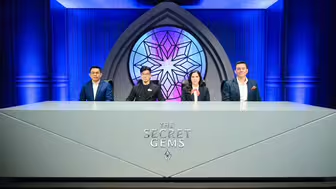
Jewelry Design Competition Show Airs in Thailand"The Secret Gems" features eight Thai jewelry brands paired with a team of young craftspeople who create jewelry together to win challenges.


CollectionsOct 19, 2026
John Hardy Enters the Medallion Chat With Talisman Collection The brand’s “Modern Talisman” capsule collection introduces pendants inspired by the mythology, natural world, and spiritual ethos of Bali.

Brought to you by
Open an Account, Get $50 Off Your First Order. No Code Needed.Built on Relationships. Refined by Craft.

IndependentsOct 19, 2026
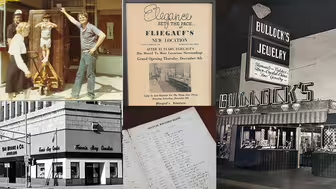
The Stories of 5 Jewelers Celebrating Their Centennials in 2026Independent jewelers from New Mexico to New Jersey answer the question: What has kept your store in business for 100 years?

Weekly QuizOct 15, 2026
This Week’s QuizTest your jewelry news knowledge by answering these questions.


SurveysOct 16, 2026
How Inflation, Gas Prices Will Affect Holiday Sales The NRF is expecting holiday sales to increase this year, but consumers and retailers alike are facing Grinch-like headwinds.
CollectionsOct 16, 2026
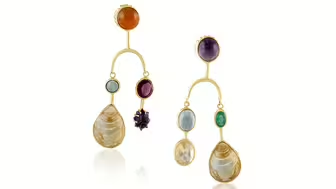
Christina Puchi’s Earrings Hold the UniverseOur Piece of the Week gathers the planets, represented by a variety of colored gemstones, in a pair of 14-karat yellow gold earrings.

Brought to you by
Meet Gemology’s Next Generation Microscope: GIA® Gemolite® NXT Professional EditionExperience gemstones with greater precision and comfort than ever before.

IndependentsOct 16, 2026
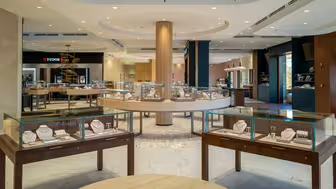
Reeds Jewelers Expands, Relocates FlagshipThe New York-based jeweler is moving its Amherst flagship store to a larger location in nearby Snyder.

MajorsOct 16, 2026
Katy Chen Appointed Executive Vice President of Graff USA Chen, who worked at Cartier and Tiffany & Co., will lead retail sales and operations for the luxury jeweler’s 11 U.S. stores.

IndependentsOct 15, 2026
Retailer Hall of Fame 2026: Amy and Elise Greenberg For 40 years, sisters Amy and Elise Greenberg have helmed their 126-year-old family business, leading with appreciation and integrity.
WatchesOct 15, 2026
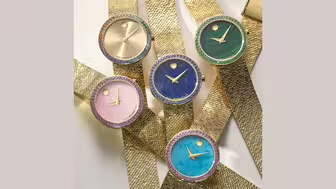
Stephanie Gottlieb’s New Movado Watches Are Made for Your Wrist StackMovado teamed up with the New York-based fine jewelry designer on a new collection of Movado Museum Velura watches.
SourcingOct 15, 2026
Signet Jewelers, Richemont May Join Bidder for De Beers, Report SaysThe two companies are reportedly in talks to join the Global Diamond Consortium, led by former De Beers CEO Gareth Penny, as per Bloomberg.
CollectionsOct 15, 2026
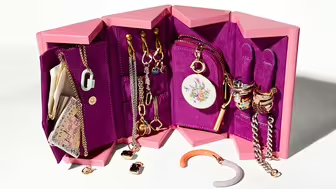
Wolf x Marla Aaron's New Jewelry Box Is for Some (Not All) of Your ThingsThe “Some of the Things” box follows the two larger “Everything” box designs with the look and function of antique sewing and toolboxes.

IndependentsOct 14, 2026
Retailer Hall of Fame 2026: Coleman and Mitchell ClarkFourth-generation jewelers Coleman and Mitchell Clark exemplify the best qualities of their predecessors: humility, modesty, and confidence.

SourcingOct 14, 2026
Manuel Marcial de Gomar, ‘The Emerald Whisperer,’ Dies at 90The gem hunter, whose 70-year career was defined by adventure and exploration, is remembered for his steadfast faith and sense of wonder.
FinancialsOct 14, 2026
LVMH’s Jewelry Brands Turn in ‘Very Good’ Performance in Q3 Tiffany & Co. continued its full-scale store renovation project while Bulgari’s high jewelry collection generated “record-breaking revenue.”
Events & AwardsOct 14, 2026
Chicago Responsible Jewelry Conference Releases 2026 ProgramThis year’s sessions feature leading voices from human rights, legal, and conservation organizations.

MajorsOct 13, 2026
David Webb Owner Purchases Lugano JewelryThe high-end jewelry retailer was sold to private investment firm Middle West Partners and a group of longtime clients.

Lab-GrownOct 13, 2026
Stephanie Gottlieb Takes Lab-Grown Diamond Collection WholesaleThe jewelry designer has partnered with Sofer Jewelry to distribute her 85-piece lab-grown diamond collection.

IndependentsOct 13, 2026
Retailer Hall of Fame 2026: Sean DunnDunn, this year’s Single-Store Independent inductee, is passionate about innovation and telling the story of natural diamonds.

AuctionsOct 13, 2026
Christie's Geneva To Auction 'Bulgari Pink' DiamondThe 24-carat fancy intense pink diamond ring could fetch up to $18 million at the November sale.

IndependentsOct 13, 2026
Greenwich St. Jewelers’ New Candle Smells Like HomeThe “Island Jewel” candle honors New York City and Puerto Rico and raises money for the island’s water relief efforts.
TechnologyOct 13, 2026
GemFind Is a New JA Member Benefit Partner The partnership will give JA members access to preferred pricing, exclusive benefits, technology solutions, education, and resources.

SurveysOct 09, 2026
These Will Be the 10 Busiest Days for In-Store Shopping This Holiday SeasonStores should expect to see the most customers on Nov. 27, and Christmas week is expected to be hectic too, as Dec. 25 falls on a Friday.

CollectionsOct 09, 2026
Elisa Solomon Collabs With Serendipity 3 on ‘Frozen Hot Chocolate’ CharmThe charm, our Piece of the Week, features brown diamond frozen hot chocolate topped with white diamond whipped cream and a ruby straw.

AuctionsOct 09, 2026
8-Carat Blue Diamond Goes Unsold at UK Jewelry Auction The top lot of Elmwood’s recent fine jewelry sale in London was a 1.84-carat, D color Tiffany & Co. solitaire diamond ring.