





SurveysJul 08, 2026
Signet Jewelers Falls 5 Spots on NRF’s ‘Top 100’ Retailers ListSurveysJul 27, 2026
Jewelry Leads Luxury Market Amid Stabilization, Bain Says
Bain & Company delved into the trends shaping the luxury market, the impact of AI, and more in its recent study.


A brooch from Mikimoto’s new “L’éclat” high jewelry collection. Jewelry is leading the way as the luxury market stabilizes, according to Bain & Company’s annual study.
New York—The global luxury market is stabilizing after an onslaught of ongoing crises and obstacles in the first half of the year, from the Middle East conflict and spiking oil prices to rising inflation and struggling consumer confidence.
Despite it all, global luxury spending in 2026 is expected to reach €1.44 trillion to €1.47 trillion ($1.64 trillion to $1.68 trillion), with sales growth between flat and up 2 percent at constant exchange rates, according to the spring update to the Bain-Altagamma Luxury Goods Worldwide Market Study for 2026.
The personal luxury goods market is expected to grow 2 to 4 percent to €365 billion to €373 billion ($415 billion to $424 billion) in 2026 following last year’s slowdown.
Jewelry is leading the way, according to Bain’s analysis of each category’s performance.
Richemont, which owns Cartier, Van Cleef & Arpels, Vhernier, and Buccellati, saw its jewelry sales soar for the seventh consecutive quarter in Q1.
Kering’s jewelry brands, which include Boucheron and Pomellato, posted double-digit growth in Q1.
The apparel, eyewear, and fragrance categories also are performing well, Bain & Co. said in its study, while cosmetics are lagging.
Sales in the leather goods and footwear categories are on track for improvement.
“The luxury market is stabilizing, but this is not a return to the old rhythm, it is the emergence of a new one,” said Claudia D’Arpizio, Bain & Company senior partner and global leader of the firm’s Fashion & Luxury practice and the lead author of the study.
“Consumers are not stepping back from luxury. They are stepping forward into a new relationship with it, one defined by meaning, not just by product. The brands that will win are those that can continuously reinvent their relevance and resonate with both consumers and AI-led ecosystems.”
Released last month, the study delved into what’s shaping the luxury market today and what customers are looking for in a luxury brand.
Here are five key takeaways from the report.
AI is changing how luxury consumers shop.
Bain’s study found that half of luxury consumers already use AI in their shopping journey, with nearly all planning to continue doing so.
“Consumers increasingly discover, compare, and validate their purchases of luxury brands through AI and the technology rapidly redefines luxury relevance,” said the study.
Nearly one-quarter of luxury shoppers use AI for brand and product discovery, while two out of three of them use it to compare products.
Luxury brands that are not building “AI-native relevance” risk being left behind, Bain said.
As budgets and preferences change, some shoppers are moving away from luxury, though 70 percent intend to return, but not always to the same brands.
“The question is whether brands are building the meaning and AI-native relevance to be surfaced and chosen when that moment arrives,” said Federica Levato, Bain & Company senior partner, leader of the firm’s EMEA Fashion & Luxury practice, and co-author of the study.
The luxury resale market is hot.
The luxury resale market is thriving, the study said, with around half of all luxury shoppers checking the secondhand market before buying something new.
Watch collectors, for example, value connoisseurship over hype, with collectors prioritizing craftsmanship and rarity, which fuels the momentum in the watch resale market.
Online searches for vintage bags have more than doubled year-over-year.
The secondhand luxury goods market grew 4 to 6 percent to an estimated €50 billion ($56 billion) in 2025, Bain said in a December 2025 study, with growth boosted by “consumers’ enthusiasm for treasure hunting and iconic archival pieces.”
Despite it all, global luxury spending in 2026 is expected to reach €1.44 trillion to €1.47 trillion ($1.64 trillion to $1.68 trillion), with sales growth between flat and up 2 percent at constant exchange rates, according to the spring update to the Bain-Altagamma Luxury Goods Worldwide Market Study for 2026.
The personal luxury goods market is expected to grow 2 to 4 percent to €365 billion to €373 billion ($415 billion to $424 billion) in 2026 following last year’s slowdown.
Jewelry is leading the way, according to Bain’s analysis of each category’s performance.
Richemont, which owns Cartier, Van Cleef & Arpels, Vhernier, and Buccellati, saw its jewelry sales soar for the seventh consecutive quarter in Q1.
Kering’s jewelry brands, which include Boucheron and Pomellato, posted double-digit growth in Q1.
The apparel, eyewear, and fragrance categories also are performing well, Bain & Co. said in its study, while cosmetics are lagging.
Sales in the leather goods and footwear categories are on track for improvement.
“The luxury market is stabilizing, but this is not a return to the old rhythm, it is the emergence of a new one,” said Claudia D’Arpizio, Bain & Company senior partner and global leader of the firm’s Fashion & Luxury practice and the lead author of the study.
“Consumers are not stepping back from luxury. They are stepping forward into a new relationship with it, one defined by meaning, not just by product. The brands that will win are those that can continuously reinvent their relevance and resonate with both consumers and AI-led ecosystems.”
Released last month, the study delved into what’s shaping the luxury market today and what customers are looking for in a luxury brand.
Here are five key takeaways from the report.
AI is changing how luxury consumers shop.
Bain’s study found that half of luxury consumers already use AI in their shopping journey, with nearly all planning to continue doing so.
“Consumers increasingly discover, compare, and validate their purchases of luxury brands through AI and the technology rapidly redefines luxury relevance,” said the study.
Nearly one-quarter of luxury shoppers use AI for brand and product discovery, while two out of three of them use it to compare products.
Luxury brands that are not building “AI-native relevance” risk being left behind, Bain said.
As budgets and preferences change, some shoppers are moving away from luxury, though 70 percent intend to return, but not always to the same brands.
“The question is whether brands are building the meaning and AI-native relevance to be surfaced and chosen when that moment arrives,” said Federica Levato, Bain & Company senior partner, leader of the firm’s EMEA Fashion & Luxury practice, and co-author of the study.
The luxury resale market is hot.
The luxury resale market is thriving, the study said, with around half of all luxury shoppers checking the secondhand market before buying something new.
Watch collectors, for example, value connoisseurship over hype, with collectors prioritizing craftsmanship and rarity, which fuels the momentum in the watch resale market.
Online searches for vintage bags have more than doubled year-over-year.
The secondhand luxury goods market grew 4 to 6 percent to an estimated €50 billion ($56 billion) in 2025, Bain said in a December 2025 study, with growth boosted by “consumers’ enthusiasm for treasure hunting and iconic archival pieces.”
“The appetite for luxury remains strong. The tolerance for disappointing experiences or products does not. ”
- Federica Levato, Bain & Company
Experiential luxury is evolving.
Luxury shoppers are seeking special moments when choosing a luxury experience, shifting toward emotion- and purpose-led moments, Bain said.
Bookings across dining, leisure, and entertainment experiences are up 30 percent year-over-year, with growth driven by “bespoke, slow-travel formats rooted in local culture.”
More travelers also are headed to nontraditional locations, with trips to these locales up 20 percent year-over-year, which Bain attributes to the “elsewhere-ism” travel trend.
“The appetite for luxury remains strong. The tolerance for disappointing experiences or products does not,” Levato said.
Multi-generational travel is also trending, and, notably, half of Gen Z respondents said their parents influence their luxury brand preferences.
“Consumer sentiment towards experiences is outgrowing tangible goods by 1.5x so far in 2026, reflecting a structural and cultural shift from ownership to lived moments,” said the study.
Within the category, luxury hospitality, private jets, yachts, and cruises are resilient, with fine dining and gourmet food also doing well. The fine arts category is returning to growth.
Luxury assets, like high-end cars, are weaker, while fine wines and spirits hit a snag as alcohol consumption softens.
The design and furniture categories are slowing down, while real estate remains “constrained.”
Luxury sales are surging in America, boosted by younger shoppers.
Luxury spending in the United States is on the rise, with growth in sales of beauty, apparel, and hard luxury, which includes jewelry and watches.
American luxury brands saw Q1 sales increase about 10 to 15 percent year-over-year, adjusting for currency fluctuations.
Younger shoppers, those under 35, are outspending their elders.
“Perhaps more striking, upper middle-class households are now growing their luxury spending at roughly twice the rate of wealthier cohorts, suggesting that the market is succeeding in broadening its base,” the study said.
Globally, Europe is the luxury market’s “weak link” said Bain, as international tourist spending faltered at the start of the year, particularly as Middle Eastern tourists affected by the regional conflict stayed away.
China’s luxury market is slowly recovering while Japan faces a slowdown due to a drop in tourist traffic, particularly from China.
The personal luxury goods market is on the road to recovery.
The overall personal luxury goods market, which includes jewelry and watches, is seeing a gradual recovery, with the possibility of bouncing back this year.
In 2025, sales in the personal luxury goods market fell 2 percent (up 1 percent at constant exchange rates) year-over-year to €358 billion ($407 billion).
In 2026, the market is expected to grow 2 to 4 percent to €365 billion to €373 billion ($415 billion to $424 billion), down slightly from Bain’s previous forecast, which came out before the conflict in the Middle East began.
Bain assigned a 70 percent probability to its most recent forecast, which assumes stabilization in the Middle East, resilient local spending, and recovering demand in China.
There’s a 20 percent probability the market could grow even more, 4 to 6 percent, but this would require further easing of political tensions, renewed momentum in the U.S. market, and an accelerated recovery in China.
It’s even less likely (10 percent probability) that the market will see flat to 2 percent growth. This scenario requires escalation in the Middle East, softer tourism, or weakness in the Americas.
“Around 60 percent of luxury players are already outperforming their Q1 2025 results, and the wide performance gap that defined 2025 is beginning to close, as last year’s winners cool and former laggards recover,” said the study.
Bain’s analysis concluded that it’s a “new era” for the sector as the meaning of luxury evolves.
It’s less about social validation, like being seen with the latest handbag, and more about a sense of personal fulfillment, said the study.
“This new era for the sector means that luxury will no longer define what its consumers own but rather how they live,” it said. “It sees luxury evolving from elitism through aspiration and self-expression to an era characterized by ‘living well’.”
So, what do brands need to do in this evolving market?
The three imperatives, said Bain, are delivering wonder through immersive experiences, building cultural relevance for diverse communities, and offering AI-enabled creativity and personalization.
Editors' Picks
Sponsored by


More on Surveys
The Latest

PodcastsOct 21, 2026
Episode 10: This Episode Is Haunted Diana Singer shared the stories of two “cursed” diamonds on this month’s podcast, which was inexplicably riddled with technical issues.

IndependentsOct 21, 2026
Gardner-Collier Jewelry to Close After 9 Decades in BusinessThe family-owned jeweler has three locations across Missouri and Iowa.

SourcingOct 21, 2026
Venetia Mines Final Carats Ahead of 2-Year ShutdownThe De Beers-owned diamond mine in South Africa is being put on ice as part of a round of previously announced cost-cutting measures.

Brought to you by
A Diamond Is Forever Launches 2026 Holiday Campaign Championing Natural DiamondsA Diamond Is Forever's holiday campaign reimagines natural diamond icons for a new generation celebrating individuality.


CollectionsOct 21, 2026
Helzberg, Nordstrom Carrying New Jewelry Collection From Off-WhiteThe collection centers designs with clean geometric lines, chunky sculptural pieces, and recognizable details from the luxury fashion brand.

Weekly QuizOct 15, 2026
This Week’s QuizTest your jewelry news knowledge by answering these questions.

SourcingOct 21, 2026
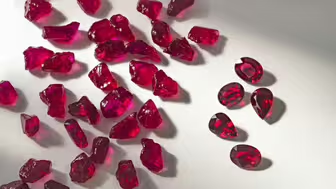
Gemfields’ Mixed-Quality Ruby Auction Earns $52MThe miner said it saw particularly strong prices for larger, fine-quality rubies at the sale.


CrimeOct 20, 2026
Security Guard Charged With Murder in Shooting at Texas MallThe guard opened fire on a man who was smashing a jewelry display case at La Gran Plaza in Fort Worth last week, police said.
Brought to you by
Open an Account, Get $50 Off Your First Order. No Code Needed.Built on Relationships. Refined by Craft.

IndependentsOct 20, 2026
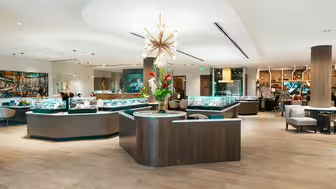
David Gardner’s Jewelers Unveils Newly Expanded, Revamped ShowroomThe Texas jeweler added 2,000 square feet to its reimagined showroom, complete with a new design studio and an event space.
SourcingOct 20, 2026
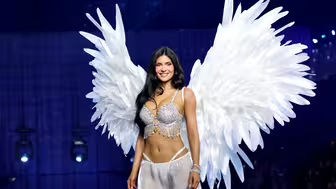
The $50M Victoria’s Secret ‘Fantasy Bra’ By The NumbersJacob & Co.'s diamond masterpiece is the most expensive Fantasy Bra ever worn on the Victoria’s Secret Fashion Show runway.

CollectionsOct 20, 2026
Mignon Faget’s Collection Chooses Handmade Over AIThe “Atelier” collection was inspired by the tools, rituals, and objects in an artist’s studio as a quiet rebuttal to an automated world.
MajorsOct 19, 2026
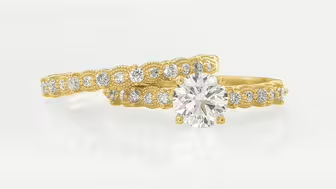
The Knot to Acquire Rival Wedding Planning Platform ZolaThe pending acquisition is an “exciting opportunity” for wedding vendors to grow their business, said The Knot Worldwide’s CEO.

SourcingOct 19, 2026
Jewelry Design Competition Show Airs in Thailand"The Secret Gems" features eight Thai jewelry brands paired with a team of young craftspeople who create jewelry together to win challenges.

CollectionsOct 19, 2026
John Hardy Enters the Medallion Chat With Talisman Collection The brand’s “Modern Talisman” capsule collection introduces pendants inspired by the mythology, natural world, and spiritual ethos of Bali.

IndependentsOct 19, 2026
The Stories of 5 Jewelers Celebrating Their Centennials in 2026Independent jewelers from New Mexico to New Jersey answer the question: What has kept your store in business for 100 years?
CollectionsOct 16, 2026
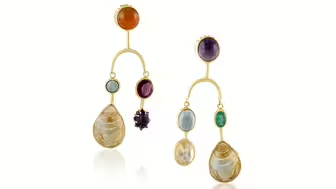
Christina Puchi’s Earrings Hold the UniverseOur Piece of the Week gathers the planets, represented by a variety of colored gemstones, in a pair of 14-karat yellow gold earrings.
IndependentsOct 16, 2026
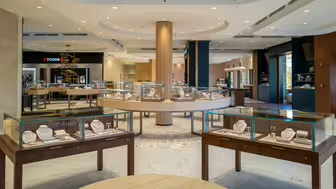
Reeds Jewelers Expands, Relocates FlagshipThe New York-based jeweler is moving its Amherst flagship store to a larger location in nearby Snyder.

MajorsOct 16, 2026
Katy Chen Appointed Executive Vice President of Graff USA Chen, who worked at Cartier and Tiffany & Co., will lead retail sales and operations for the luxury jeweler’s 11 U.S. stores.

IndependentsOct 15, 2026
Retailer Hall of Fame 2026: Amy and Elise Greenberg For 40 years, sisters Amy and Elise Greenberg have helmed their 126-year-old family business, leading with appreciation and integrity.
ColumnistsOct 15, 2026
Peter Smith: What Is the Culture REP?It’s a term Smith coined and felt compelled to share following a bad experience with an aborted flight and an unfeeling flight attendant.

WatchesOct 15, 2026
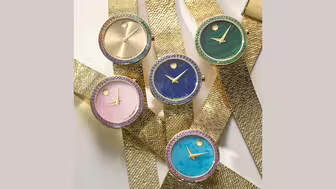
Stephanie Gottlieb’s New Movado Watches Are Made for Your Wrist StackMovado teamed up with the New York-based fine jewelry designer on a new collection of Movado Museum Velura watches.
SourcingOct 15, 2026
Signet Jewelers, Richemont May Join Bidder for De Beers, Report SaysThe two companies are reportedly in talks to join the Global Diamond Consortium, led by former De Beers CEO Gareth Penny, as per Bloomberg.
CollectionsOct 15, 2026
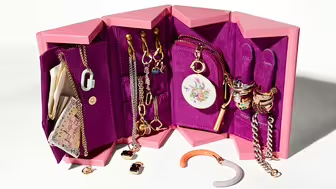
Wolf x Marla Aaron's New Jewelry Box Is for Some (Not All) of Your ThingsThe “Some of the Things” box follows the two larger “Everything” box designs with the look and function of antique sewing and toolboxes.
IndependentsOct 14, 2026
Retailer Hall of Fame 2026: Coleman and Mitchell ClarkFourth-generation jewelers Coleman and Mitchell Clark exemplify the best qualities of their predecessors: humility, modesty, and confidence.

SourcingOct 14, 2026
Manuel Marcial de Gomar, ‘The Emerald Whisperer,’ Dies at 90The gem hunter, whose 70-year career was defined by adventure and exploration, is remembered for his steadfast faith and sense of wonder.
FinancialsOct 14, 2026
LVMH’s Jewelry Brands Turn in ‘Very Good’ Performance in Q3 Tiffany & Co. continued its full-scale store renovation project while Bulgari’s high jewelry collection generated “record-breaking revenue.”

Events & AwardsOct 14, 2026
Chicago Responsible Jewelry Conference Releases 2026 ProgramThis year’s sessions feature leading voices from human rights, legal, and conservation organizations.