Senior Editor Lenore Fedow visited Savannah, Georgia, last month to attend the naming ceremony of the new Jewelers Mutual at SCAD Studio and learn more about the partnership between the insurance company and the creative arts school.
Who doesn’t love to complain now and then? Whether it’s the wrong coffee order or an annoying interaction, it feels good to vent about minor inconveniences.
When it comes to more important matters, however, the time spent addressing an issue should dwarf the time spent complaining about it.
Often, it feels like the jewelry industry spends a lot of time doing the latter instead of focusing on the former.
That being said, there are a few industry organizations that talk the talk and walk the walk when it comes to addressing one of the biggest problems: the shortage of bench jewelers.
The Jewelry Symposium and the Community for Ethical Jewelry have held discussions and webinars on the topic.
Earlier this year, Jewelers Mutual Group announced that it had a plan to address the bench jeweler shortage that involves a massive donation to one of the country’s most well-regarded art and design schools.
As retirees leave their benches, the new talent isn’t there to replace them. The industry needs an estimated 4,000 bench jewelers a year to maintain itself, according to Jewelers Mutual.
More than 70 percent of jewelers intend to hire bench jewelers but struggle to find qualified candidates, according to a recent workforce study by the U.S. Bureau of Labor and Statistics.
When new bench jewelers do enter the workforce, the education they receive needs to align with the skills jewelers are looking for when hiring.
And so, Jewelers Mutual established a 10-year partnership with the Savannah College of Art and Design (SCAD) to support bench jeweler education through a $10 million donation.
What exactly does this new partnership entail? Well, I headed down to Savannah last month to find out.
Hosted by Jewelers Mutual and SCAD, I spent four days talking with the leaders who set this plan into motion and meeting with SCAD students.
On the first night, Tuesday evening, I attended a welcome dinner with guests from Jewelers Mutual and SCAD at the Olde Pink House, a Southern restaurant in the city’s historic district, housed in a mansion built in 1771.
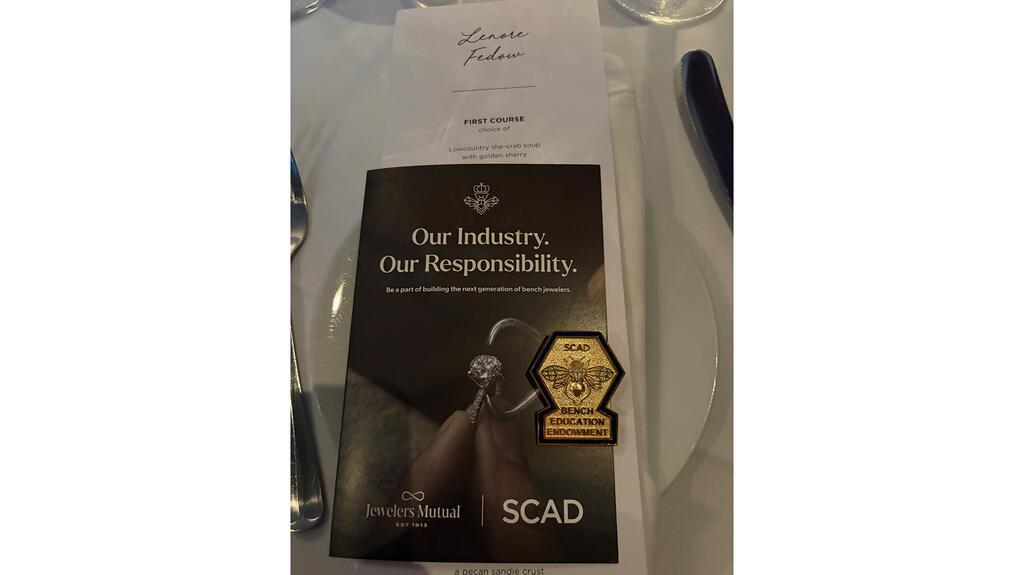
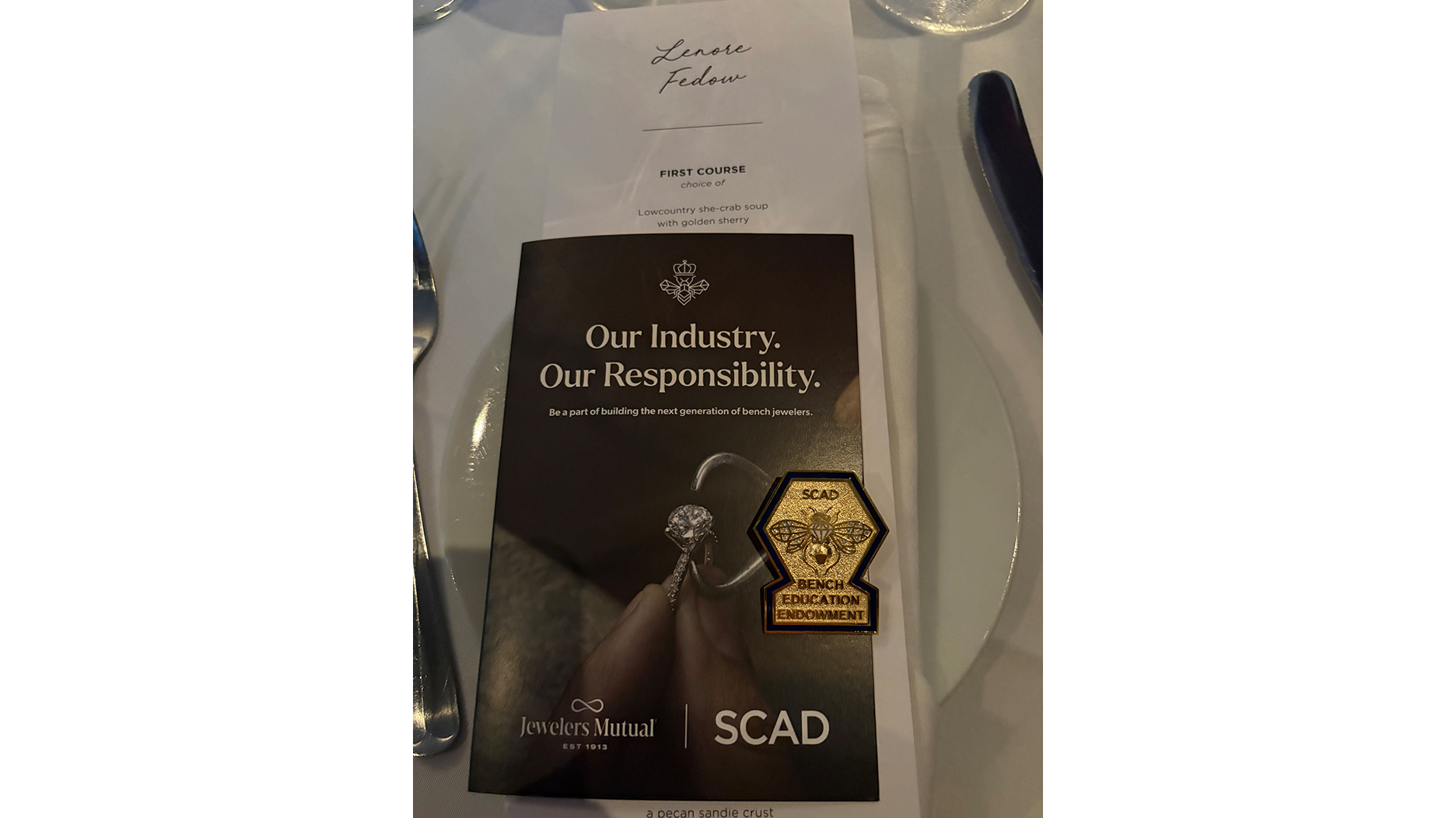
After opening remarks by Jewelers Mutual CEO Scott Murphy, guests were given a commemorative pin, designed by a SCAD alum, with a bee on it, a nod to SCAD’s mascot, Art T. Bee, and its new scholarship.
The Bench Education Endowment scholarship, or BEE, will draw in and support students pursuing careers as bench jewelers.
At a welcome dinner, guests received this bee pin designed by a SCAD alum.
The scholarship is just one piece of the partnership.
On Wednesday morning, the press group I was part of headed to SCADStory, an immersive 4D experience that tells the story of how the school, which was founded in 1978, came to be.
As imaginative and creative as the space was, the presentation stressed that SCAD’s goal is to prepare students for fulfilling, real-world careers, bucking the idea of the “starving artist.”
Later that morning, we headed to the naming ceremony for the Jewelers Mutual Studio, which houses the SCAD jewelry department.
During the ceremony, Murphy highlighted how important it is for other industry organizations to step up to address the bench jeweler shortage.
“As wonderful as the Savannah College of Art and Design is … and as committed and as pure of heart our intentions at Jewelers Mutual are … we can’t do it alone. This is truly going to require us to come together as an industry,” said Murphy.
“We hope that anyone who believes in this industry will come and be a part of this with us.”
Audra Pittman, SCAD’s vice president of giving, spoke about why the partnership is meaningful to its students.
“For our current students, this partnership levels up their final years and glittering portfolios,” she said.
“For our incoming and soon-to-be students, they will walk into a space literally endowed by the industry. And for young creatives years away from even applying to SCAD, their future awaits.”
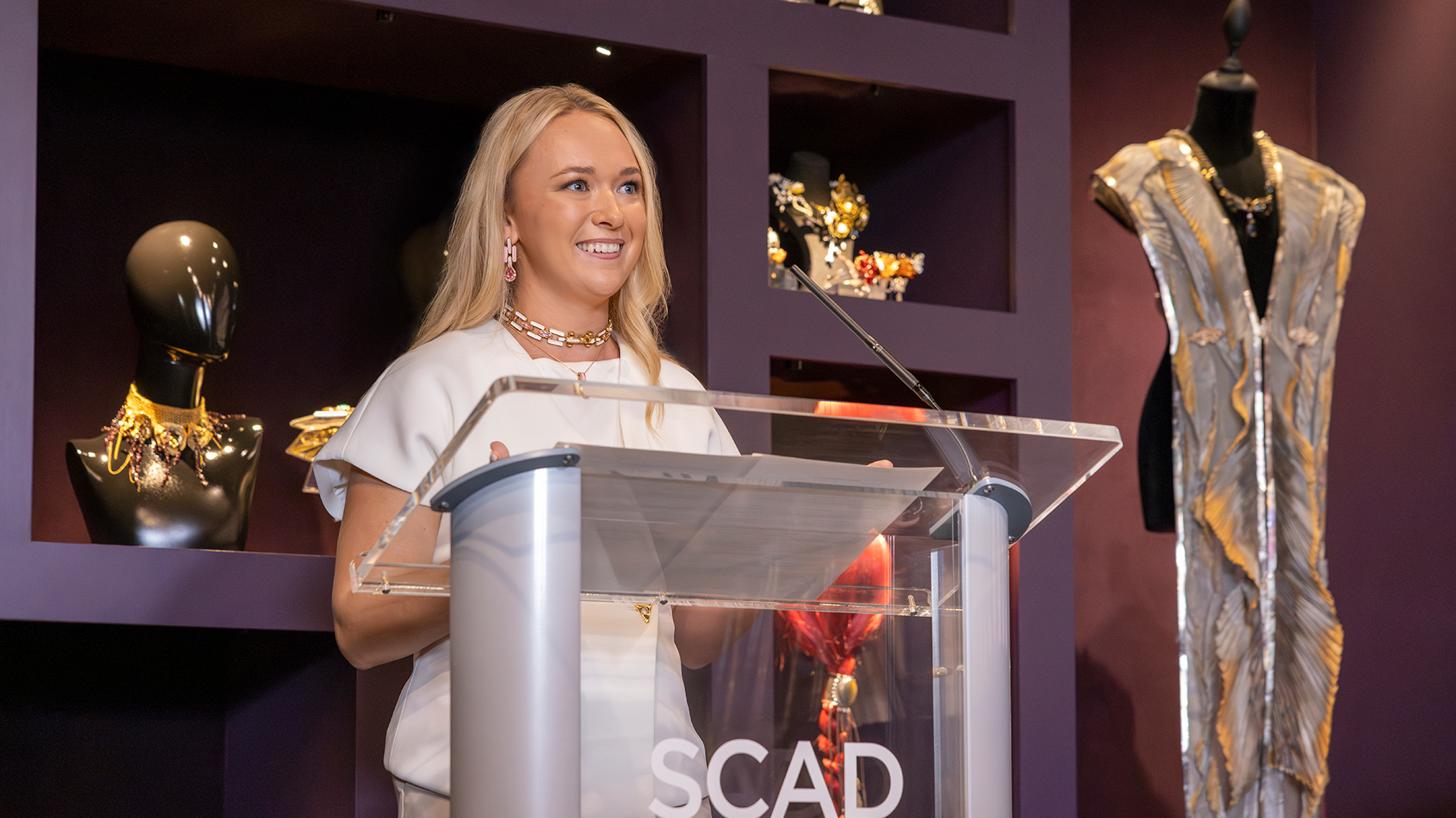
During the ceremony, SCAD senior Elle Jerge shared her experience being a student in the jewelry program.
She began as a fashion major but switched to jewelry after taking an entry-level jewelry class.
Her mother was also a jeweler.
SCAD senior Elle Jerge spoke at the naming ceremony about her time as a student in the jewelry program. At the time of the ceremony, Jerge had just returned from showing her senior collection. The Jewelers Mutual donation funded all the seniors’ collections this year.
“Finding myself at a jeweler’s bench, I had never felt so inspired. The rhythm of the sounds, the feel of the metal, the sight of something beautiful taking shape right in front of me,” Jerge said.
She spoke lovingly about the jewelry studio, calling it her “home away from home.”
After the ceremony, I got a chance to sit sat down with Murphy and Pittman, as well as Jewelers Mutual President Mike Alexander and Jennifer Markas, head of industry relations and Impact Fund.
I wanted to know why Jewelers Mutual chose SCAD and what the next phase of the partnership will look like.
Markas shed some light on the research process, which included connecting with more than 30 colleges and universities that have a jewelry program in the United States.
Enrollment was an important factor in the decision, she said, noting SCAD had doubled enrollment in its jewelry program since 2022.
The physical space the college had available also was a factor, since benches take up a lot of space. SCAD was looking to double the number of benches it had to around 200.
“It’s the largest jewelry program in the United States. And by large, I don’t just mean the size, but that it’s comprehensive. They have a full-on curriculum, from designing to fabrication to showcasing and selling,” Markas said.
“SCAD is the college of art and creative careers. You can’t get any more germane than that.”
“A lot of times, the industry says ‘We have an issue. What can we do?’ [Jewelers Mutual] put their money where their mouth is.” – Audra Pittman, VP of Giving at SCAD
Pittman had been in touch with Markas about the proposed partnership but had no idea the magnitude of the investment and the impact they wanted to make, she said.
“When they said $10 million, I was like ‘Oh my God!’ This is transformative. A lot of times, the industry says ‘We have an issue. What can we do?’ [Jewelers Mutual] put their money where their mouth is,” she said.
While the money is certainly valuable to the program, it’s the ongoing support and connections that are also making a difference, said Pittman.
She’s met with manufacturers and independent jewelers who are looking to hire bench jewelers.
“Well, we have the students, we have the talent. And [Jewelers Mutual] is opening doors for us,” she said.
Talent and skill are important, but having a well-regarded industry player supporting students is just as vital, particularly when it comes to internships and careers.
“This is impactful with dollars, with time, with resources and connections,” Pittman said.
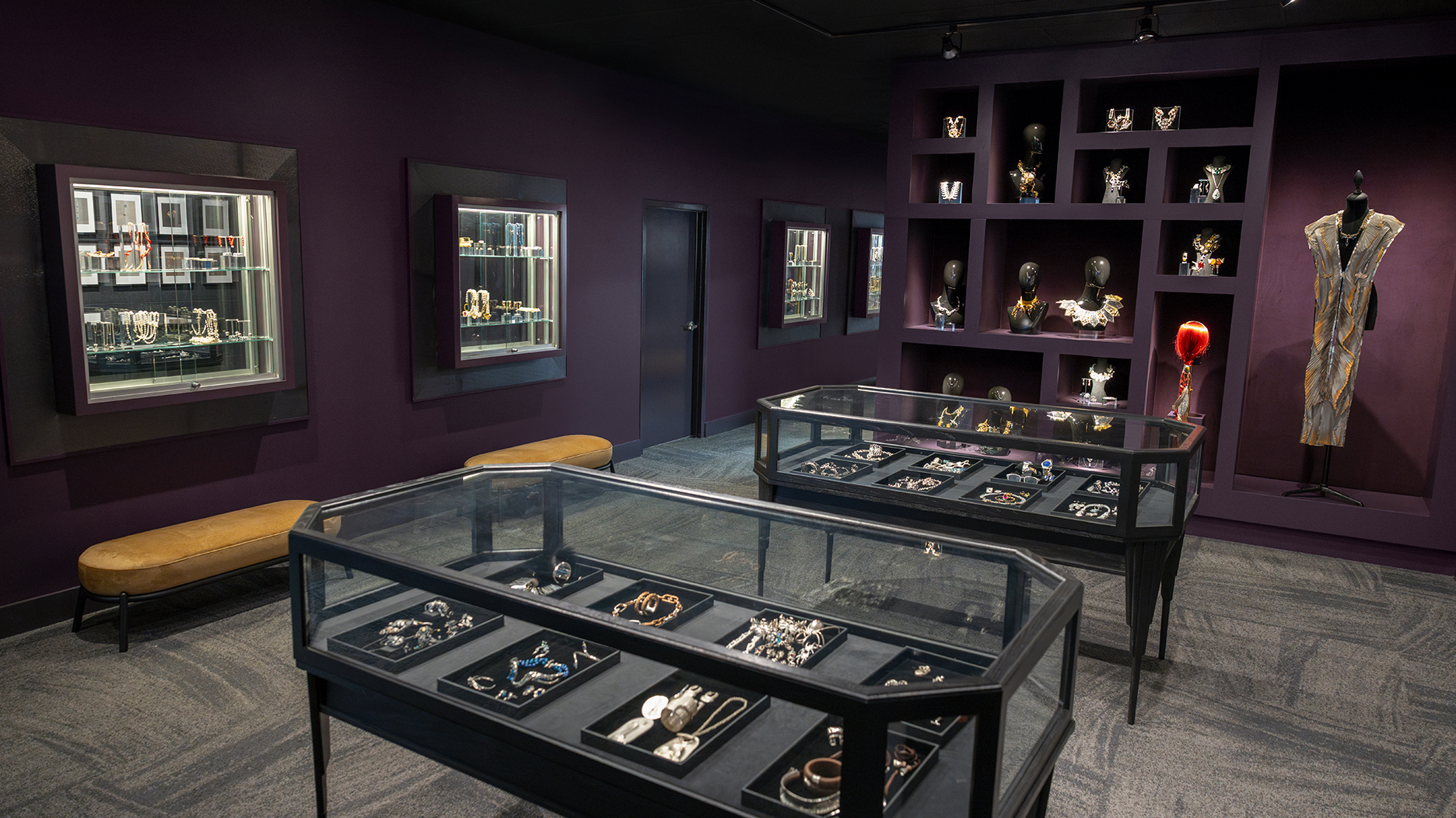
The students’ work is on display as you enter the studio.
The jewelry industry has responded to news of the partnership with “genuine excitement,” said Alexander, noting his experience at Jewelers Mutual’s Half Moon Bay Conference in April.
“Everybody we talked to [at the conference] says they want to chip in, in some way, shape, or form,” he said. “Now, you have to see if it translates into scholarships, endowments, things like that.”
CEO Murphy said he really feels the industry will come together on this, most importantly with internships and career opportunities.
“I really am excited about seeing how this is going to be the feeder of talent for the next generation back into the industry,” he said.
The best way to understand the talent SCAD has to offer is to come see for yourself.
Markas is encouraging the industry to come down to Savannah and visit the school.
The Atlanta Jewelry Show, which has been held in Atlanta for the past 76 years, will host a “road show” event at the Savannah Convention Center in April 2027, offering exhibitors and retailers a convenient opportunity to connect with students.
Ideally, Markas said, jewelry industry organizations will be calling Jewelers Mutual and asking how they can get involved, rather than the other way around.
“I want to see the organizations really latch on to this amazing opportunity,” she added.
Related stories will be right here …
Another big question for me was this: why is Jewelers Mutual, an insurance company, doing this?
JM doesn’t need bench jewelers, and the lack thereof doesn’t directly affect its business.
“We don’t need bench jewelers or talent, but our customers do. And we really hope they see the promise of this program and what we’ve opened doors to,” Markas said.
The students are especially excited about the doors of opportunity that are opening, said Pittman.
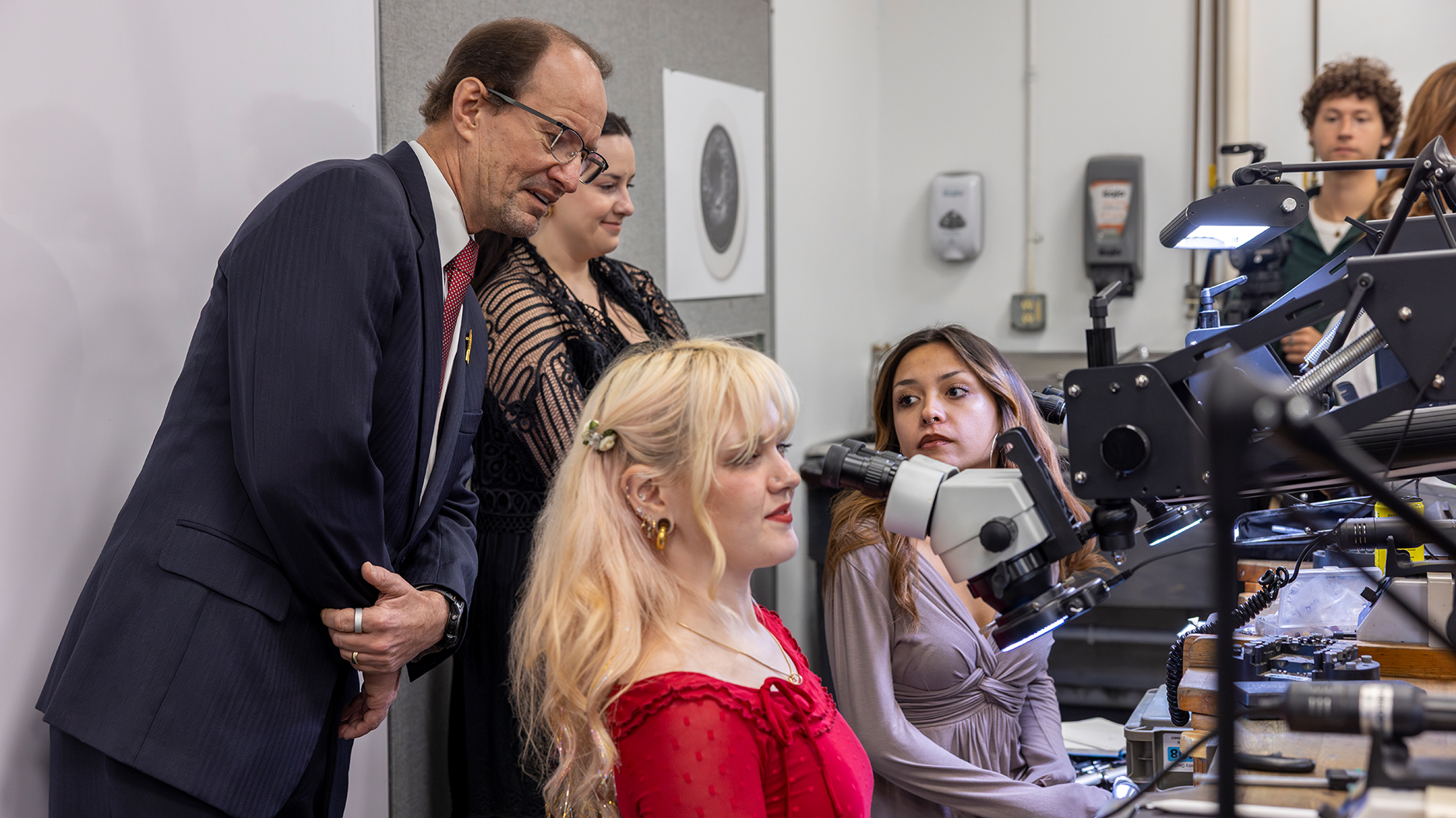
Jewelers Mutual CEO Scott Murphy toured the students’ workspaces.
Juniors and seniors have told her that they never would have finished their collections without the investment in the resources they needed.
She also noted that the support from the trade had an impact on parents, many of whom are often wary about encouraging their children to pursue careers in the arts.
“For [the parents] to see that the industry is investing, this must be something worth it,” she said.
The new opportunities, like exhibiting at a jewelry trade show, and the chance to get real-world experience are also a draw for students, noted Pittman.
After the naming ceremony, our group got a tour of the facilities and a chance to see the students at work.
The students were excited to show us around and share what they’d been working on.
“Could you imagine being a jeweler that’s getting ready to hire somebody, and you’ve got somebody that comes in with that mindset? That’s contagious,” Murphy said.
At the time I visited in mid-May, there were 167 jewelry majors and 65 minors, plus the students in the graduate and master’s programs.
Built in 1970, the 13,562-square-foot building that houses the Jewelers Mutual Studio is the largest of its kind in the U.S. United States, said SCAD. The school acquired the building in 2001.
The revamped space has a welcome lobby, a new gallery space to showcase the students’ work, and a new Gem Resource room.
A portion of the JM funding goes toward updates to jewelry-making technology and equipment, and the studio is chock-full of machines: laser welders, mass centrifugal finishing equipment, induction and vacuum casting, electroplating and e-coating systems, and advanced engraving tools for detailing.
SCADlab, which has 3D printers and large-format photo printers, is also located within the building.
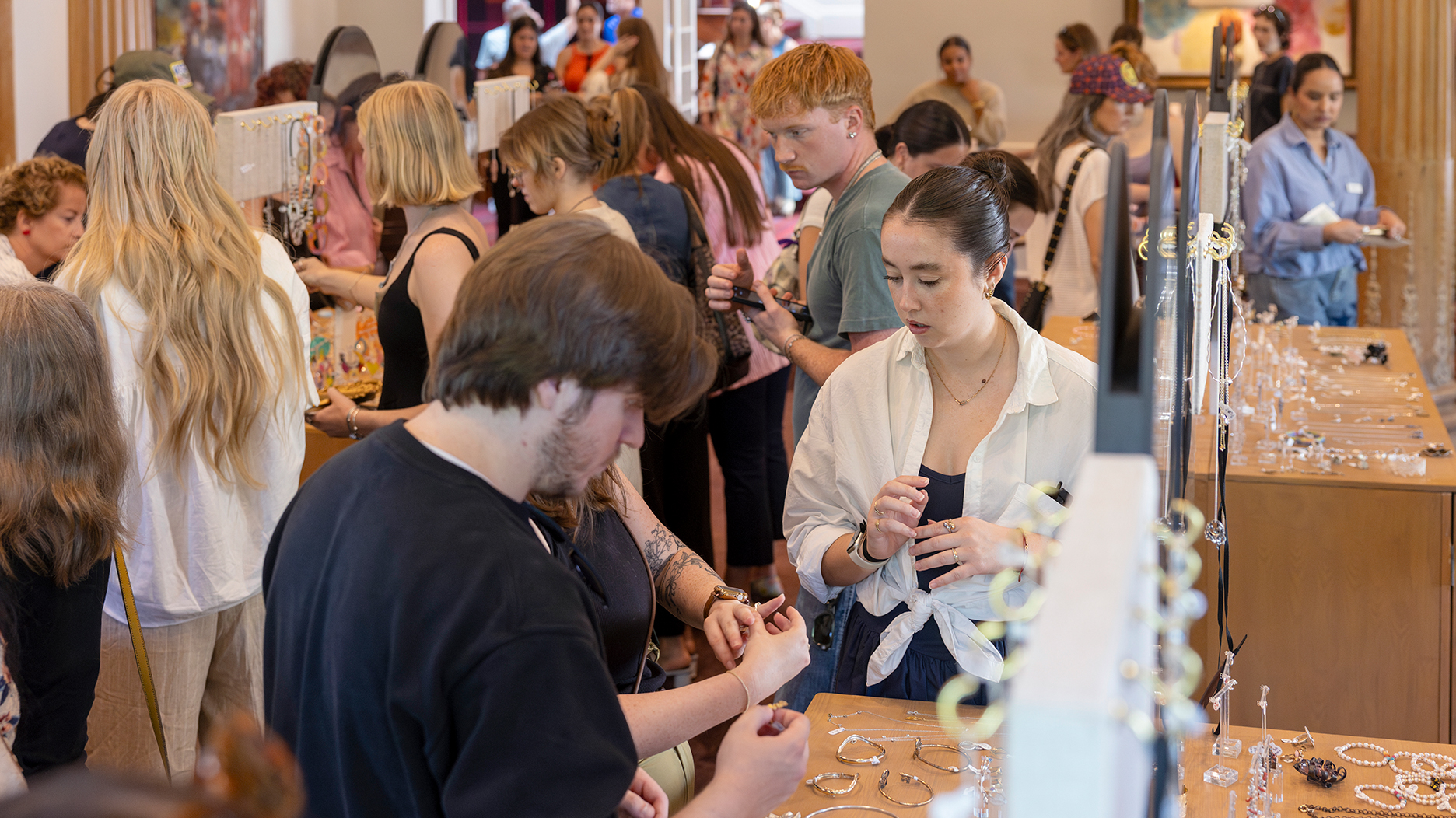
The SCAD Jewelry trunk show was held in Poetter Hall, open to the public.
On Thursday, I attended the SCAD Jewelry trunk show, where jewelry students got the chance to showcase and sell their work to the public.
This was a highlight for me.
I had seen the students’ work behind glass during the studio tour but to see it up close and try it on is entirely different.
The level of skill and creativity, all these different aesthetics displayed side by side, was incredible to see.
I had another chance to meet with the students on Friday at Origin Coffee Bar.
These were fashion students, and while my focus is jewelry, I couldn’t pass up the chance to chat with emerging talent.
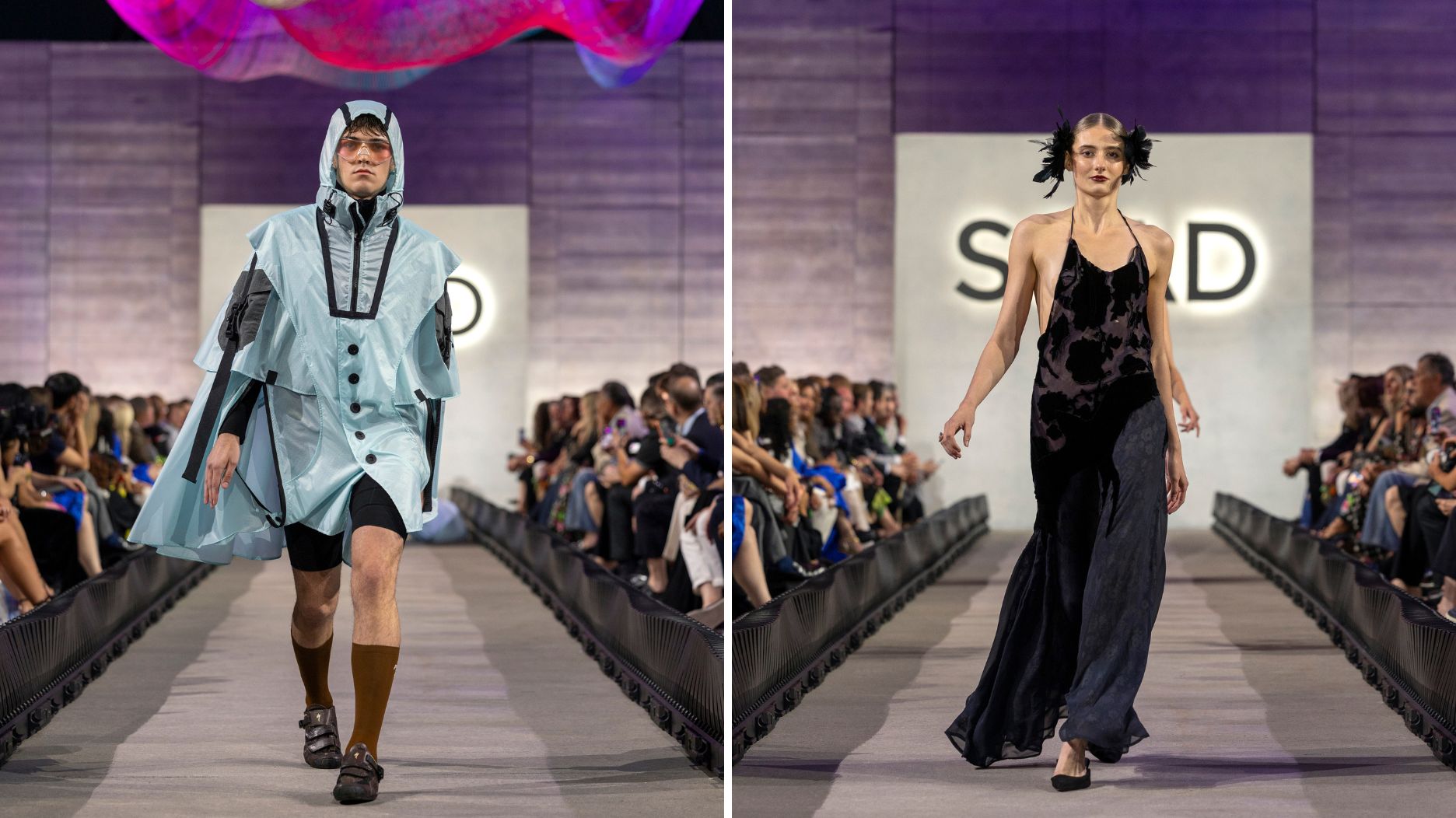
I met a fellow Brooklynite, Noah Drew, whose line was inspired by cycling, and student Amelia Langton, who spent an unbelievable amount of time on what may be the most lovely, ethereal dress I’ve ever seen.
I also met supermodel Coco Rocha, no big deal. She was there to coach the student models that would soon be walking the SCAD Fashion Show runway.
My days on campus were jam-packed with tours, including the backlots of SCAD Film Studios, SCAD School of Fashion, and Bazaar by shopSCAD, a boutique that stocks products created by SCAD students and alumni.
I screen printed my own tote bag at SCAD Fibers and toured the Gutstein Gallery and the SCAD Museum of Art.
Student models walk the SCAD Fashion Show runway in designs by students Noah Drew (left) and Amelia Langton.
The grand finale of the trip was the SCAD Fashion Show.
Seated in the front row (fancy me!) with the other press, I watched in awe as the models glided down the runway wearing magnificent student creations.
Like the jewelry trunk show, each design was unique yet flowed together beautifully, from futuristic to fantastical.
The whole experience, from touring the citywide campus to meeting with the students, left me feeling inspired, grateful, and a bit nostalgic.
Going behind the scenes and seeing all the work that went into these students’ creations, I remembered how badly I wanted the career I have now and what it took to get here.
About 10 years ago, I was a full-time business journalism student with a part-time retail job, waking up before the sun to make it to my internship before the stock market’s opening bell. And I was happy to do it, because I found joy in the work, and the career I wanted felt so close.
What was important for me then, and for these jewelry students now, was support and mentorship.
I learned from seasoned professionals with relevant experience in their fields and saw what I could be in the smart, determined, accomplished women that guided my way. Their connections and references helped secure internships and jobs.
It is wonderful and necessary to have talent and drive, but guidance and financial support bridge the dream and reality.
In the same way, bench jewelers are the difference between a dreamed design on paper and a finished piece of jewelry in your hand.
My hope is that this partnership inspires many more collaborations and that the jewelry industry comes together to support the next generation of talent.