






ColumnistsJan 09, 2024
On Data: The Top-Performing Jewelry Categories in 2023ColumnistsJan 18, 2024
Squirrel Spotting: What Will 2024 Look Like for Independent Retailers?
Peter Smith is optimistic, particularly for jewelers who do these three things well.


Peter Smith is an industry consultant, speaker, sales trainer, and author. He can be reached via email at TheRetailSmiths@gmail.com.
The most recent data on retail sales performance for 2023 is nothing short of awe-inspiring. The Edge Retail Academy (ERA) reports that independent retail jewelers finished almost flat versus 2022.
The ERA numbers reflect performance of independents only. We have yet to see results from the majors but if the recent past is any indicator, those numbers will likely be down 12 percent or more on a same-store basis.
If the majors do report those kinds of numbers—significantly worse than independents—it will be the result of multiple factors including the collapse of lab-grown diamond prices, continued declines in foot traffic, lower average tickets (see: lab grown), and ongoing difficulty hiring salespeople in an environment as close to full employment as we are likely to see.
The majors also must contend with the challenges associated having so many stores in malls, as some estimates indicate there are many more malls than needed for the population and the way people shop today.
For independent jewelers, despite the overall outstanding performance in 2023, not all stores benefited equally.
There were, of course, retailers who far outperformed the market, and there were others who underperformed.
The rising tides of 2021 and 2022, which seemed to lift all jewelry stores, were a good deal more selective in 2023, as some retailers witnessed a resumption of pre-COVID challenges.
Anecdotally, it also feels like we are witnessing more retailers closing their stores in recent weeks than at any time previously, including the Great Recession. The more than two decades-long contraction in the number of retail jewelry stores appears to be accelerating after the respite of the post-2020 period.
Every closing, of course, has its own story, but I imagine some of those retailers are exiting now, delighted to have enjoyed an unexpectedly strong jewelry market in recent years, and ahead of anticipated headwinds to come.
They’ve fought the good fight, had a nice kicker towards the end, and are now happy to exit stage left while the going is good.
The ERA numbers reflect performance of independents only. We have yet to see results from the majors but if the recent past is any indicator, those numbers will likely be down 12 percent or more on a same-store basis.
If the majors do report those kinds of numbers—significantly worse than independents—it will be the result of multiple factors including the collapse of lab-grown diamond prices, continued declines in foot traffic, lower average tickets (see: lab grown), and ongoing difficulty hiring salespeople in an environment as close to full employment as we are likely to see.
The majors also must contend with the challenges associated having so many stores in malls, as some estimates indicate there are many more malls than needed for the population and the way people shop today.
For independent jewelers, despite the overall outstanding performance in 2023, not all stores benefited equally.
There were, of course, retailers who far outperformed the market, and there were others who underperformed.
The rising tides of 2021 and 2022, which seemed to lift all jewelry stores, were a good deal more selective in 2023, as some retailers witnessed a resumption of pre-COVID challenges.
Anecdotally, it also feels like we are witnessing more retailers closing their stores in recent weeks than at any time previously, including the Great Recession. The more than two decades-long contraction in the number of retail jewelry stores appears to be accelerating after the respite of the post-2020 period.
Every closing, of course, has its own story, but I imagine some of those retailers are exiting now, delighted to have enjoyed an unexpectedly strong jewelry market in recent years, and ahead of anticipated headwinds to come.
They’ve fought the good fight, had a nice kicker towards the end, and are now happy to exit stage left while the going is good.
“[Over the past few years] retailers who executed well saw incredible results. However, retailers (and suppliers) who did not also had good years because the rising tide lifted all boats, masking a great many sins.”
It should be noted that it was not a stellar year across the board for many on the supplier side of the business, particularly those heavily dependent on diamond-centric deliverables.
Those suppliers had to contend with declining diamond prices, the continued intrusion of lab grown, and a retailer base that tightened its belt when it came to investing in new products.
Many retailers even curtailed regular replenishment believing the robust retail economy would collapse late in the year, which didn’t happen.
After performing at about a 3 percent decline to 2022 for much of the year, independents looked somewhat anxiously to the latter part of the calendar, wondering how long the strong business climate would continue.
I didn’t hear a single person predict what actually happened—business got better in November and December, to see sales end at almost flat for the year.
So, what do we think 2024 will bring?
In short, I’m hugely optimistic for retailers who execute brilliantly. One might argue that has always been the case, but that simply wasn’t true over the past few years.
Yes, retailers who executed well saw incredible results.
However, retailers (and suppliers) who did not also had good years because the rising tide lifted all boats, masking a great many sins.
Assuming the majors do report sales declines of approximately 12 percent in 2023, with the independents having performed almost flat, we already have seen a decline in the broader category industry-wide last year.
I believe that trend will accelerate in 2024.
However, I remain bullish about the prospects for the best independents, those who execute exceptionally well.
I believe 2024 will be a microcosm of the past couple of decades, with fewer retailers doing more business, and a continued shift to better quality and branding.
The full scope of what great execution looks like is beyond a single column, a given book, or even yours truly.
In the interest of brevity, and priority, I will point to the three biggest rocks, those things that every single retail jeweler should be examining and can control, even if it doesn’t always feel that way.
People
This is such a complex and challenging aspect of the business and getting it right (we know it’s always a moving target) is so important.
You have to start by being brutally honest about your culture.
Ask yourself why your most talented people would want to stay with you, and why quality people should come to work for you.
If your attitude about managing people, compensation, scheduling, and developing people hasn’t significantly evolved over the last 10 years, it is probably outdated.
“If ... there is no flexibility, you are going to struggle to retain and attract young talent.”
Empty euphemisms about young people not wanting to work hard, or that they are only interested in work-from-home employers misses a broader point.
Must every current and prospective employee be available to work every hour you are open? Is there no room for flexibility at all in your model?
If the answer is yes, they must work all those hours, and no, there is no flexibility, you are going to struggle to retain and attract young talent.
That’s not a “them” problem; that’s a “you” problem.
Ask yourself, why should current and potential employees commit to employment in a business that offers a non-competitive employment package (compensation, vacation, sick days, health insurance, etc.)?
Why would they favor employers who do not contribute to their career development over those who do?
If you don’t offer tuition reimbursement, do you participate at all in ongoing professional development? When was the last time you sent your people to an educational conference, or had a professional trainer visit your store (I hear that Peter Smith guy has a great Sales Masterclass!!!)?
Retention of your best people (turnover on the whole is not necessarily a bad thing) and making yourself attractive to quality candidates are two sides of the same coin.
Ultimately, it’s about creating the kind of culture people want to be part of because it allows them to be the best version of themselves.
The last point I’ll make on the people front is you must have a structured and disciplined process for identifying and hiring candidates. That means modeling your best people, warts and all, and hiring the critical (read: non-teachable) traits.
Twenty-five percent of all people have the necessary wiring for sales, but if you don’t hire people who are self-motivated (whether they worked in sales previously or not), don’t expect them to be successful in a sales environment.
Likewise, if your hire people with low resilience, don’t expect them to succeed in an environment with constant rejection as an ever-present reality.
And make sure your candidates have empathy. If they don’t care enough about your customers to deliver the best possible buying experience, they don’t need to be in sales.
Sales and Profitability
The best retailers manage their sales and profitability.
Clearly establishing sales as the priority is essential. Of course, you want to love your customers, your employees, and your products, but those goals are not mutually exclusive from driving profitable revenues.
Ensuring that message resonates throughout the entirety of your organization, not just your salespeople, is a critical step.
To be clear, being nice to customers and having good product knowledge is important. However, having the aforementioned attitude and knowledge absent the ability, or the will, to inspire and influence consumer buying behavior is a luxury a business cannot afford.
With respect to profitability, any retailer who depends on ongoing discounting is doing no favors to their business or their customers.
A 15 to 20 percent discount may seem innocuous in real time, but that equates to a potential hit of 30 to 40 percent on your gross profit.
“Converting customers at a higher average ticket must be a central tenet of your business.”
The vendor will charge you the same cost, whether you discount or not, so the entirety of that markdown comes from your side of the cost equation.
As for those customers who get reductions, there is growing evidence to suggest they are not better off for having received the discount.
Customers have a higher perceived value on non-discounted products than off-price items, and they feel better for having paid more. I know it sounds crazy, but it is true.
In “Brainfluence: 100 Ways to Persuade and Convince Consumers With Neuromarketing,” Roger Dooley wrote, “My advice is to price the product appropriately for the target market and to be aware that discounting may actually reduce the quality of the customer experience.”
One of my mantras is, converting customers at a higher average ticket must be a central tenet of your business. In a world of declining foot traffic, anything less is willful compliance in the demise of your own business.
Having salespeople who are equipped to sell, not just deliver pleasant service, is a big component of that goal, and having an active customer relationship management (CRM) system is one of your best tools.
Returning customers convert at a 70 percent higher rate than prospects, and at a more than 30 percent higher average ticket.
The more energized your CRM is, the better your business and your customers will be.
Make it easy for customers to think about your business for all of their milestone occasions, and sometimes just because!
Product
The product landscape has been fascinating to watch in recent years.
We’ve seen high-end timepieces, led by Rolex, perform at a level not previously experienced.
We’ve witnessed secondhand watches enjoy a zenith (that’s the second pun in this section, sorry), and we saw the emergence of lab-grown diamonds as a serious disruptor in a marketplace not friendly to disruption (anyone remember how we reacted to e-commerce? Pandora in its early days? Branded diamonds?).
With lab grown currently embroiled in a price collapse, and sales of previously owned time pieces seeming to have plateaued, we can only guess at what the product stories will be for 2024.
“We ought to be paying close attention to what is happening elsewhere in better quality retail environments.”
Noise is being made in some sectors about great things happening with bridal, but there is precious little evidence to suggest that the annual (excepting the COVID impact) 2 million or so marriages will increase or decrease in any significant way.
I’m guessing we’ll see a stabilization on all things diamond, after an unstable year.
Diamond products, typically 40-50 percent of all retail sales, are not going to materially drop off any more than one of the other categories are going to become half of the business.
There is, of course, questions about what the role of lab grown will be going forward, and how long high-end timepieces will continue to perform at such a high level.
What is more certain for me, however, is that we ought to be paying close attention to what is happening elsewhere in better quality retail environments.
To that end, over-stuffing showcases with all manner of goods (even if you get them on memo) is not a good strategy. Having curated collections and brands that represent who you are, or want to be, is becoming increasingly more important.
Embracing data and automation with your products and brands wherever and whenever possible—not because it’s what your suppliers want, but because it is the right thing to do for your business—will be more important than ever.
The more you do that, the more time you’ll have to work on your business.
For those retailers who do the hard work of addressing the things that are most important in their business, I believe 2024 will be a good year.
For those expecting the past to be prelude, I expect you’ll be correct only to the degree that more and more business will shift to the best retail operators, and the contraction in the overall number of jewelry stores will accelerate, as per recent indicators.
The glass, in my opinion, is decidedly half full.
Happy retailing!
Editors' Picks
Sponsored by


More on Columnists

The Latest

CrimeOct 22, 2026
Jeweler Shot and Killed in His Suburban Cincinnati Store Tara Sinchuri was the owner of Everest Jewels in Fairfield, Ohio, and a father of three. He was found dead in his store on Tuesday.


MajorsOct 22, 2026
Neiman Marcus Has Gifts for the Jewelry Lover Who Has EverythingBespoke experiences from Buccellati and Verdura are on the retailer’s 2026 “Fantasy Gifts” list.


Events & AwardsOct 22, 2026
JIS Fall 2026 Reports Record-Breaking Attendance The number of participants at the fall show was up 12 percent.

Brought to you by
A Diamond Is Forever Launches 2026 Holiday Campaign Championing Natural DiamondsA Diamond Is Forever's holiday campaign reimagines natural diamond icons for a new generation celebrating individuality.


CollectionsOct 22, 2026
Billie Eilish, Finneas Co-Design Collection for John HardyThe Academy and Grammy award-winning siblings have collaborated with John Hardy on a new jewelry line inspired by their personal style.

Weekly QuizOct 22, 2026
This Week’s QuizTest your jewelry news knowledge by answering these questions.



PodcastsOct 21, 2026
Episode 10: This Episode Is Haunted Diana Singer shared the stories of two “cursed” diamonds on this month’s podcast, which was inexplicably riddled with technical issues.

IndependentsOct 21, 2026
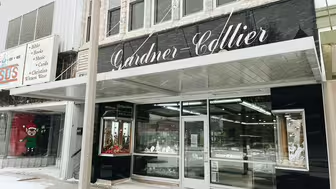
Gardner-Collier Jewelry to Close After 9 Decades in BusinessThe family-owned jeweler has three locations across Missouri and Iowa.

Brought to you by
Open an Account, Get $50 Off Your First Order. No Code Needed.Built on Relationships. Refined by Craft.


SourcingOct 21, 2026
Venetia Mines Final Carats Ahead of 2-Year ShutdownThe De Beers-owned diamond mine in South Africa is being put on ice as part of a round of previously announced cost-cutting measures.

CollectionsOct 21, 2026
Helzberg, Nordstrom Carrying New Jewelry Collection From Off-WhiteThe collection centers designs with clean geometric lines, chunky sculptural pieces, and recognizable details from the luxury fashion brand.
SourcingOct 21, 2026
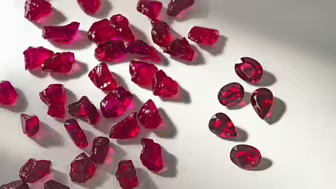
Gemfields’ Mixed-Quality Ruby Auction Earns $52MThe miner said it saw particularly strong prices for larger, fine-quality rubies at the sale.

CrimeOct 20, 2026
Security Guard Charged With Murder in Shooting at Texas MallThe guard opened fire on a man who was smashing a jewelry display case at La Gran Plaza in Fort Worth last week, police said.

IndependentsOct 20, 2026
David Gardner’s Jewelers Unveils Newly Expanded, Revamped ShowroomThe Texas jeweler added 2,000 square feet to its reimagined showroom, complete with a new design studio and an event space.

SourcingOct 20, 2026
The $50M Victoria’s Secret ‘Fantasy Bra’ By The NumbersJacob & Co.'s diamond masterpiece is the most expensive Fantasy Bra ever worn on the Victoria’s Secret Fashion Show runway.

CollectionsOct 20, 2026
Mignon Faget’s Collection Chooses Handmade Over AIThe “Atelier” collection was inspired by the tools, rituals, and objects in an artist’s studio as a quiet rebuttal to an automated world.
MajorsOct 19, 2026
The Knot to Acquire Rival Wedding Planning Platform ZolaThe pending acquisition is an “exciting opportunity” for wedding vendors to grow their business, said The Knot Worldwide’s CEO.

SourcingOct 19, 2026
Jewelry Design Competition Show Airs in Thailand"The Secret Gems" features eight Thai jewelry brands paired with a team of young craftspeople who create jewelry together to win challenges.

CollectionsOct 19, 2026
John Hardy Enters the Medallion Chat With Talisman Collection The brand’s “Modern Talisman” capsule collection introduces pendants inspired by the mythology, natural world, and spiritual ethos of Bali.
IndependentsOct 19, 2026
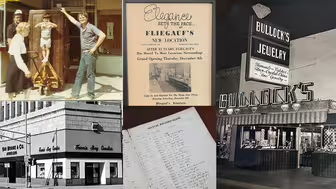
The Stories of 5 Jewelers Celebrating Their Centennials in 2026Independent jewelers from New Mexico to New Jersey answer the question: What has kept your store in business for 100 years?

SurveysOct 16, 2026
How Inflation, Gas Prices Will Affect Holiday Sales The NRF is expecting holiday sales to increase this year, but consumers and retailers alike are facing Grinch-like headwinds.
CollectionsOct 16, 2026
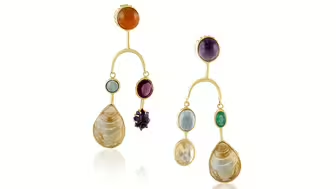
Christina Puchi’s Earrings Hold the UniverseOur Piece of the Week gathers the planets, represented by a variety of colored gemstones, in a pair of 14-karat yellow gold earrings.
IndependentsOct 16, 2026
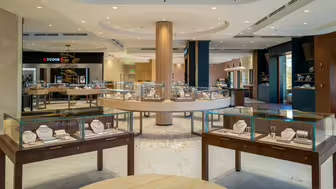
Reeds Jewelers Expands, Relocates FlagshipThe New York-based jeweler is moving its Amherst flagship store to a larger location in nearby Snyder.

MajorsOct 16, 2026
Katy Chen Appointed Executive Vice President of Graff USA Chen, who worked at Cartier and Tiffany & Co., will lead retail sales and operations for the luxury jeweler’s 11 U.S. stores.

IndependentsOct 15, 2026
Retailer Hall of Fame 2026: Amy and Elise Greenberg For 40 years, sisters Amy and Elise Greenberg have helmed their 126-year-old family business, leading with appreciation and integrity.
WatchesOct 15, 2026
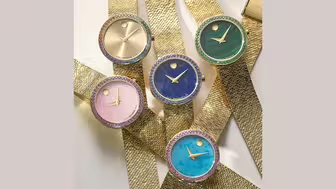
Stephanie Gottlieb’s New Movado Watches Are Made for Your Wrist StackMovado teamed up with the New York-based fine jewelry designer on a new collection of Movado Museum Velura watches.
SourcingOct 15, 2026
Signet Jewelers, Richemont May Join Bidder for De Beers, Report SaysThe two companies are reportedly in talks to join the Global Diamond Consortium, led by former De Beers CEO Gareth Penny, as per Bloomberg.
CollectionsOct 15, 2026
Wolf x Marla Aaron's New Jewelry Box Is for Some (Not All) of Your ThingsThe “Some of the Things” box follows the two larger “Everything” box designs with the look and function of antique sewing and toolboxes.