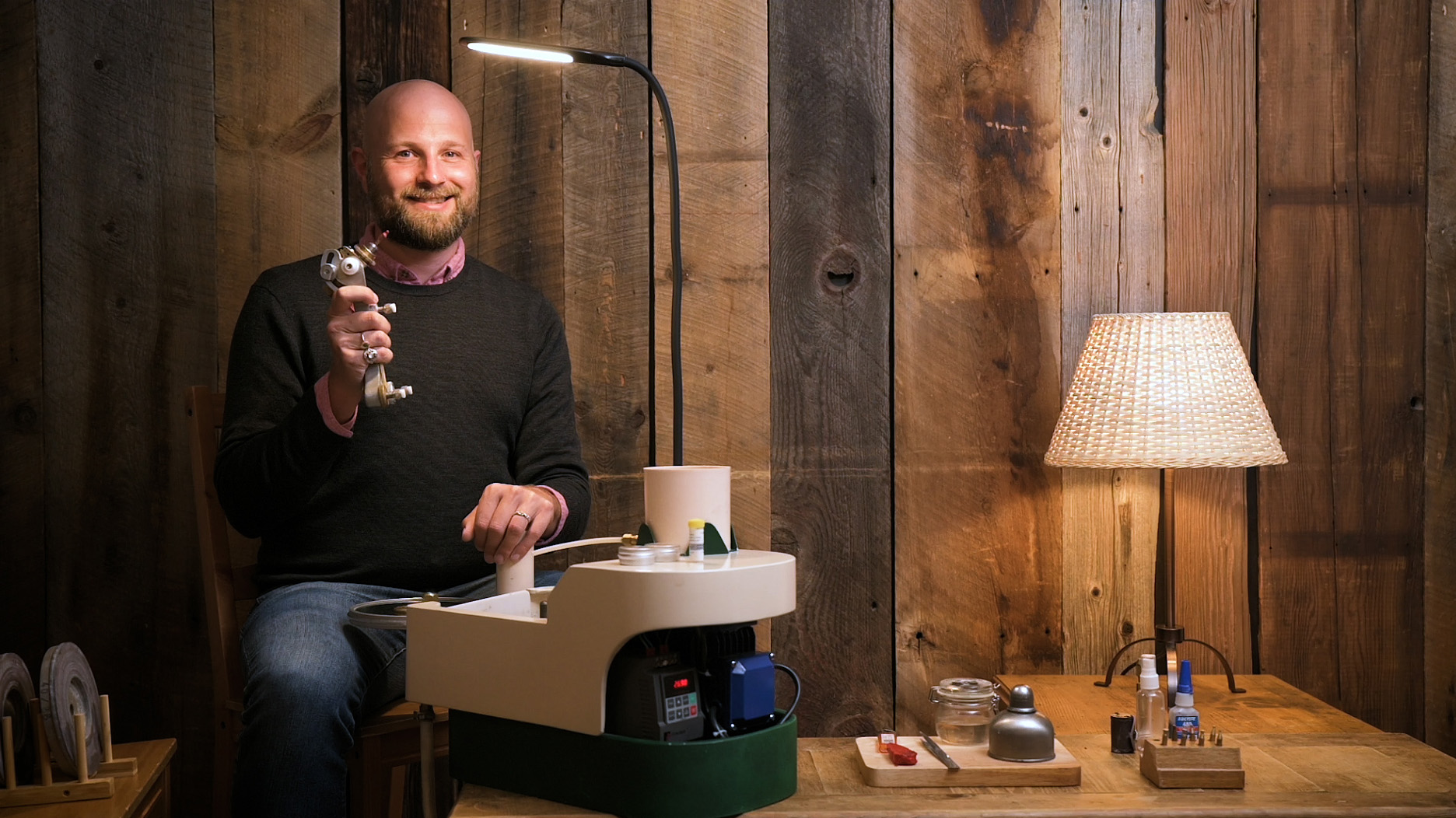
A group of Faceting Apprentice students in Brooklyn, New York; Faceting Apprentice is a gem-cutting school founded in 2019 by lapidarists Justin K. Prim and Victoria Raynaud. For the State of Colored Stones story in the 2026 State of the Majors issue, National Jeweler interviewed young American gemstone cutters about how they are approaching their craft and connecting with other cutters, both online and off.
Editor’s Note: This story first appeared in the print edition of the 2026 State of the Majors. Click here to see the full issue.
From its inception, gem cutting in America has been defined by innovation and artistic expression. Those traits are still at the core of the trade today, enriched by the evolution of technology.
Today’s young American lapidarists are largely self-taught, and they look to online platforms to get connected, find resources, and make sales.
For many, it’s a hobby, but for some, it’s their main gig.
In a culture where a commercial workshop setting isn’t appealing, making a full-time career of cutting colored gemstones in the modern industry landscape requires initiative, passion, and strong relationships.
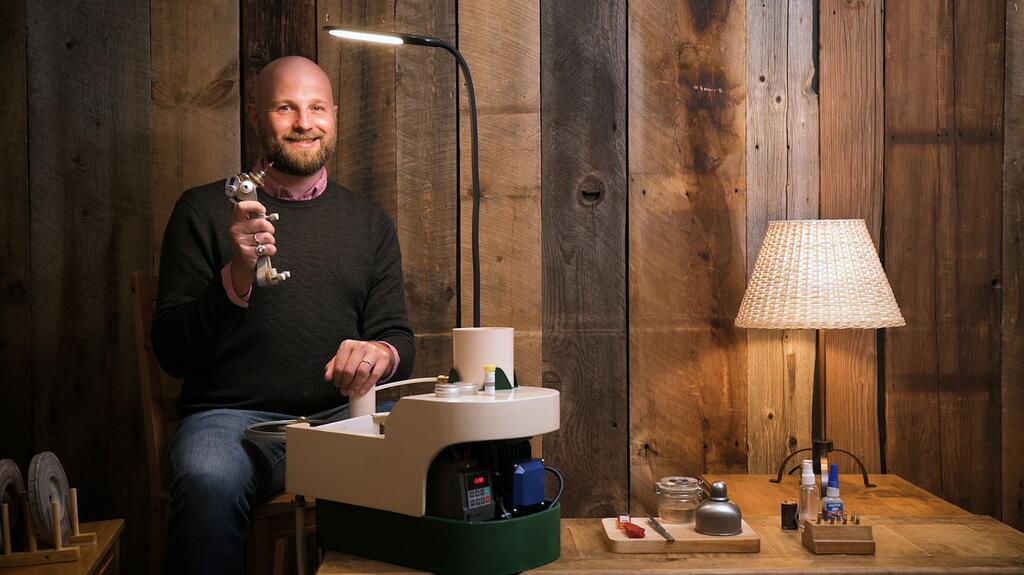
The State of the Trade Justin K. Prim is a teacher, gemologist, and lapidarist at Magus Gems, which he runs with his wife, Victoria Raynaud, who is also a gem cutter.
Based in France, they have a gem-cutting school, Faceting Apprentice, where they offer virtual and in-person classes in Lyon, as well as a twice annual two-week class in Brooklyn, New York.
Justin K. Prim is a teacher, gemologist, and lapidarist at Magus Gems. He and his wife are the owners of Faceting Apprentice, a gem-cutting school that offers both online and in-person courses.
Prim also has a YouTube channel, @JustinKPrim, about gemstone cutting, providing not only instructional content, but also videos about different machines, different cultures, history, and techniques.
A few years ago, the couple took a year-long road trip across America, making stops at various lapidary clubs and major jewelry hubs along the way for a project Prim was working on about the history of American gem cutting.
Visits to several cutting workshops confirmed what they already knew—there is a shortage of commercial gemstone cutters in America.
Historically, faceting was a trade that required years of meticulous practice to master.
Training was hands-on, and techniques were guarded knowledge. In some cultures, this is still the norm.
In Prim’s next book, which is forthcoming, he writes that America developed its own gemstone cutting industry in isolation, disconnected from the apprenticeship traditions of Europe.
“To summarize American gem cutting, it starts in the 1930s, and it’s basically people who are amateurs training other people who are amateurs, and the thing goes on and on and on over the generations,” he says.
American lapidarists embraced the fantasy cut, invented by legendary German cutter Bernd Munsteiner in the ‘60s. (The fantasy cut community is still growing today, led by next-generation cutters like Ian Loska and Nolan Sponsler.)
They were excited by the idea of breaking tradition and exploring beyond strict cutting standards. Newcomers to the trade have channeled the same pioneering spirit.
“They want to just cut the things they like or cut the designs they like. It’s a very artisan market.” - Justin K. Prim
While a culture that encourages experimentation and discovery may have an upside for individual craftsmen, it doesn’t bode well for an industry with workshops in big cities that desperately need bodies on benches.
“It’s a problem to figure out how to get the people who want to be gem cutters to the people who want to hire gem cutters,” Prim says.
Like many other young Americans, newcomers to the craft are unlikely to commit early on to a career they perceive to be a lifelong sentence, he notes.
“I polled the Facebook group asking gem cutters, ‘If you could get a job at a gem-cutting factory in your local town, and you got paid the same amount of money as a plumber, like $40 an hour or something, would you take that job?’ And 100 percent said no.
“They don’t want anyone to tell them what to do. They don’t want to cut anything they don’t want to cut. They want to just cut the things they like or cut the designs they like. It’s a very artisan market.”
That mentality, not surprisingly, doesn’t necessarily fly in a workshop.
Instead of freewheeling (no pun intended) artists, workshops would prefer cutters trained in specific ways and may perceive self-taught cutters’ processes—which Prim described as “quirky”—or slower pace as adverse qualities.
But, without novice cutters to train from scratch, self-made craftsmen who are open to being retrained are their only option in many cases.
Career Avenues While not every student who attends his school is looking to start a business, Prim is candid with those who are looking to make a career of lapidary work.
“As a gem cutter, you almost always have to be an entrepreneur,” he says. “The downside is you have an income cap, and that is how many stones you can do a day.”
A group of students watching Prim give a demonstration
He estimates five, but that’s on a day when you don’t need to answer emails, go to the post office, or create content for social media.
He encourages those who are serious about becoming a full-time lapidarist to start with local jewelers.
“Every jeweler in America needs someone to do repairs and recuts, and they don’t know who to send it to,” he says.
“If your jeweler discovers there’s a good [local] gem cutter at a reasonable price and they don’t have to send it to New York, potentially get it lost in the mail or just have it be away from their city ... There’s an unlimited amount of work that way.”
Once a relationship is established, Prim says a jeweler might even start asking their cutter to source material for them at trade shows to bring back and cut to their specifications.
“That’s a long-term plan, but you can do it, especially in a rural area,” he says.
Digital Community Prim got into the industry in 2014 at the age of 30.
At the time, he’d just moved to San Francisco from Chicago, and a coworker introduced him to gem shows. Soon after, he found and joined a lapidary club two blocks from his house.
“For two years, I went there every single day before and after work, and I learned how to make [cabochons]. I learned how to carve a little bit, but what I wanted to do was faceting, and there was a two-year waiting list for the faceting class,” he says.
When he finally got into the faceting class, he was hooked.
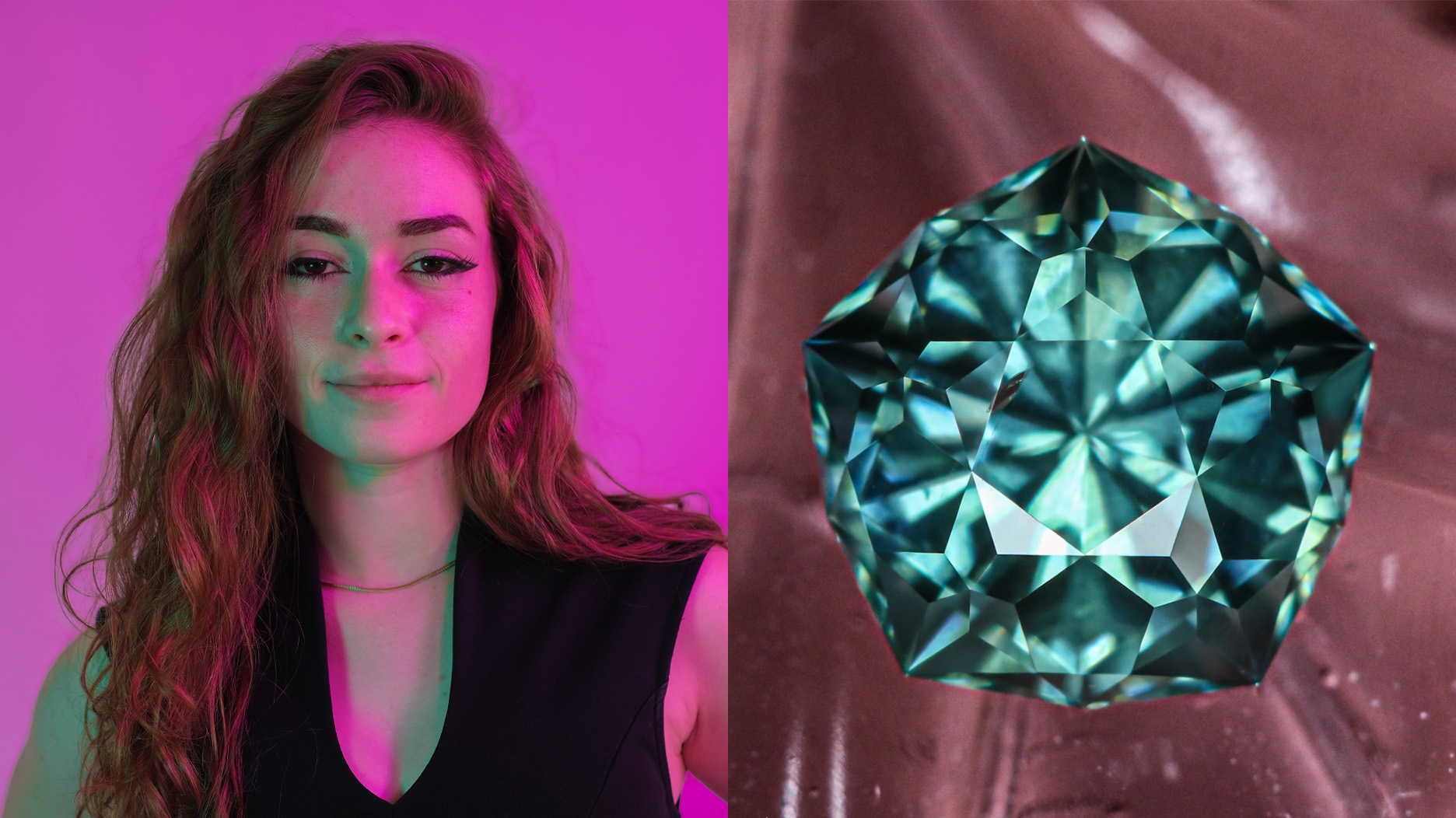
A heliodor, faceted by Prim, cut into a 5-sided design
He bought a machine online, and within a year, he moved to Bangkok to go to the Gemological Institute of America.
Online communities and resources played a major role in Prim’s immersion into the lapidary world.
“By the time I really got deep into cutting, I was already on my way to Bangkok, and so of course, I was able to see the stones that were in Bangkok, but I didn’t meet [American cutters] until a lot later,” he says.
“My early inspirations were those American cutters who were posting on Instagram.”
Some of the content creators he recalls discovering online were Jean-Noel Soni of Top Notch Faceting, a lapidarist known for embracing crystals’ natural forms, and Arya Akhavan, the plastic surgeon and crystal chemistry researcher behind Surgical Precision Gems.
Related stories will be right here …
In addition to social media, Prim has found that web forums and chat apps like Discord are helpful for lapidaries to share resources and stay connected.
“The community is crucial. It used to be that the lapidary club or the mineral club was how you would build that community, but today, post-2010, it’s Facebook groups,” he says.
“It’s a good way that you could get activated immediately without having to drive far or buy a machine.”
The Self-Taught Path Jenna Sloane, 25, is a lapidary artist based in California.
Jenna Sloane (left) is a 25-year-old gem cutter based in California. At right, a 1.38-carat sapphire from Rock Creek, Montana, that she faceted.
“Very often, I have to make a point of saying that I’m a full-time gem cutter, because I didn’t realize how many professional gem cutters have [other] full-time jobs,” she says.
She taught herself to facet and began pursuing her graduate gemologist diploma from GIA while studying industrial design in college.
At the time, she was making and selling pendants made from cross-sections of pinecones, and requests for her to add gemstones to the pieces spurred her to learn more about gems.
A post on social media about gem cutting inspired her to explore the craft, and her tinkering evolved into something more substantial.
She worked in a jewelry store for a while before making the leap to becoming a full-time, independent gemstone cutter.
“I wasn’t receiving any benefits. I was making $600 a week, working as a bench jeweler, jewelry photographer, website developer, social media manager, lapidary, and gem identifier, and I just felt very exploited,” she says.
“My work was just not really equipped for such an established, large jewelry store, and they didn’t have rough because most jewelers do not have rough gemstones to cut themselves.
“A lot of their clients only wanted a 20-carat Ceylon sapphire … a little 21-year-old is not going to get her hands on that rough.”
Today, Sloane cuts mainly unconventional shapes, like kites, shield cuts, hexagons, and egg shapes.
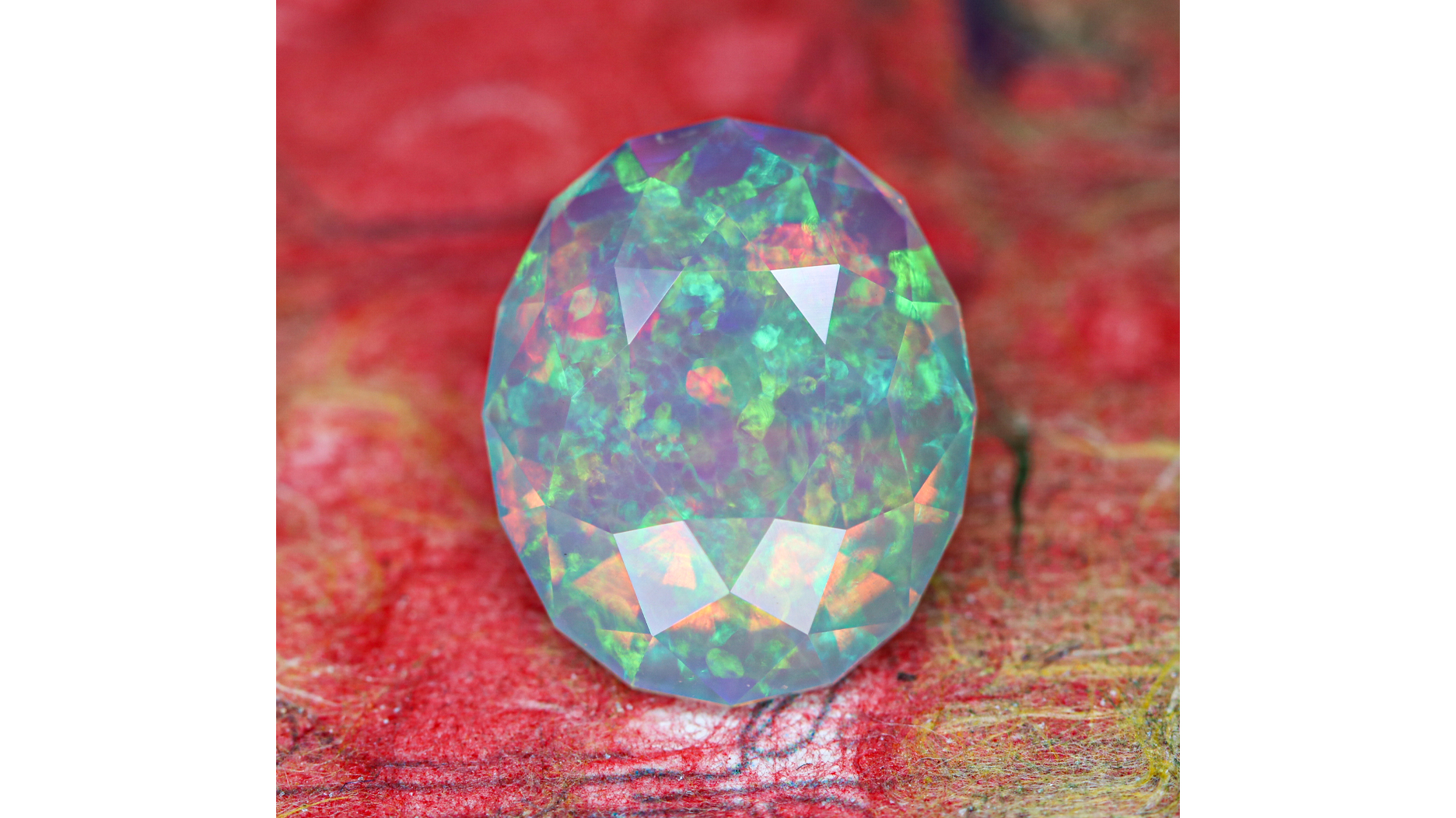
A 4.30-carat Ethiopian opal cut by Sloane
However, succeeding as a full-time cutter means finding a balance between taking orders that keep the lights on and developing a signature that sets you apart as an artist.
“I modify every pattern I find,” she says. “The outline shape might be traditional for setting purposes, but I try and keep all of my facet designs different.”
Taking initiative is also a big part of making life work as a full-time lapidarist.
Sloane recently traveled to the Montana sapphire mines to meet with producers and build relationships at the source.
“That’s probably one of the biggest gestures possible for these mine owners, [traveling] to meet them and to try and build this connection. It’s like bringing flowers to someone. I think that’s just something that makes them remember you better.”
Building a Brand Nadine Marshall, 19, is also a full-time gemstone cutter.
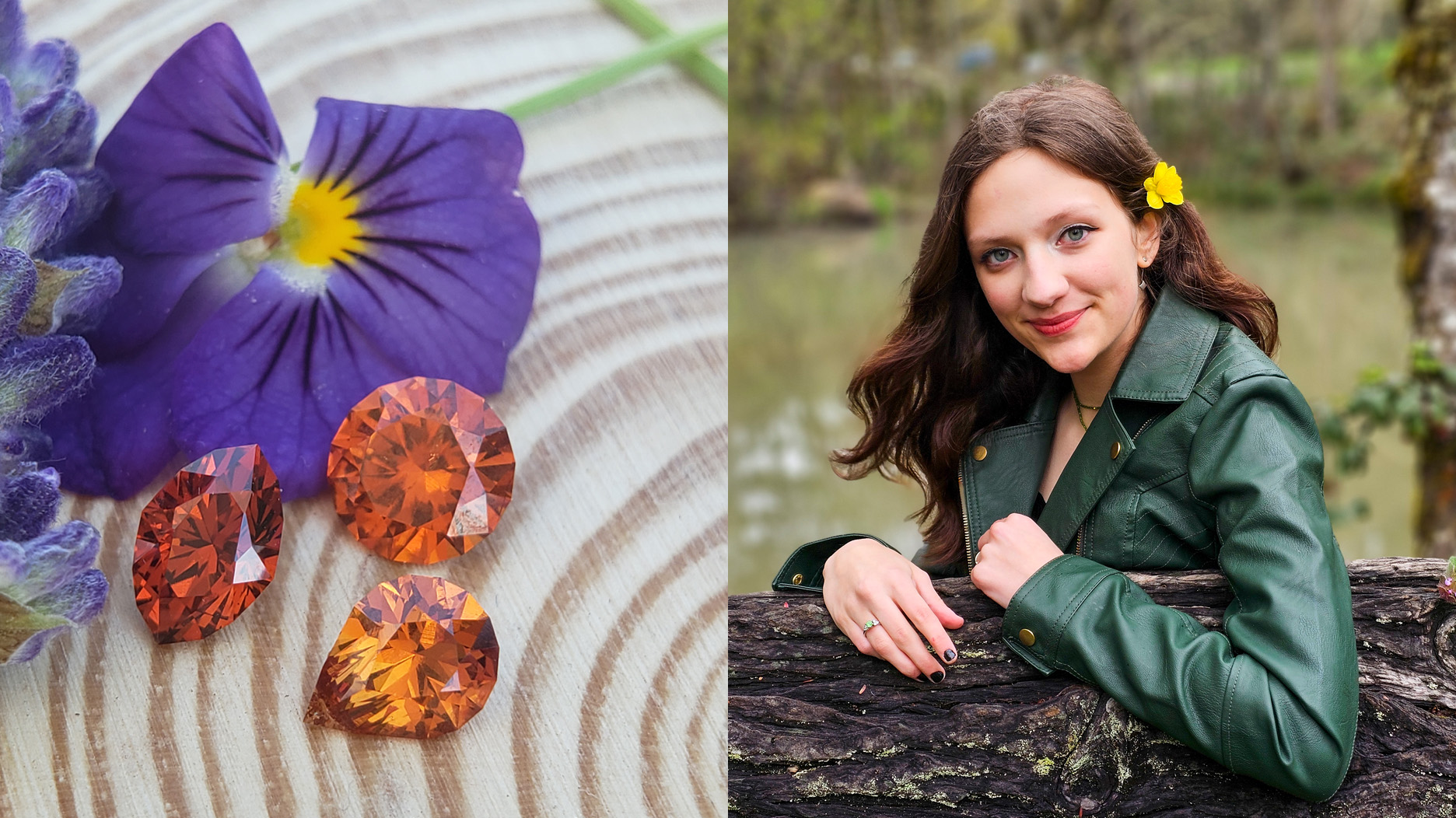
Nadine Marshall (right) has been cutting gemstones since she was 12. At left, three spessartine garnets—a 1.60-carat marquise, a 1.60-carat pear, and a 1.66-carat round—from the Little Three mine in San Diego, California, faceted by her.
She grew up rock hunting and gold panning in the Pacific Northwest and took an interest in faceting at an early age.
At 12, Marshall began taking lessons from a friend she and her father met through a rock club.
“He was willing to teach me for free; he loved that I was willing to learn at a young age,” she says. “He said, ‘Nobody is willing to do this anymore, it’s a dying trade, so I’m more than happy to teach you.’”
He taught her the basics but also encouraged her to follow the flow of a gemstone, a skill that helped when she began creating her own cuts.
She eventually got her own gem-cutting machine, and her parents helped her set up an Instagram account, @ilovegreenrocks.
People she met via social media encouraged her to go to Tucson, including rough gemstone dealer Joe Henley, who wanted to help her get there.
He donated a few pieces of rough for her to facet and they auctioned them off. The proceeds paid for her family to travel to Arizona.
“That’s when I really decided that building a business could help me get into the industry the way I want to, but it could also help me pay for my education and the opportunities that I’m going to struggle getting, because I wasn’t born [into this] and I have to learn things the hard way,” Marshall says.
“I have to learn things through trial and error, and that can be expensive.”
A 1.3-carat tsavorite faceted in a design Marshall calls “The North Star”
Marshall earned her graduate gemologist diploma from GIA this past November and has been refining not only her craft, but also her image and brand.
Her focus this year is to produce and promote more of the cuts she has created.
“When I first started, my cutting quality was very different than what it is now. Sometimes I find myself trying to reintroduce my stuff to people who saw it when I was younger but not [lately].”
Like Sloane, Marshall has pursued relationships with Montana sapphire miners, and both women have worked with Anza Gems, Monica Stephenson’s company that partners with artisanal mining communities in East Africa.
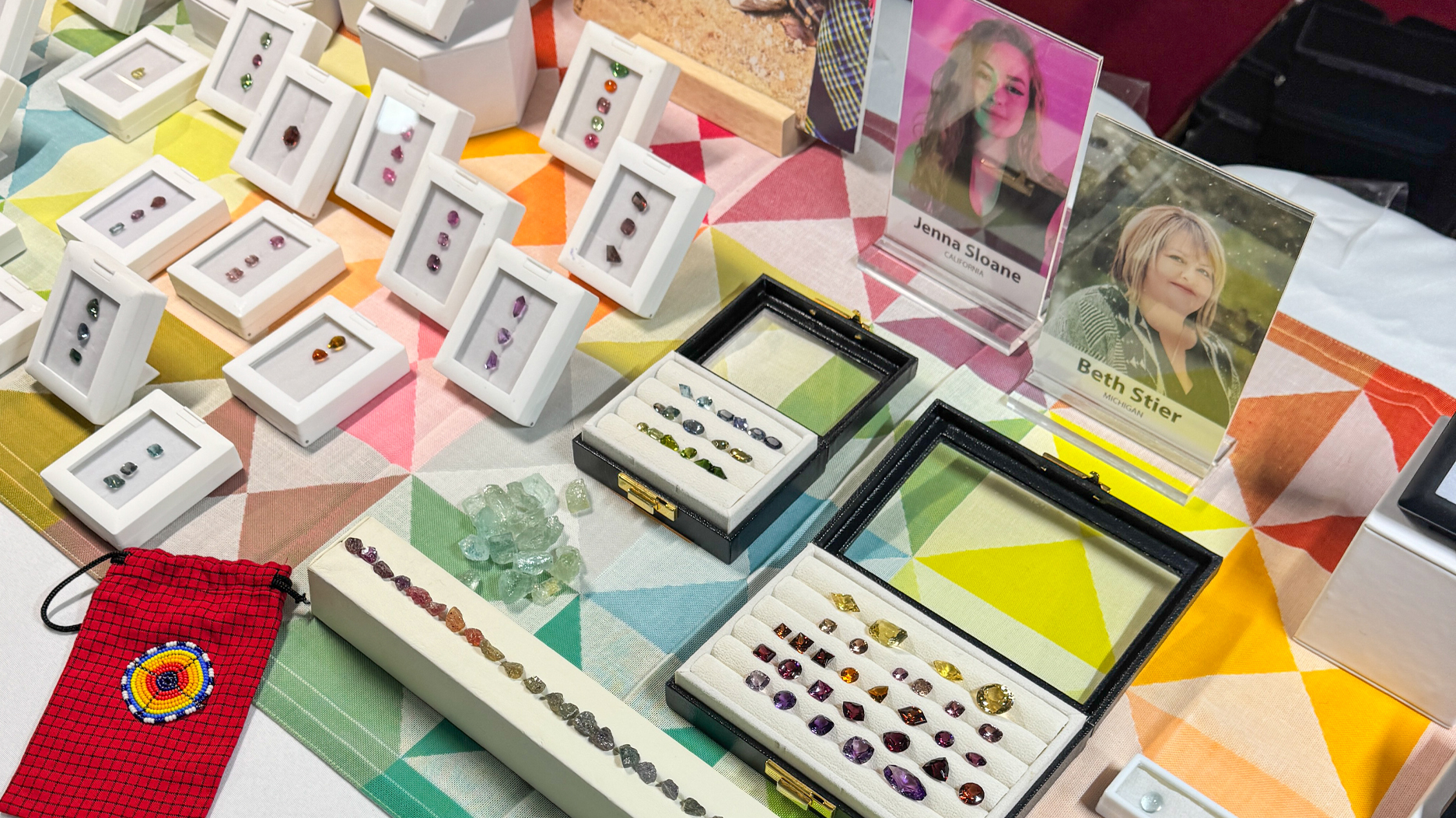
When exhibiting at trade shows, like the Ethical Gem Fair, Anza Gems displays photos of its cutters next to the stones they faceted.
Anza Gems' booth at the Ethical Gem Fair, with photos of gem cutters Jenna Sloane and Beth Stier displayed next to their work
It’s an effort to highlight the company’s role in the stone’s mine-to-market journey—the fact that there is a real person, whether in a workshop overseas or in a garage in Oregon, behind the gem’s transformation—and invites an appreciation for the craft.
The American Cost Working with a cutter in America is generally a more expensive option than using a commercial operation overseas, a fact not lost on jewelers across the country.
Premiums are often for legitimate reasons, like higher operating costs and extraordinary quality, especially for artists producing fantasy cuts, which are exclusive, labor-intensive, and often made for high-end, one-of-a-kind designer pieces.
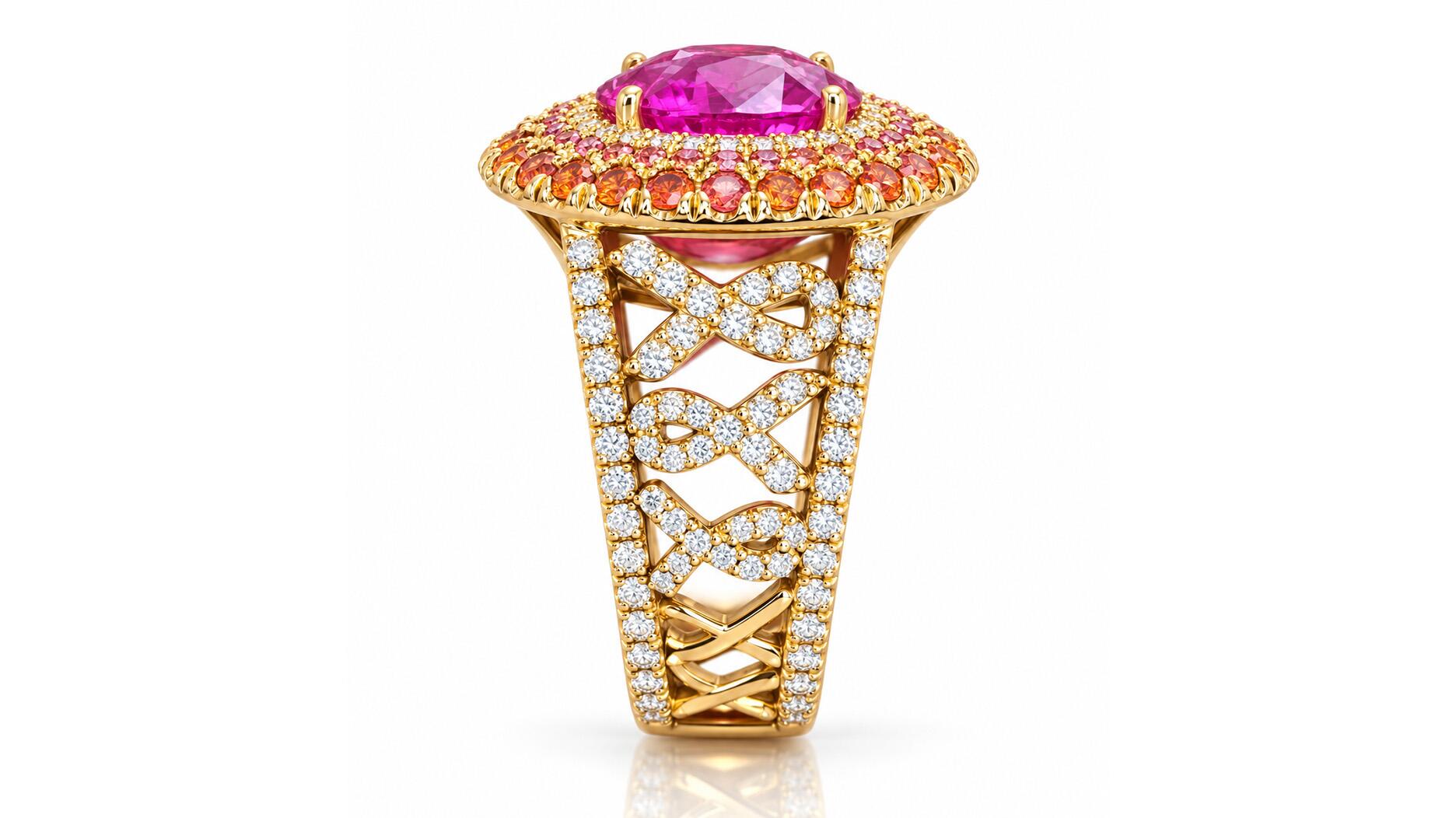
An 18-karat gold ring from Olivia Sugarman Jewelry titled “She Who Dares the Night” set with a 2.37-carat heated sapphire from Dry Cottonwood Creek, Montana, cut by Jenna Sloane, and accented with 1 carat of D-color, VS clarity diamonds and 1 carat of color-enhanced diamonds.
However, for the average business transaction, education on the retail side of the business can provide context for the upcharge.
“Part of our whole educational outreach is trying to train people about quality factors, like what makes a good stone,” Prim says.
“A customer who doesn’t know about cutting quality, like a jeweler, wouldn’t even look at our stones, because they wouldn’t even have an incentive to seek more than what you can buy [on the mass market].”
On the cutter side, a bit of ego management may be the key to achieving competitive pricing.
Prim recalls Lisa Elser, a Vancouver-based cutter, sharing her stance on pricing.
“She is very vocal and consistent about saying, ‘The stones are not worth more money because I cut them. A stone is a stone. I cut it well, so it’s worth the maximum of that stone, but that doesn’t mean I get to double the price because my name’s attached to it.’”
Prim says they aim to show small jewelers in Lyon that their prices are not that much higher, and the quality is a lot better.
“That’s incentive, and that’s something they can tell their customers, ‘This is the best, and you can have it. And it’s not that much more, but it is more.’”
Supporting American cutters is insurance for those preserving not only the craft of gemstone cutting but also valuable relationships with the artists.
“It’s going to be really hard for me to be in the business if [my clients] go for a cheaper gem than the American-cut gem,” Sloane says.
“If I can’t afford to keep running my business, I won’t be there in the future to repair their gems or cut custom stones [when the cheaper gem needs to be replaced.]
“Sometimes it feels like a negative thing to say, but people need to recognize that I can only be there for them in the future if they’re here for me now.”