







GradingOct 07, 2020
Gübelin to Develop AI Approach to Gemstone Analysis GradingApr 19, 2021
Here’s What SSEF Found When It Studied High-Quality Afghan Emeralds
The Swiss lab reveals how stones from the Panjshir Valley are both different from and similar to emeralds from other places.


The Swiss Gemmological Institute SSEF released the results of what it claims is the first published study of a new high-quality emerald type from Afghanistan. At left, an Afghan emerald, and at right, a Colombian emerald (Image courtesy SSEF)
Basel, Switzerland—The Swiss Gemmological Institute SSEF conducted intensive research on high-quality Afghan emeralds and has released its findings for the trade.
In 2017, the lab started seeing a new kind of emerald from the country’s Panjshir Valley, nearly all of which were fine quality, SSEF Director Michael Krzemnicki said.
As they do for all less familiar material, researchers at SSEF decided to study the emeralds extensively to find ways to separate them from others.
This was necessary, especially given that the material is occasionally mislabeled as Colombian, Krzemnicki said.
The high-quality Panjshir Valley emeralds closely match the South American specimens in terms of both their appearance and their gemological properties, SSEF said.
The Swiss lab conducted the study by testing and analyzing more than 100 gem-quality emeralds from the Panjshir Valley, ranging from 1 carat to more than 30 carats.
It also looked at emeralds from Colombia, Zambia, Ethiopia, Pakistan and Davdar, China, the lab confirmed.
To develop reliable ways to distinguish the Afghan emeralds from others, SSEF compared emeralds from different origins through laser-ablation mass spectrometry using its state-of-the-art GemTOF instrument and by applying a machine-learning statistical algorithm for data processing and visualization.
By compiling 56 elements in the calculation, the Afghan emeralds could be characterized and differentiated from other emeralds, particularly Colombian.
The research team reported that gemologically, Afghan emeralds are characterized by spiky to tubular fluid inclusions and very fine and parallel hollow channels, both of which are similar to inclusions that can be found in Colombian emeralds.
But though the team also occasionally saw “chevron-like” growth features, the honeycomb-like pattern characteristic of Colombian emeralds—a graining often known in the trade as “gota de aceite”—has not yet been spotted in Afghan emeralds.
Related stories will be right here …
In 2017, the lab started seeing a new kind of emerald from the country’s Panjshir Valley, nearly all of which were fine quality, SSEF Director Michael Krzemnicki said.
As they do for all less familiar material, researchers at SSEF decided to study the emeralds extensively to find ways to separate them from others.
This was necessary, especially given that the material is occasionally mislabeled as Colombian, Krzemnicki said.
The high-quality Panjshir Valley emeralds closely match the South American specimens in terms of both their appearance and their gemological properties, SSEF said.
The Swiss lab conducted the study by testing and analyzing more than 100 gem-quality emeralds from the Panjshir Valley, ranging from 1 carat to more than 30 carats.
It also looked at emeralds from Colombia, Zambia, Ethiopia, Pakistan and Davdar, China, the lab confirmed.
To develop reliable ways to distinguish the Afghan emeralds from others, SSEF compared emeralds from different origins through laser-ablation mass spectrometry using its state-of-the-art GemTOF instrument and by applying a machine-learning statistical algorithm for data processing and visualization.
By compiling 56 elements in the calculation, the Afghan emeralds could be characterized and differentiated from other emeralds, particularly Colombian.
The research team reported that gemologically, Afghan emeralds are characterized by spiky to tubular fluid inclusions and very fine and parallel hollow channels, both of which are similar to inclusions that can be found in Colombian emeralds.
But though the team also occasionally saw “chevron-like” growth features, the honeycomb-like pattern characteristic of Colombian emeralds—a graining often known in the trade as “gota de aceite”—has not yet been spotted in Afghan emeralds.
Chemically, the composition of Afghan emeralds is “astonishingly similar” to Colombian emeralds, SSEF said, adding only a careful trace element analysis of the stones would reveal the differences.
The most common difference between the two is a higher iron concentration in the Afghan samples when compared to Colombian.
On the other hand, the iron content of the Afghan emeralds was still much smaller than that found in those mined in Zambia, Brazil, and Russia, among others.
In addition to being able to separate Afghan emeralds from other sources, another big takeaway for Krzemnicki from the study had to do with quality and origin.
He said one thing he found striking was the “exceptional quality” of some of the stones—very clear and with few fissures.
The study is a good reminder, he reiterated, that there are always new sources, or new pockets from existing sources, being discovered, as is the case with this Afghan material, bringing the market new fine quality stones.
“I feel the trade has, let’s say, a wrong idea of quality. Colombian emerald has a certain historical notion, but at the very end, when we talk about quality, other sources can deliver the best quality. For example, sapphires from Madagascar can be super quality. These Afghanistan emeralds can too. It doesn’t always have to be these old, established sources.”
SSEF called its research the first detailed study characterizing this type of emerald from Afghanistan.
Krzemnicki said they wanted to make the information available to other labs or trade members involved in gem testing; the scientists published their methods and findings in the most recent edition of the Gemmological Association of Great Britain’s Journal of Gemmology.
A PDF of the article can be found on the Gem-A website as well as the SSEF website.


More on Grading

The Latest

SourcingOct 27, 2026
De Beers Celebrates the Holidays With New ‘Desert Diamonds’ CampaignThe “Icons” holiday campaign spotlights four classic diamond jewelry styles reimagined in “Desert Diamond” tones.


IndependentsOct 27, 2026
Solomon Brothers Acquires Mervis Diamond ImportersSolomon Brothers, which has three stores in the Metro Atlanta area, said it may continue to acquire other independent jewelers.


IndependentsOct 27, 2026
Gabriel & Co. Supports Charity Partner DKMS With Gala, New JewelsThe fine jewelry brand raised $2.3 million at its annual gala that supports the nonprofit’s fight against blood cancer and blood disorders.
Brought to you by
A Diamond Is Forever Launches 2026 Holiday Campaign Championing Natural DiamondsA Diamond Is Forever's holiday campaign reimagines natural diamond icons for a new generation celebrating individuality.


Events & AwardsOct 27, 2026
JFC Announces 2027 ‘Facets’ HonoreesThe annual fundraising event is slated for June 6, 2027, at The Venetian Resort in Las Vegas.
Weekly QuizOct 22, 2026
This Week’s QuizTest your jewelry news knowledge by answering these questions.


CollectionsOct 26, 2026
Bliss Lau’s ‘Vantage’ Point Is the Hawaiian HorizonIn her “Vantage” collection, Lau explores heritage, identity, and inner strength through designs featuring blue-green Guatemalan jade.

MajorsOct 26, 2026
Tiffany & Co. Takes Consumers Behind the ScenesThe jeweler gave the public backstage tours of its flagship store and its design and innovation workshop as part of LVMH’s open house.


Brought to you by
Open an Account, Get $50 Off Your First Order. No Code Needed.Built on Relationships. Refined by Craft.


Events & AwardsOct 26, 2026
Support JFC’s ‘Monster Mash Challenge,’ If You DareVote for which jewelry professional should dress up as a monster to support Jewelers for Children’s annual Halloween fundraiser.

MajorsOct 23, 2026
PGI USA Set to Close at Year’s EndThe closure is part of a global restructuring that also includes PGI winding down its operations in Japan, South Korea, and Hong Kong.

SourcingOct 23, 2026
Rachel Chalchinsky’s ‘Survivor Tribute’ RingThe ring, our Piece of the Week, was designed by eight-year breast cancer survivor Rachel Chalchinsky of Color Source Gems.

TechnologyOct 23, 2026
JA Unveils New Website, LogoThe website offers enhanced member benefit access, industry directories, educational resources, a job board, and access to the MJSA Journal.


FinancialsOct 23, 2026
Kering’s Jewelry Sales Up Double Digits in Q3Boucheron and Pomellato had a strong third quarter, with Kering looking at jewelry as an increasingly important part of its portfolio.

CrimeOct 22, 2026
Jeweler Shot and Killed in His Suburban Cincinnati Store Tara Sinchuri was the owner of Everest Jewels in Fairfield, Ohio, and a father of three. He was found dead in his store on Tuesday.

MajorsOct 22, 2026
Neiman Marcus Has Gifts for the Jewelry Lover Who Has EverythingBespoke experiences from Buccellati and Verdura are on the retailer’s 2026 “Fantasy Gifts” list.

Events & AwardsOct 22, 2026
JIS Fall 2026 Reports Record-Breaking Attendance The number of participants at the fall show was up 12 percent.

CollectionsOct 22, 2026
Billie Eilish, Finneas Co-Design Collection for John HardyThe Academy and Grammy award-winning siblings have collaborated with John Hardy on a new jewelry line inspired by their personal style.


PodcastsOct 21, 2026
Episode 10: This Episode Is Haunted Diana Singer shared the stories of two “cursed” diamonds on this month’s podcast, which was inexplicably riddled with technical issues.

IndependentsOct 21, 2026
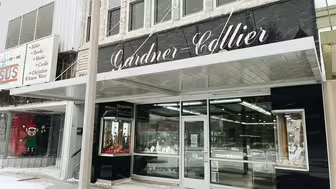
Gardner-Collier Jewelry to Close After 9 Decades in BusinessThe family-owned jeweler has three locations across Missouri and Iowa.

SourcingOct 21, 2026
Venetia Mines Final Carats Ahead of 2-Year ShutdownThe De Beers-owned diamond mine in South Africa is being put on ice as part of a round of previously announced cost-cutting measures.

CollectionsOct 21, 2026
Helzberg, Nordstrom Carrying New Jewelry Collection From Off-WhiteThe collection centers designs with clean geometric lines, chunky sculptural pieces, and recognizable details from the luxury fashion brand.
SourcingOct 21, 2026
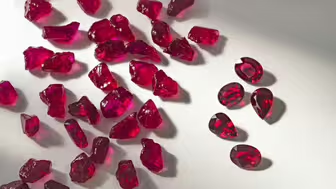
Gemfields’ Mixed-Quality Ruby Auction Earns $52MThe miner said it saw particularly strong prices for larger, fine-quality rubies at the sale.

CrimeOct 20, 2026
Security Guard Charged With Murder in Shooting at Texas MallThe guard opened fire on a man who was smashing a jewelry display case at La Gran Plaza in Fort Worth last week, police said.

IndependentsOct 20, 2026
David Gardner’s Jewelers Unveils Newly Expanded, Revamped ShowroomThe Texas jeweler added 2,000 square feet to its reimagined showroom, complete with a new design studio and an event space.

SourcingOct 20, 2026
The $50M Victoria’s Secret ‘Fantasy Bra’ By The NumbersJacob & Co.'s diamond masterpiece is the most expensive Fantasy Bra ever worn on the Victoria’s Secret Fashion Show runway.

CollectionsOct 20, 2026
Mignon Faget’s Collection Chooses Handmade Over AIThe “Atelier” collection was inspired by the tools, rituals, and objects in an artist’s studio as a quiet rebuttal to an automated world.
MajorsOct 19, 2026
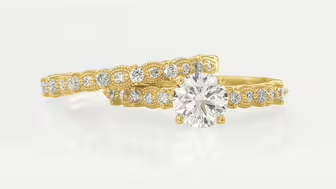
The Knot to Acquire Rival Wedding Planning Platform ZolaThe pending acquisition is an “exciting opportunity” for wedding vendors to grow their business, said The Knot Worldwide’s CEO.