






EditorsApr 15, 2025
Q&A: Bogolo Joy Kenewendo on Making Deals, Marketing DiamondsEditorsJun 11, 2025
Q&A: Al Cook on Differentiating Natural Diamonds, Traceability, and Tariffs
The De Beers Group CEO discusses the company’s new “beacon” program, the likelihood diamonds will be exempt from tariffs, and “Origin.”


De Beers Group CEO Al Cook speaking Friday at a breakfast held during JCK Las Vegas. The diamond miner and marketer made a number of announcements at the show, including the introduction of its first “beacon” program in 16 years.
Last week during the Las Vegas shows, De Beers Group announced the launch of its first “beacon” program in 16 years.
Called “Ombré Desert Diamonds,” it will emphasize using off-white, champagne, and brown-colored diamonds of varying shades in jewelry.
The concept of setting jewelry with diamonds that exist in the space between colorless/near colorless and fancy colored is certainly not new, but this move by De Beers comes at a time when the natural diamond industry needs to distinguish itself from lab-grown diamonds, which are, by and large, D-F color and of high clarity.
It also comes at a time when De Beers needs to sell more diamonds, period.
On a personal level, I like the idea.
I think diamonds that have a “faint,” “very light,” or “light” tint (per the GIA color grading scale) bring warmth to pieces, particularly when set in yellow gold.
Generally speaking, I’ve always thought the industry put too much emphasis on “perfection” in gemstones, whether diamonds or colored gemstones. Flaws make everything more interesting.
In Las Vegas, De Beers also formally launched what it is calling “Origin, De Beers Group,” its branded loose polished diamond program that will allow retailers to tell consumers where their diamond was mined, cut, and polished, and whom it benefited along the way.
Following these announcements made at the company’s annual breakfast event on Friday, I had the chance to sit down with CEO Al Cook to talk “Desert Diamonds,” “Origin,” tariffs, and more.
This interview has been edited for length and clarity.
Michelle Graff: I was really interested when I saw the release come out this morning about the “Ombré Desert Diamonds” because I was just talking to a designer who said her clients now want a diamond with a little tint of color because they want people to know it’s a natural diamond.
Can you talk a little bit about the thought process behind the new beacon program?
Al Cook: I'll come on to your point on differentiating from lab grown. But it starts with a fundamental belief that people want to know the source of what they purchase. Whether it’s, where’s the cotton in the shirt from, or where’s my meat being bred, or my coffee being grown? People want that.
And it’s remarkable that when people go into a diamond store, their question is, where’s this diamond from? When we couple that with our pride in producing diamonds in South Africa, Botswana, Namibia, and Canada, it seems to us there’s a fantastic story to tell that hasn’t been told well enough.
We would like the customers of the future to ask the question, “Where is my diamond from? Is it ethical? Is it sustainable? And is it responsible?”
We’re incredibly fortunate that so many of our diamonds come from beautiful African deserts.
Our thinking then evolved to, how can we reflect the deserts in the jewelry itself and this rich array of colors, from brown through to cream?
[It] gave us this opportunity to tell the story of the desert, tell the story of the countries that it came from, the hand that crafted it, the land that grew it, the people who benefited [from it].
As we evolved our thinking and talked to Signet [Jewelers], which has been a wonderful partner, we developed this theme.
We discussed the point you made, which is that in a world where people want to be unique, in a world where people are rejecting commodities, in a world where people want something that’s real and reflects them, a “Desert Diamond” does exactly that.
Its color will be unique, and its origin will be unique, and it contrasts completely with the endless array of commoditized lab grown.
I think we’re already seeing the bifurcation [between natural and lab-grown diamonds] that we always talked about emerging. You can go down the corridor and get lab grown for $45 a carat now.
This is really a way of saying, look, we’re not really worrying about that. We’re about creating a new level of desire for diamonds.
The final point I’ll make is, De Beers has traditionally brought to the diamond industry what we call beacons, starting with the three-stone ring.
They’ve been wonderful, but they’ve always been about design.
This is going to be about design—we’re working to create the most beautiful designs out there—but it is also about the source.
[We think] that combination of a design that reflects the source is magical. In the early tests we’ve done, it has had very magical scores.
Called “Ombré Desert Diamonds,” it will emphasize using off-white, champagne, and brown-colored diamonds of varying shades in jewelry.
The concept of setting jewelry with diamonds that exist in the space between colorless/near colorless and fancy colored is certainly not new, but this move by De Beers comes at a time when the natural diamond industry needs to distinguish itself from lab-grown diamonds, which are, by and large, D-F color and of high clarity.
It also comes at a time when De Beers needs to sell more diamonds, period.
On a personal level, I like the idea.
I think diamonds that have a “faint,” “very light,” or “light” tint (per the GIA color grading scale) bring warmth to pieces, particularly when set in yellow gold.
Generally speaking, I’ve always thought the industry put too much emphasis on “perfection” in gemstones, whether diamonds or colored gemstones. Flaws make everything more interesting.
In Las Vegas, De Beers also formally launched what it is calling “Origin, De Beers Group,” its branded loose polished diamond program that will allow retailers to tell consumers where their diamond was mined, cut, and polished, and whom it benefited along the way.
Following these announcements made at the company’s annual breakfast event on Friday, I had the chance to sit down with CEO Al Cook to talk “Desert Diamonds,” “Origin,” tariffs, and more.
This interview has been edited for length and clarity.
Michelle Graff: I was really interested when I saw the release come out this morning about the “Ombré Desert Diamonds” because I was just talking to a designer who said her clients now want a diamond with a little tint of color because they want people to know it’s a natural diamond.
Can you talk a little bit about the thought process behind the new beacon program?
Al Cook: I'll come on to your point on differentiating from lab grown. But it starts with a fundamental belief that people want to know the source of what they purchase. Whether it’s, where’s the cotton in the shirt from, or where’s my meat being bred, or my coffee being grown? People want that.
And it’s remarkable that when people go into a diamond store, their question is, where’s this diamond from? When we couple that with our pride in producing diamonds in South Africa, Botswana, Namibia, and Canada, it seems to us there’s a fantastic story to tell that hasn’t been told well enough.
We would like the customers of the future to ask the question, “Where is my diamond from? Is it ethical? Is it sustainable? And is it responsible?”
We’re incredibly fortunate that so many of our diamonds come from beautiful African deserts.
Our thinking then evolved to, how can we reflect the deserts in the jewelry itself and this rich array of colors, from brown through to cream?
[It] gave us this opportunity to tell the story of the desert, tell the story of the countries that it came from, the hand that crafted it, the land that grew it, the people who benefited [from it].
As we evolved our thinking and talked to Signet [Jewelers], which has been a wonderful partner, we developed this theme.
We discussed the point you made, which is that in a world where people want to be unique, in a world where people are rejecting commodities, in a world where people want something that’s real and reflects them, a “Desert Diamond” does exactly that.
Its color will be unique, and its origin will be unique, and it contrasts completely with the endless array of commoditized lab grown.
I think we’re already seeing the bifurcation [between natural and lab-grown diamonds] that we always talked about emerging. You can go down the corridor and get lab grown for $45 a carat now.
This is really a way of saying, look, we’re not really worrying about that. We’re about creating a new level of desire for diamonds.
The final point I’ll make is, De Beers has traditionally brought to the diamond industry what we call beacons, starting with the three-stone ring.
They’ve been wonderful, but they’ve always been about design.
This is going to be about design—we’re working to create the most beautiful designs out there—but it is also about the source.
[We think] that combination of a design that reflects the source is magical. In the early tests we’ve done, it has had very magical scores.
“For a new generation that asks a lot of questions, there’s this extraordinary ability to tell the stories no one ever really asked about when we started advertising a hundred years ago.” — Al Cook, De Beers Group
MG: I also think the “Desert Diamonds” initiative is interesting because my long-term view of the industry is, everybody has been so focused on colorless, high clarity, we don’t want to see inclusions. This is such a departure, but I think it probably is going to work well on a younger generation who maybe didn’t grow up with that as much.
As a geologist, when you came into the industry, is that one of the observations you made—diamonds have this beautiful spectrum of color, spectrum of clarity; why are we putting such an emphasis on this perfect end when you could be selling it all? Was that something that struck you?
AC: It’s a really interesting question.
As a geologist … we could only get up to eight on the [Mohs hardness] scale because as geology students, we couldn’t afford to have diamonds in our labs.
But certainly, I find it absolutely fascinating how the forces of the earth and these little sources of other elements can completely change the color of a diamond.
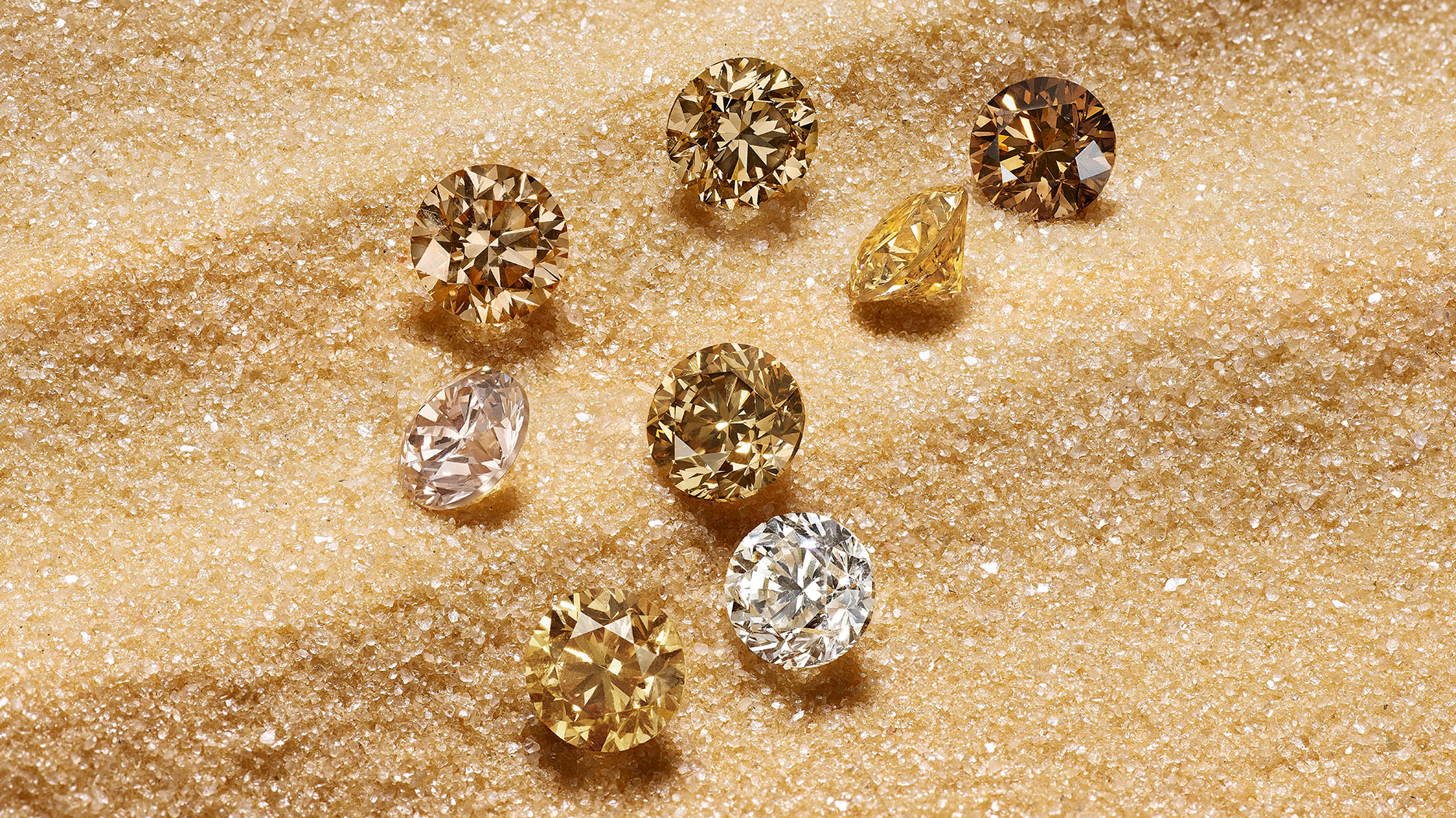
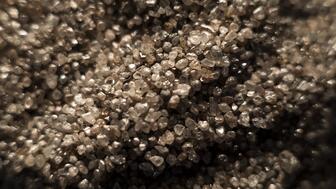
De Beers released this image of loose diamonds in conjunction with the launch of “Ombré Desert Diamonds,” its first industry-wide marketing push (also known as a “beacon” program) since “Everlon” in 2009.
Every D-E-F diamond is unique if you look deep enough inside it, but it just becomes incredible when you look at the array of colors out there and the causes of that, whether that’s a little bit of boron coming into the carbon lattice or it’s the bending of the lattice itself under pressure that gives deeper colors.
For a new generation that asks a lot of questions … there’s this extraordinary ability to tell the stories no one ever really asked about when we started advertising a hundred years ago.
MG: Tell me a little bit about how “Origin, De Beers Group” is going to work. If I’m a retailer, do I have to opt into the program? And does it cost money?
AC: Retailers have to participate with us in the program.
We’re working on the terms with them, but the idea is very much a win-win. So far, retailers’ interest in “Origin” has surpassed our highest expectations.
We want to work with the very finest quality of retailers; this isn’t a big-box play.
We’re going to focus it initially in the United States, where we know we’ve got very discerning clients and people who really care about this.
MG: Is there a set of diamonds in a showcase with the “Origin” label and does that retailer then explain to their customers, if you buy this diamond, you can trace it all the way to the mine? Is that how it’s going to work?
AC: We go further than that. What we provide, based on Tracr, is a digital experience available on mobile or on [desktop] computers. It enables us, for every single diamond, to tell a very unique story.
If you come into a store in California or Long Island, [New York], you’ll have a QR code that you scan, and that will tell you the complete story of the diamond.
It’ll start with where it was brought out of the ground, how it was cut, and you’ll get the stories of the people who were around the mine, whose lives were benefited by this, who contributed to the creation of your diamond.
We’ll take that story through the cutting and the polishing and all the benefits that are brought there.
We’ll show you the rough, and we’ll use our proprietary alpha technology to show you the rough with the polished together so you can see the complete story.
What you get, I think, are two things. Firstly, you get the guarantee that your diamond is ethical, sustainable, and responsible, but beyond that, you get this extraordinary story that no other producer of diamonds can match, and certainly lab grown could never match. It’s an amazing story of the good that the diamond has done.
So, when you’re buying a diamond to commemorate this special moment in your life, you’re also benefiting so many other people in their lives.
MG: When do you think this will be launched?
AC: We’ve actually been running pilots for the last 12 months, so quietly just testing the concept.
MG: When do you expect a wide rollout?
AC: Second half of this year.
“We’re confident that as the noise abates, there’s every justification and every reason that a product that cannot be created in America won’t be tariffed.” — Al Cook, De Beers Group
MG: I want to discuss a couple other topics outside of the new beacon program and “Origin, De Beers Group.”
In an interview you gave to CNBC recently, you said you felt confident diamonds entering the U.S. would be exempt from tariffs. Why do you feel that way?
AC: So, first and foremost, there are no commercial diamond deposits in the United States. There’s no kimberlite in the United States, and there never will be.
However many tariffs we put on diamonds, we can never create an American diamond mining job. There are no jobs to protect or jobs to grow and therefore, a tariff would simply become a consumption tax.
One thing that this American government has been very responsible about is protecting the American consumer. We’re confident that as things settle through, as the noise abates, there’s every justification and every reason that a product that cannot be created in America won’t be tariffed.
MG: I know De Beers has lobbyists in Washington, D.C. Is this the feedback you’re getting from them?
AC: We talk to a lot of governments. I speak regularly to the United States government but also to the United Kingdom and the Indian governments, which are doing trade negotiations with the United States. I think all of that gives us confidence that we’ll get to a very sensible outcome.
MG: I appreciate that, but I feel that the U.S. government right now is somewhat unpredictable; it seems like things change overnight. Do you ever worry that you think it’s going to go one way and then, at the last minute, it goes the other way?
AC: We look at the long term. Undoubtedly, the world is very volatile at the moment. We look through that volatility and that’s why I say ultimately, we think we’ll get to the right place in this.
MG: Where is De Beers regarding the pending separation from Anglo American?
AC: My sense is the first half of next year is likely to be the culmination of the separation process.
We’re quite fortunate that we’ve got two very responsible owners that both care a lot about De Beers. As a result of that, I feel like things are going in the right direction.
Having said that, the volatility of the last six months has just meant that we need to proceed in the right way and make sure that we get the right buyer rather than right now.


More on Editors



The Latest

Policies & IssuesOct 08, 2026
Third Wave of IEEPA Tariff Refunds Begins This round of tariff refunds is for importers that have sued over IEEPA tariffs in the Court of International Trade and won.

CollectionsOct 08, 2026
Brent Neale’s New Collection Goes ‘Back to Basics’It revisits the brand’s most requested silhouettes, from "Pillow"-set necklaces and bracelets to "Signature"-set rings and earrings.


SourcingOct 08, 2026
Ethical Gem Fair Heads Back to BrooklynThe trade-only event includes buying opportunities as well as educational sessions on artisanal mining, the new Paraíba source, and more.


Brought to you by
Meet Gemology’s Next Generation Microscope: GIA® Gemolite® NXT Professional EditionExperience gemstones with greater precision and comfort than ever before.


Events & AwardsOct 08, 2026
Pattons Fine Jewelry Sweeps Local Design ContestAra Chanakian, a jeweler at Pattons, took home top honors in every category at Jewelers of Louisiana’s annual jewelry design competition.
Weekly QuizOct 08, 2026
This Week’s QuizTest your jewelry news knowledge by answering these questions.


AuctionsOct 08, 2026
Reba McEntire’s Jewelry, Watches Head to Julien’s AuctionsThe live charity benefit sale in Nashville will also feature gowns, boots, and other memorabilia from the country music legend.


Supplier BulletinOct 08, 2026
Overnight Mountings’ Bridal Builder Helps Jewelers Turn Custom Design into a Hands-On Selling ExperienceSponsored by Overnight Mountings
Brought to you by
Your Piece Could Be the One Editors Talk AboutSubmit your pieces for a chance to win in this year's competition.


Policies & IssuesOct 07, 2026
The Plumb Club Amplifies Its Voice as Geopolitical Pressures MountThe supplier organization recently joined JA and JVC to have more input on political issues affecting the jewelry industry.

CollectionsOct 07, 2026
Blue Nile, Royal Asscher Collection Highlights Natural Diamond BeautyBlue Nile, a Signet Jewelers-owned brand, is now Royal Asscher’s exclusive licensed retailer in North America.

CollectionsOct 07, 2026
4 Standout Pieces in Audemars Piguet’s First High Jewelry Collection “Royal Oak” pays homage to the brand’s most popular watch model using 18-karat gold as well as diamonds, emeralds, and sapphires.

MajorsOct 07, 2026
Empire Safe & Vault Promotes Juan Morales to CEOAs part of the transition, Joseph Nicosia has stepped into the role of COO.

SourcingOct 07, 2026
AGTA Extends Deadline for 2026 Spectrum Awards EntriesParticipants now have until Oct. 14 to complete their submissions.

Policies & IssuesOct 06, 2026
6 Charged in Connection to String of New Jersey Smash-and-GrabsThe alleged thieves used crow bars and sledgehammers to smash into jewelry stores across the state.

ColumnistsOct 06, 2026
Sherry Smith: Is the Consumer Really Trading Up?Ahead of the holidays, Smith urges jewelers to take a hard look at who’s buying jewelry, what they’re purchasing, and who’s stopped buying.


SourcingOct 06, 2026
DDG Taps Influencers for ‘My Diamond Does Good’ CampaignIn the new consumer-facing campaign, four fashion and lifestyle creators share the stories behind their natural diamond pieces.

MajorsOct 06, 2026
Frederick Goldman Names COO, CMOFGI President John Orrico is also leaving the company after more than 13 years.

Events & AwardsOct 06, 2026
JIS Fall Returns to MiamiThe 2026 edition will feature presentations on alternative materials and design trends, as well as pop-up activations on the show floor.

SourcingOct 05, 2026
De Beers to Take Full Ownership of Gahcho KuéIt is the last fully operational diamond mine in Canada following the recent closures of Ekati and Diavik.

AuctionsOct 05, 2026
The Star Cats of the Sandy Lerner AuctionThese jewels stood out at Bonhams’ sale of the cat-loving tech entrepreneur’s collection of objects depicting the feline form.

CollectionsOct 05, 2026
Sorellina Writes Another Love Letter for ‘Postscript’ CollectionThe fine jewelry brand has expanded the collection that debuted at Couture with four new designs based on its most popular styles.

SourcingOct 05, 2026
Bruce Bridges Joins CIBJO BoardThe AGTA president was elected for a two-year term on the board of directors.

SourcingOct 02, 2026
De Beers, National Geographic Society Renew Okavango Eternal Partnership The partnership, a pledge to protect Africa’s Okavango River Basin, has been extended for an additional five years.

MajorsOct 02, 2026
Pandora Opens New $150M Manufacturing Facility in VietnamThe new facility, its first outside of Thailand, will boost its manufacturing capacity by 50 percent.

TrendsOct 02, 2026
Hearts On Fire Celebrates 30th Anniversary With Heart PendantThe special-edition “Dream” pendant, our Piece of the Week, was created to mark Hearts On Fire’s 30-year milestone with 30 diamonds.

CrimeOct 01, 2026
Police Looking for 4 Suspects in $600K Smash-and-Grab RobberyDubai Jewelers in Springfield, Virginia, was once again the target of an armed robbery.

SurveysOct 01, 2026
Rolex Ranks Among Most Recommended Brands in US, Survey Says YouGov’s 2026 U.S. Most Recommended Brands report’s out, and a fast-fashion giant is sitting at No. 1 while Rolex is just shy of the top 5.