





ColumnistsMay 28, 2024
The Smart Lab: How to Effectively Navigate Jewelry Brand Requests ColumnistsJun 11, 2024
Vegas Musings: Equal Parts Noise and Inspiration
Fresh off Jewelry Market Week 2024, Peter Smith separates the positive—retail and product innovation—from the positively annoying.


Peter Smith is an industry consultant, speaker, sales trainer, and author. He can be reached via email at TheRetailSmiths@gmail.com.
When I’m invited to speak at events or conferences, I make sure to tell those booking me that I’m not a motivational speaker; I am a truth-teller. I’m a pragmatic optimist who believes in calling it like I see it.
I highlight the stuff we ought to be doing more of, and the stuff we ought to be doing less of.
I connect the dots of what I’m seeing and hearing, aligned with what the data tells me, and I make conclusions and recommendations about the best path forward.
For the life of me, I’ll never understand why anyone ever entertains fire-breathing zealots as speakers, those self-assured prognosticators sharing doomsday scenarios—falling skies and the benefits of underground bunkers, generously stocked with canned goods and bottled water.
Dale Carnegie wrote, “Any fool can criticize, condemn and complain, and most fools do.”
Why we feel the need to put them on stages, let alone on stages during Jewelry Market Week in Las Vegas, will forever be a curiosity to me.
They are demotivating charlatans, and I wish institutions and businesses would stop booking them, not because we should hide from hard truths, but because despite hard truths, there is much to be excited about in our industry.
As the ancient Greek philosopher Heraclitus observed, “No man ever steps in the same river twice.”
Change is ever-present, and, if we’re being honest, we’ve not always handled change well in our business.
I remember the diamond conference at the Park Plaza in New York in 2004 when the collected angst from retailers about selling diamonds online bordered on insane, as though we could somehow stem the emergence of e-commerce itself.
There are still legions of retailers who won’t entertain jewelry brands (we’ll leave the definition of “brands” for another column) believing, despite compelling evidence to the contrary, that young shoppers prefer to reward a jeweler’s buying acumen, their skill with a loupe, and the merits of generics in place of relevant brand experiences.
Having just returned from JCK Las Vegas, I’m still reeling from the chatter and anxiety about lab-grown diamonds.
We have, once again, chosen to address an innovation in moral terms—righteously indignant, or vehemently pro-lab grown.
Or, worse yet, we behave like lambs to the slaughter. “What can I do?” one retailer shrugged. “I can’t get my salespeople to sell natural diamonds.”
Related stories will be right here …
I highlight the stuff we ought to be doing more of, and the stuff we ought to be doing less of.
I connect the dots of what I’m seeing and hearing, aligned with what the data tells me, and I make conclusions and recommendations about the best path forward.
For the life of me, I’ll never understand why anyone ever entertains fire-breathing zealots as speakers, those self-assured prognosticators sharing doomsday scenarios—falling skies and the benefits of underground bunkers, generously stocked with canned goods and bottled water.
Dale Carnegie wrote, “Any fool can criticize, condemn and complain, and most fools do.”
Why we feel the need to put them on stages, let alone on stages during Jewelry Market Week in Las Vegas, will forever be a curiosity to me.
They are demotivating charlatans, and I wish institutions and businesses would stop booking them, not because we should hide from hard truths, but because despite hard truths, there is much to be excited about in our industry.
As the ancient Greek philosopher Heraclitus observed, “No man ever steps in the same river twice.”
Change is ever-present, and, if we’re being honest, we’ve not always handled change well in our business.
I remember the diamond conference at the Park Plaza in New York in 2004 when the collected angst from retailers about selling diamonds online bordered on insane, as though we could somehow stem the emergence of e-commerce itself.
There are still legions of retailers who won’t entertain jewelry brands (we’ll leave the definition of “brands” for another column) believing, despite compelling evidence to the contrary, that young shoppers prefer to reward a jeweler’s buying acumen, their skill with a loupe, and the merits of generics in place of relevant brand experiences.
Having just returned from JCK Las Vegas, I’m still reeling from the chatter and anxiety about lab-grown diamonds.
We have, once again, chosen to address an innovation in moral terms—righteously indignant, or vehemently pro-lab grown.
Or, worse yet, we behave like lambs to the slaughter. “What can I do?” one retailer shrugged. “I can’t get my salespeople to sell natural diamonds.”
Allow me to connect a few dots.
Lab-grown diamonds are not going anywhere. They won’t disappear because a few zealots preach firebrand from the pulpit, but they are having an impact.
Retailers need a strategy to deal with them, beyond casting aspersions and making predictions based more on hope than expectation.
We are deep into a two-decades long stagnation of foot traffic into retail jewelry stores. The decline is not chronic, but it is a factor.
We could, of course, blame the internet, but the reality is a strong online presence is a boon to great retail experiences, not a detriment. It helps drive qualified customers into physical stores.
The real issue with lab-grown diamonds shouldn’t be a moral conundrum, but the downward pressure on average tickets should be concerning.
If you are seeing fewer customers (and your conversion rate is not materially changing) and your average ticket is declining, that is troubling math, and we ought to be concerned about that.
I steadfastly encourage you to have a strategy to manage and mitigate anything that contributes to a reduction of your average ticket.
You are the captain of your ship, and you should steer a course, with or without lab-grown diamonds, that ensures the health of your business in the near and long term.
As for the good news from the show, there were two things that moved me.
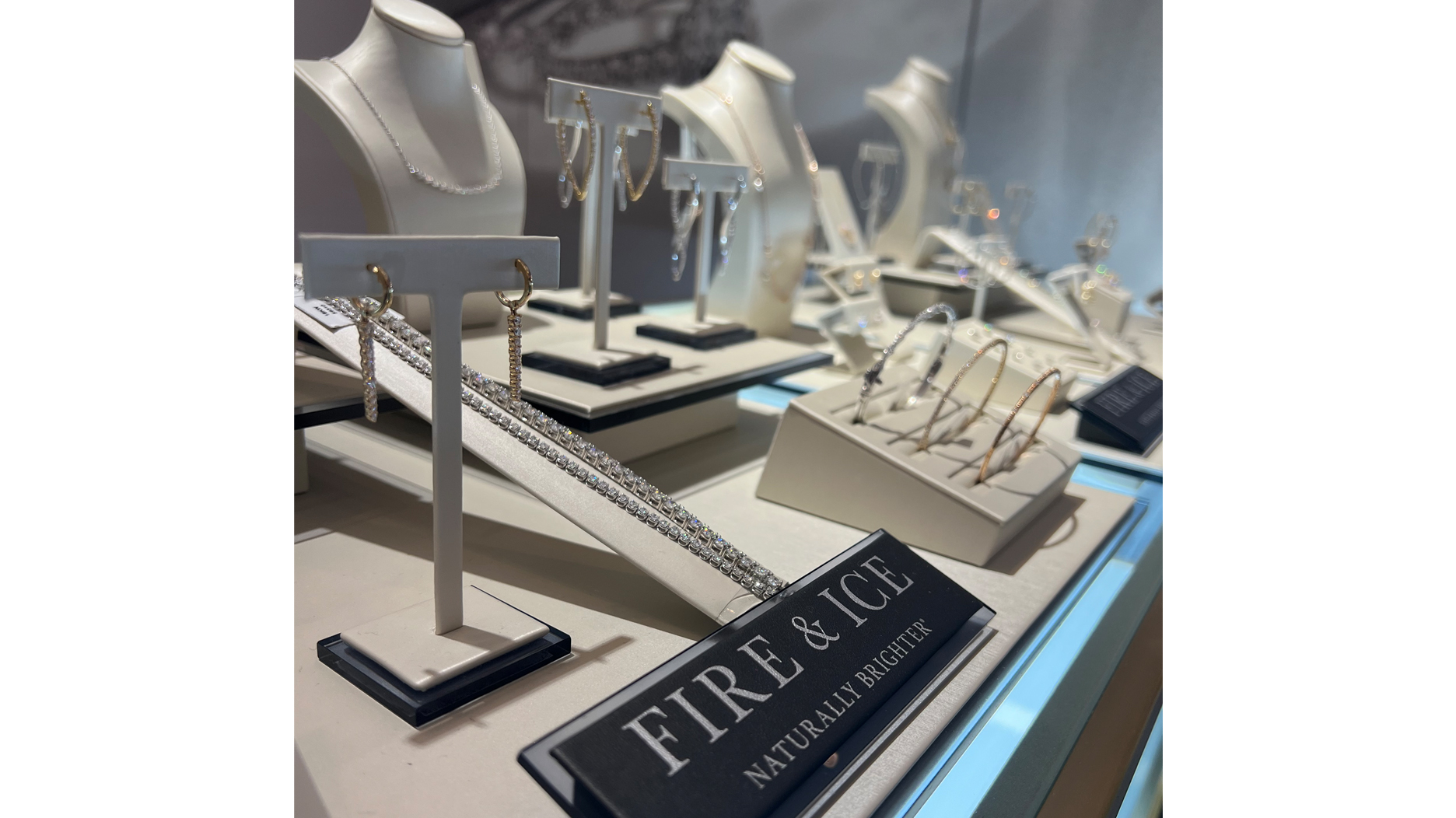
The Fire & Ice display at the Luxury show at JCK Las Vegas 2024
In the first instance, my client, Fire & Ice, reintroduced the diamond brand, first launched 10 years ago, to great fanfare from current and prospective clients.
There was no shortage of irony in witnessing such excitement for a story in a natural diamond brand against the backdrop of all the lab-grown noise. It’s the most excited I’ve ever been about a finished diamond story.
The second big theme for me was the sheer number of retailers who enthusiastically shared their plans to build new stores.
I’ve attended JCK for decades and I cannot recall a time when there was this much enthusiasm for innovative retail developments.
Having retailers walk me through their plans is always fun, but even more so when the quantity of them is exceeded only by the quality of most of the projects.
We’ve seen a gradual decline in the total number of retailers for years, even as total sales in jewelry and watches is today far in excess of pre-pandemic highs.
There is no question that we are experiencing a significant shift to quality in our business, and I’m all for it.
Happy retailing!


More on Columnists



The Latest

SurveysOct 16, 2026
How Inflation, Gas Prices Will Affect Holiday Sales The NRF is expecting holiday sales to increase this year, but consumers and retailers alike are facing Grinch-like headwinds.

CollectionsOct 16, 2026
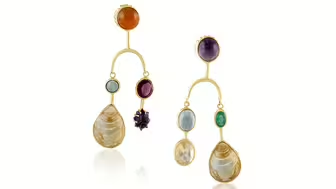
Christina Puchi’s Earrings Hold the UniverseOur Piece of the Week gathers the planets, represented by a variety of colored gemstones, in a pair of 14-karat yellow gold earrings.

IndependentsOct 16, 2026
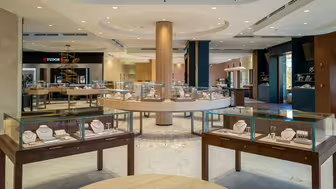
Reeds Jewelers Expands, Relocates FlagshipThe New York-based jeweler is moving its Amherst flagship store to a larger location in nearby Snyder.


Brought to you by
Meet Gemology’s Next Generation Microscope: GIA® Gemolite® NXT Professional EditionExperience gemstones with greater precision and comfort than ever before.


MajorsOct 16, 2026
Katy Chen Appointed Executive Vice President of Graff USA Chen, who worked at Cartier and Tiffany & Co., will lead retail sales and operations for the luxury jeweler’s 11 U.S. stores.

Weekly QuizOct 15, 2026
This Week’s QuizTest your jewelry news knowledge by answering these questions.


IndependentsOct 15, 2026
Retailer Hall of Fame 2026: Amy and Elise Greenberg For 40 years, sisters Amy and Elise Greenberg have helmed their 126-year-old family business, leading with appreciation and integrity.
WatchesOct 15, 2026
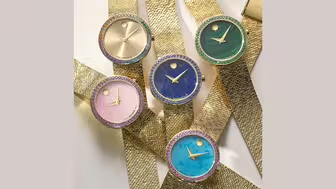
Stephanie Gottlieb’s New Movado Watches Are Made for Your Wrist StackMovado teamed up with the New York-based fine jewelry designer on a new collection of Movado Museum Velura watches.
Brought to you by
Your Piece Could Be the One Editors Talk AboutSubmit your pieces for a chance to win in this year's competition.

SourcingOct 15, 2026
Signet Jewelers, Richemont May Join Bidder for De Beers, Report SaysThe two companies are reportedly in talks to join the Global Diamond Consortium, led by former De Beers CEO Gareth Penny, as per Bloomberg.
CollectionsOct 15, 2026
Wolf x Marla Aaron's New Jewelry Box Is for Some (Not All) of Your ThingsThe “Some of the Things” box follows the two larger “Everything” box designs with the look and function of antique sewing and toolboxes.

IndependentsOct 14, 2026
Retailer Hall of Fame 2026: Coleman and Mitchell ClarkFourth-generation jewelers Coleman and Mitchell Clark exemplify the best qualities of their predecessors: humility, modesty, and confidence.

SourcingOct 14, 2026
Manuel Marcial de Gomar, ‘The Emerald Whisperer,’ Dies at 90The gem hunter, whose 70-year career was defined by adventure and exploration, is remembered for his steadfast faith and sense of wonder.

FinancialsOct 14, 2026
LVMH’s Jewelry Brands Turn in ‘Very Good’ Performance in Q3 Tiffany & Co. continued its full-scale store renovation project while Bulgari’s high jewelry collection generated “record-breaking revenue.”

Events & AwardsOct 14, 2026
Chicago Responsible Jewelry Conference Releases 2026 ProgramThis year’s sessions feature leading voices from human rights, legal, and conservation organizations.

MajorsOct 13, 2026
David Webb Owner Purchases Lugano JewelryThe high-end jewelry retailer was sold to private investment firm Middle West Partners and a group of longtime clients.

Lab-GrownOct 13, 2026
Stephanie Gottlieb Takes Lab-Grown Diamond Collection WholesaleThe jewelry designer has partnered with Sofer Jewelry to distribute her 85-piece lab-grown diamond collection.

IndependentsOct 13, 2026
Retailer Hall of Fame 2026: Sean DunnDunn, this year’s Single-Store Independent inductee, is passionate about innovation and telling the story of natural diamonds.

AuctionsOct 13, 2026
Christie's Geneva To Auction 'Bulgari Pink' DiamondThe 24-carat fancy intense pink diamond ring could fetch up to $18 million at the November sale.

IndependentsOct 13, 2026
Greenwich St. Jewelers’ New Candle Smells Like HomeThe “Island Jewel” candle honors New York City and Puerto Rico and raises money for the island’s water relief efforts.
TechnologyOct 13, 2026
GemFind Is a New JA Member Benefit Partner The partnership will give JA members access to preferred pricing, exclusive benefits, technology solutions, education, and resources.

SurveysOct 09, 2026
These Will Be the 10 Busiest Days for In-Store Shopping This Holiday SeasonStores should expect to see the most customers on Nov. 27, and Christmas week is expected to be hectic too, as Dec. 25 falls on a Friday.

CollectionsOct 09, 2026
Elisa Solomon Collabs With Serendipity 3 on ‘Frozen Hot Chocolate’ CharmThe charm, our Piece of the Week, features brown diamond frozen hot chocolate topped with white diamond whipped cream and a ruby straw.

AuctionsOct 09, 2026
8-Carat Blue Diamond Goes Unsold at UK Jewelry Auction The top lot of Elmwood’s recent fine jewelry sale in London was a 1.84-carat, D color Tiffany & Co. solitaire diamond ring.

WatchesOct 09, 2026
Movado to Sell Majority Stake in Ebel for $66.5MThe watch company agreed to sell a 95 percent interest to a group comprised of F.P. Journe, Chanel, and Swiss watch exec Pierre Jacques.

Policies & IssuesOct 08, 2026
Third Wave of IEEPA Tariff Refunds Begins This round of tariff refunds is for importers that have sued over IEEPA tariffs in the Court of International Trade and won.

CollectionsOct 08, 2026
Brent Neale’s New Collection Goes ‘Back to Basics’It revisits the brand’s most requested silhouettes, from "Pillow"-set necklaces and bracelets to "Signature"-set rings and earrings.

SourcingOct 08, 2026
Ethical Gem Fair Heads Back to BrooklynThe trade-only event includes buying opportunities as well as educational sessions on artisanal mining, the new Paraíba source, and more.