






Recorded WebinarsMar 31, 2023
Watch: How Is the Industry Doing When It Comes to Diversity?Policies & IssuesJun 07, 2023
Experts Discuss Disability Inclusion at WJA’s Las Vegas Breakfast
Members gathered Friday morning at JCK to hear from Diversability founder Tiffany Yu and Molly Kettle of Gamut Management.


WJA members stand with GAMUT management’s Molly Kettle (second from left) and entrepreneur and disability advocate Tiffany Yu (fifth from left) following their panel talk at WJA’s second “Generating Community Impact Breakfast” at JCK.
Las Vegas—This year at JCK, the Women’s Jewelry Association (WJA) hosted its second “Generating Community Impact Breakfast” and the topic was disability inclusion in the jewelry and watch industries.
Members gathered in the San Polo Ballroom Friday morning to hear from entrepreneur and disability rights advocate Tiffany Yu and GAMUT management Chief Operating Officer Molly Kettle on the types of mindset shifts needed, from designing adaptive jewelry to marketing jewelry and timepieces for people with disabilities.
Yu is the founder of Diversability, a social enterprise to advocate for equality for people with disabilities.
In 2020, she was the co-chair of the World Economic Forum Sustainable Development Impact Summit.
Started in 2019, GAMUT management is a consulting, talent management and accreditation company helping businesses to become “disability confident” in how they engage with, create adaptive products for, and represent people with disabilities. Yu is represented by the company as well.
To begin the breakfast, Yu presented and then the two joined a panel led by WJA Executive Director Jennifer Markas.
Related stories will be right here …
Members gathered in the San Polo Ballroom Friday morning to hear from entrepreneur and disability rights advocate Tiffany Yu and GAMUT management Chief Operating Officer Molly Kettle on the types of mindset shifts needed, from designing adaptive jewelry to marketing jewelry and timepieces for people with disabilities.
Yu is the founder of Diversability, a social enterprise to advocate for equality for people with disabilities.
In 2020, she was the co-chair of the World Economic Forum Sustainable Development Impact Summit.
Started in 2019, GAMUT management is a consulting, talent management and accreditation company helping businesses to become “disability confident” in how they engage with, create adaptive products for, and represent people with disabilities. Yu is represented by the company as well.
To begin the breakfast, Yu presented and then the two joined a panel led by WJA Executive Director Jennifer Markas.
In her opening presentation, Yu recalled how, at 9 years old, she was in a car accident that left her paralyzed in one arm.
“You can either age into disability or it can happen very suddenly,” Yu said. “A lot of people will say that disability is one of these intersections and one of these communities that you can join at any time.”
Yu said disability is not just about the health condition; it’s the interaction with a person’s physical, external environment that creates a disability experience.
She cited the 2022 “Disability Impacts All of Us” report by the Centers for Disease Control and Prevention, which estimates that one in four American adults are living with a disability.
“We, as disabled people, actually control about $21 billion of discretionary income, which is more than the Black ($3 billion) and Latinx markets ($16 billion) combined,” Yu said.
“We’ve got some money and we want to spend it at your companies.”
Yu showed the audience a video of how she puts on a necklace, demonstrating how clasps can be difficult for people with certain disabilities.
She said adaptive design—things like curb cuts, electric toothbrushes, bendy straws and speech-to-text—while good for business, also are helpful for people, like moms with strollers, who don’t have a disability.
During the panel discussion, Kettle echoed that sentiment, stating that while there does need to be a shift in product design and marketing strategy, there’s also “an innovation aspect,” that everyone can benefit from an easier clasp.
“If we’re all lucky enough to age, we will probably join the disability community at some stage in our life,” Kettle said.
“If you want true change and you want to make more money, hire disabled people into your company.” — Tiffany Yu, Diversability
Also, people with different disabilities have different ways of engaging with products.
As an example, Yu shared the story of a company that created a tactile watch for someone with impaired sight.
“It has little bumps all on it where someone who is blind is able to wear the watch and be able to tell what the hour it is,” Yu said. “The interesting thing about that watch is, I still can’t put it on.
“What is inclusive and adaptive for one person might not be for another. And that highlights the diversity within disability. We all want to wear watches and we all want to know what time it is, but we all have different ways of engaging with that product.”
Adaptive products also should include cohesive marketing with disability representation.
“How inviting you are being? What kinds of products do you have to offer?” Kettle said. “There’s a whole new customer base you could reach by providing products those customers may need as well as targeting them in a different way.”
Yu prompted the audience to think, “If Tiffany is your archetype of customer, how would she engage with the product?”
For true inclusivity, intentionality is necessary at every level, including internally.
“I spend most of my time talking about disability at work because to me, that’s the place I think will create the biggest type of systemic change,” Yu said. “So, if you want true change and you want to make more money, hire disabled people into your company.”
Kettle reminded attendees that disability inclusion is a journey and a process, but what matters is the intentional effort and the willingness to listen to feedback.
“It’s thinking about it in your day-to-day, in your plans, in your strategies and what it looks like,” she said. “Wherever you are is OK.”
The WJA breakfast was sponsored by the Natural Diamond Council, Jewelers Vigilance Committee, Guild+Facet, V&A Group, SHR Jewelry Group and the JCK Industry Fund.


More on Policies & Issues


The Latest

CollectionsOct 26, 2026
Bliss Lau’s ‘Vantage’ Point Is the Hawaiian HorizonIn her “Vantage” collection, Lau explores heritage, identity, and inner strength through designs featuring blue-green Guatemalan jade.


MajorsOct 26, 2026
Tiffany & Co. Takes Consumers Behind the ScenesThe jeweler gave the public backstage tours of its flagship store and its design and innovation workshop as part of LVMH’s open house.


Events & AwardsOct 26, 2026
Support JFC’s ‘Monster Mash Challenge,’ If You DareVote for which jewelry professional should dress up as a monster to support Jewelers for Children’s annual Halloween fundraiser.


Brought to you by
A Diamond Is Forever Launches 2026 Holiday Campaign Championing Natural DiamondsA Diamond Is Forever's holiday campaign reimagines natural diamond icons for a new generation celebrating individuality.


MajorsOct 23, 2026
PGI USA Set to Close at Year’s EndThe closure is part of a global restructuring that also includes PGI winding down its operations in Japan, South Korea, and Hong Kong.
Weekly QuizOct 22, 2026
This Week’s QuizTest your jewelry news knowledge by answering these questions.


SourcingOct 23, 2026
Rachel Chalchinsky’s ‘Survivor Tribute’ RingThe ring, our Piece of the Week, was designed by eight-year breast cancer survivor Rachel Chalchinsky of Color Source Gems.

TechnologyOct 23, 2026
JA Unveils New Website, LogoThe website offers enhanced member benefit access, industry directories, educational resources, a job board, and access to the MJSA Journal.

Brought to you by
Open an Account, Get $50 Off Your First Order. No Code Needed.Built on Relationships. Refined by Craft.


FinancialsOct 23, 2026
Kering’s Jewelry Sales Up Double Digits in Q3Boucheron and Pomellato had a strong third quarter, with Kering looking at jewelry as an increasingly important part of its portfolio.

CrimeOct 22, 2026
Jeweler Shot and Killed in His Suburban Cincinnati Store Tara Sinchuri was the owner of Everest Jewels in Fairfield, Ohio, and a father of three. He was found dead in his store on Tuesday.

MajorsOct 22, 2026
Neiman Marcus Has Gifts for the Jewelry Lover Who Has EverythingBespoke experiences from Buccellati and Verdura are on the retailer’s 2026 “Fantasy Gifts” list.

Events & AwardsOct 22, 2026
JIS Fall 2026 Reports Record-Breaking Attendance The number of participants at the fall show was up 12 percent.

CollectionsOct 22, 2026
Billie Eilish, Finneas Co-Design Collection for John HardyThe Academy and Grammy award-winning siblings have collaborated with John Hardy on a new jewelry line inspired by their personal style.

PodcastsOct 21, 2026
Episode 10: This Episode Is Haunted Diana Singer shared the stories of two “cursed” diamonds on this month’s podcast, which was inexplicably riddled with technical issues.

IndependentsOct 21, 2026
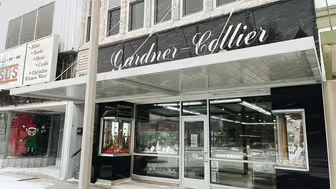
Gardner-Collier Jewelry to Close After 9 Decades in BusinessThe family-owned jeweler has three locations across Missouri and Iowa.

SourcingOct 21, 2026
Venetia Mines Final Carats Ahead of 2-Year ShutdownThe De Beers-owned diamond mine in South Africa is being put on ice as part of a round of previously announced cost-cutting measures.

CollectionsOct 21, 2026
Helzberg, Nordstrom Carrying New Jewelry Collection From Off-WhiteThe collection centers designs with clean geometric lines, chunky sculptural pieces, and recognizable details from the luxury fashion brand.
SourcingOct 21, 2026
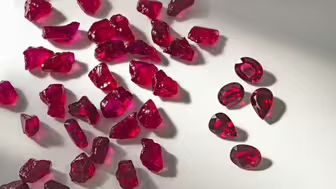
Gemfields’ Mixed-Quality Ruby Auction Earns $52MThe miner said it saw particularly strong prices for larger, fine-quality rubies at the sale.

CrimeOct 20, 2026
Security Guard Charged With Murder in Shooting at Texas MallThe guard opened fire on a man who was smashing a jewelry display case at La Gran Plaza in Fort Worth last week, police said.
IndependentsOct 20, 2026
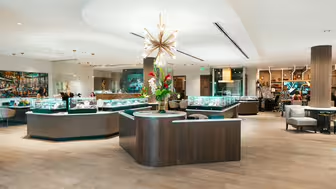
David Gardner’s Jewelers Unveils Newly Expanded, Revamped ShowroomThe Texas jeweler added 2,000 square feet to its reimagined showroom, complete with a new design studio and an event space.
SourcingOct 20, 2026
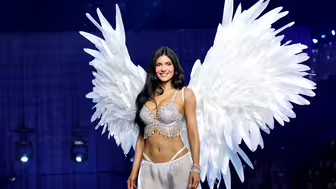
The $50M Victoria’s Secret ‘Fantasy Bra’ By The NumbersJacob & Co.'s diamond masterpiece is the most expensive Fantasy Bra ever worn on the Victoria’s Secret Fashion Show runway.

CollectionsOct 20, 2026
Mignon Faget’s Collection Chooses Handmade Over AIThe “Atelier” collection was inspired by the tools, rituals, and objects in an artist’s studio as a quiet rebuttal to an automated world.
MajorsOct 19, 2026
The Knot to Acquire Rival Wedding Planning Platform ZolaThe pending acquisition is an “exciting opportunity” for wedding vendors to grow their business, said The Knot Worldwide’s CEO.

SourcingOct 19, 2026
Jewelry Design Competition Show Airs in Thailand"The Secret Gems" features eight Thai jewelry brands paired with a team of young craftspeople who create jewelry together to win challenges.

CollectionsOct 19, 2026
John Hardy Enters the Medallion Chat With Talisman Collection The brand’s “Modern Talisman” capsule collection introduces pendants inspired by the mythology, natural world, and spiritual ethos of Bali.
IndependentsOct 19, 2026
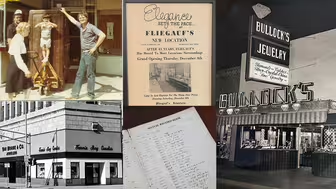
The Stories of 5 Jewelers Celebrating Their Centennials in 2026Independent jewelers from New Mexico to New Jersey answer the question: What has kept your store in business for 100 years?

SurveysOct 16, 2026
How Inflation, Gas Prices Will Affect Holiday Sales The NRF is expecting holiday sales to increase this year, but consumers and retailers alike are facing Grinch-like headwinds.