







SourcingMar 09, 2021
De Beers Group on How It Will Achieve Gender Parity by 2030SourcingJul 29, 2021
De Beers Owner Pumping $100M Into Sustainability Projects
Anglo American is donating the money to its Anglo American Foundation, which supports projects in countries where it mines.


Anglo American is donating $100 million to its foundation, which supports programs focused on education, health, and the environment in the countries where it operates. For De Beers, some of that money could go toward its “Building Forever” goals, which include achieving gender parity by 2030.
London—Anglo American, the mining conglomerate that owns De Beers, announced Thursday that it is giving $100 million to its foundation to support environmental, health and education programs worldwide.
The Anglo American Foundation supports projects in all the countries where Anglo mines, explores or has joint ventures involving gems and minerals.
The massive donation will help to accelerate the company’s progress toward reaching the United Nations’ Sustainable Development Goals, with a particular emphasis on programs that empower women, young people, and vulnerable groups in the countries where Anglo has business.
Projects that could get a boost from the $100 million donation include those focused on the environment, community health, education and skills, livelihoods, and institutional capacity development.
For De Beers specifically, the money would be put toward the company’s “Building Forever” goals, which focus on protecting the environment, leading ethical practices across the jewelry industry, and increasing diversity among its ranks.
Related stories will be right here …
The Anglo American Foundation supports projects in all the countries where Anglo mines, explores or has joint ventures involving gems and minerals.
The massive donation will help to accelerate the company’s progress toward reaching the United Nations’ Sustainable Development Goals, with a particular emphasis on programs that empower women, young people, and vulnerable groups in the countries where Anglo has business.
Projects that could get a boost from the $100 million donation include those focused on the environment, community health, education and skills, livelihoods, and institutional capacity development.
For De Beers specifically, the money would be put toward the company’s “Building Forever” goals, which focus on protecting the environment, leading ethical practices across the jewelry industry, and increasing diversity among its ranks.
Anglo American made the announcement as it reported its half-year financial results Thursday.
The results showed what has been said time and again since the start of the pandemic—consumers are buying diamond jewelry, which means De Beers is mining and selling more rough.
In the first half of the year, production was up 37 percent to 15.4 million carats from 11.3 million carats in the same period in 2020. Compared to 2019, production is essentially flat.
Total first-half revenue approached $3 billion, well ahead of $1.2 billion in the first half of 2020.
Profitability also returned for De Beers.
Anglo reported underlying EBITDA of $610 million for De Beers in the first half of the year, compared with just $2 million in the same period last year.
Overall, the long-term outlook for diamond jewelry demand remains “positive,” Anglo said, while supply is expected to remain flat or shrink.
“The longer-term transformation of the diamond value chain continues, including a sustained focus on stock level optimization and distribution of polished diamonds and diamond jewelry, increased online purchasing, and greater focus on the provenance and sustainability credentials of companies and their products,” the company said.
Among De Beers’ growth projects is construction of a new mining vessel for Marine Namibia.
Construction began in 2019 and is on schedule, Anglo American said, with the vessel expected to be in Cape Town, South Africa by the third quarter 2021 for the fitting of the mining and plant equipment.
Mine life extension projects include the transition from open-pit to underground mining at Venetia in South Africa, which is expected to add an extra 95 million carats and extend the mine’s life to 2045.
Underground mining at Venetia is expected to commence in 2023.
There is also the Cut-9 extension at Jwaneng in Botswana, which will extend the life of the mine to 2036 and produce an extra 51 million carats of diamonds.
First production from the extended cut is expected in 2027.
More on Sourcing

The Latest

MajorsOct 23, 2026
PGI USA Set to Close at Year’s EndThe closure is part of a global restructuring that also includes PGI winding down its operations in Japan, South Korea, and Hong Kong.

TechnologyOct 23, 2026
JA Unveils New Website, LogoThe website offers enhanced member benefit access, industry directories, educational resources, a job board, and access to the MJSA Journal.


FinancialsOct 23, 2026
Kering’s Jewelry Sales Up Double Digits in Q3Boucheron and Pomellato had a strong third quarter, with Kering looking at jewelry as an increasingly important part of its portfolio.


Brought to you by
A Diamond Is Forever Launches 2026 Holiday Campaign Championing Natural DiamondsA Diamond Is Forever's holiday campaign reimagines natural diamond icons for a new generation celebrating individuality.


CrimeOct 22, 2026
Jeweler Shot and Killed in His Suburban Cincinnati Store Tara Sinchuri was the owner of Everest Jewels in Fairfield, Ohio, and a father of three. He was found dead in his store on Tuesday.
Weekly QuizOct 22, 2026
This Week’s QuizTest your jewelry news knowledge by answering these questions.


MajorsOct 22, 2026
Neiman Marcus Has Gifts for the Jewelry Lover Who Has EverythingBespoke experiences from Buccellati and Verdura are on the retailer’s 2026 “Fantasy Gifts” list.

Events & AwardsOct 22, 2026
JIS Fall 2026 Reports Record-Breaking Attendance The number of participants at the fall show was up 12 percent.

Brought to you by
Open an Account, Get $50 Off Your First Order. No Code Needed.Built on Relationships. Refined by Craft.


CollectionsOct 22, 2026
Billie Eilish, Finneas Co-Design Collection for John HardyThe Academy and Grammy award-winning siblings have collaborated with John Hardy on a new jewelry line inspired by their personal style.


PodcastsOct 21, 2026
Episode 10: This Episode Is Haunted Diana Singer shared the stories of two “cursed” diamonds on this month’s podcast, which was inexplicably riddled with technical issues.


IndependentsOct 21, 2026
Gardner-Collier Jewelry to Close After 9 Decades in BusinessThe family-owned jeweler has three locations across Missouri and Iowa.

CollectionsOct 21, 2026
Helzberg, Nordstrom Carrying New Jewelry Collection From Off-WhiteThe collection centers designs with clean geometric lines, chunky sculptural pieces, and recognizable details from the luxury fashion brand.
SourcingOct 21, 2026
Gemfields’ Mixed-Quality Ruby Auction Earns $52MThe miner said it saw particularly strong prices for larger, fine-quality rubies at the sale.

CrimeOct 20, 2026
Security Guard Charged With Murder in Shooting at Texas MallThe guard opened fire on a man who was smashing a jewelry display case at La Gran Plaza in Fort Worth last week, police said.
IndependentsOct 20, 2026
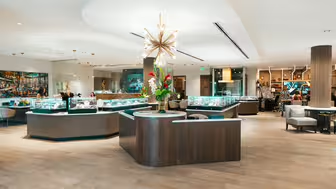
David Gardner’s Jewelers Unveils Newly Expanded, Revamped ShowroomThe Texas jeweler added 2,000 square feet to its reimagined showroom, complete with a new design studio and an event space.

SourcingOct 20, 2026
The $50M Victoria’s Secret ‘Fantasy Bra’ By The NumbersJacob & Co.'s diamond masterpiece is the most expensive Fantasy Bra ever worn on the Victoria’s Secret Fashion Show runway.

CollectionsOct 20, 2026
Mignon Faget’s Collection Chooses Handmade Over AIThe “Atelier” collection was inspired by the tools, rituals, and objects in an artist’s studio as a quiet rebuttal to an automated world.
MajorsOct 19, 2026
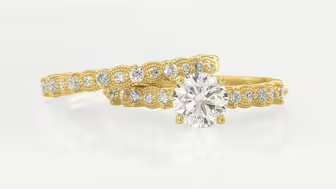
The Knot to Acquire Rival Wedding Planning Platform ZolaThe pending acquisition is an “exciting opportunity” for wedding vendors to grow their business, said The Knot Worldwide’s CEO.

SourcingOct 19, 2026
Jewelry Design Competition Show Airs in Thailand"The Secret Gems" features eight Thai jewelry brands paired with a team of young craftspeople who create jewelry together to win challenges.

CollectionsOct 19, 2026
John Hardy Enters the Medallion Chat With Talisman Collection The brand’s “Modern Talisman” capsule collection introduces pendants inspired by the mythology, natural world, and spiritual ethos of Bali.
IndependentsOct 19, 2026
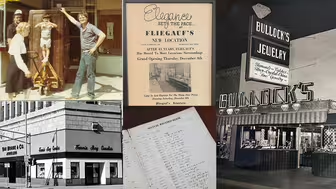
The Stories of 5 Jewelers Celebrating Their Centennials in 2026Independent jewelers from New Mexico to New Jersey answer the question: What has kept your store in business for 100 years?

SurveysOct 16, 2026
How Inflation, Gas Prices Will Affect Holiday Sales The NRF is expecting holiday sales to increase this year, but consumers and retailers alike are facing Grinch-like headwinds.
CollectionsOct 16, 2026
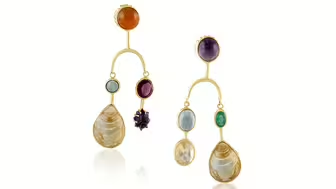
Christina Puchi’s Earrings Hold the UniverseOur Piece of the Week gathers the planets, represented by a variety of colored gemstones, in a pair of 14-karat yellow gold earrings.
IndependentsOct 16, 2026
Reeds Jewelers Expands, Relocates FlagshipThe New York-based jeweler is moving its Amherst flagship store to a larger location in nearby Snyder.

MajorsOct 16, 2026
Katy Chen Appointed Executive Vice President of Graff USA Chen, who worked at Cartier and Tiffany & Co., will lead retail sales and operations for the luxury jeweler’s 11 U.S. stores.

IndependentsOct 15, 2026
Retailer Hall of Fame 2026: Amy and Elise Greenberg For 40 years, sisters Amy and Elise Greenberg have helmed their 126-year-old family business, leading with appreciation and integrity.

ColumnistsOct 15, 2026
Peter Smith: What Is the Culture REP?It’s a term Smith coined and felt compelled to share following a bad experience with an aborted flight and an unfeeling flight attendant.