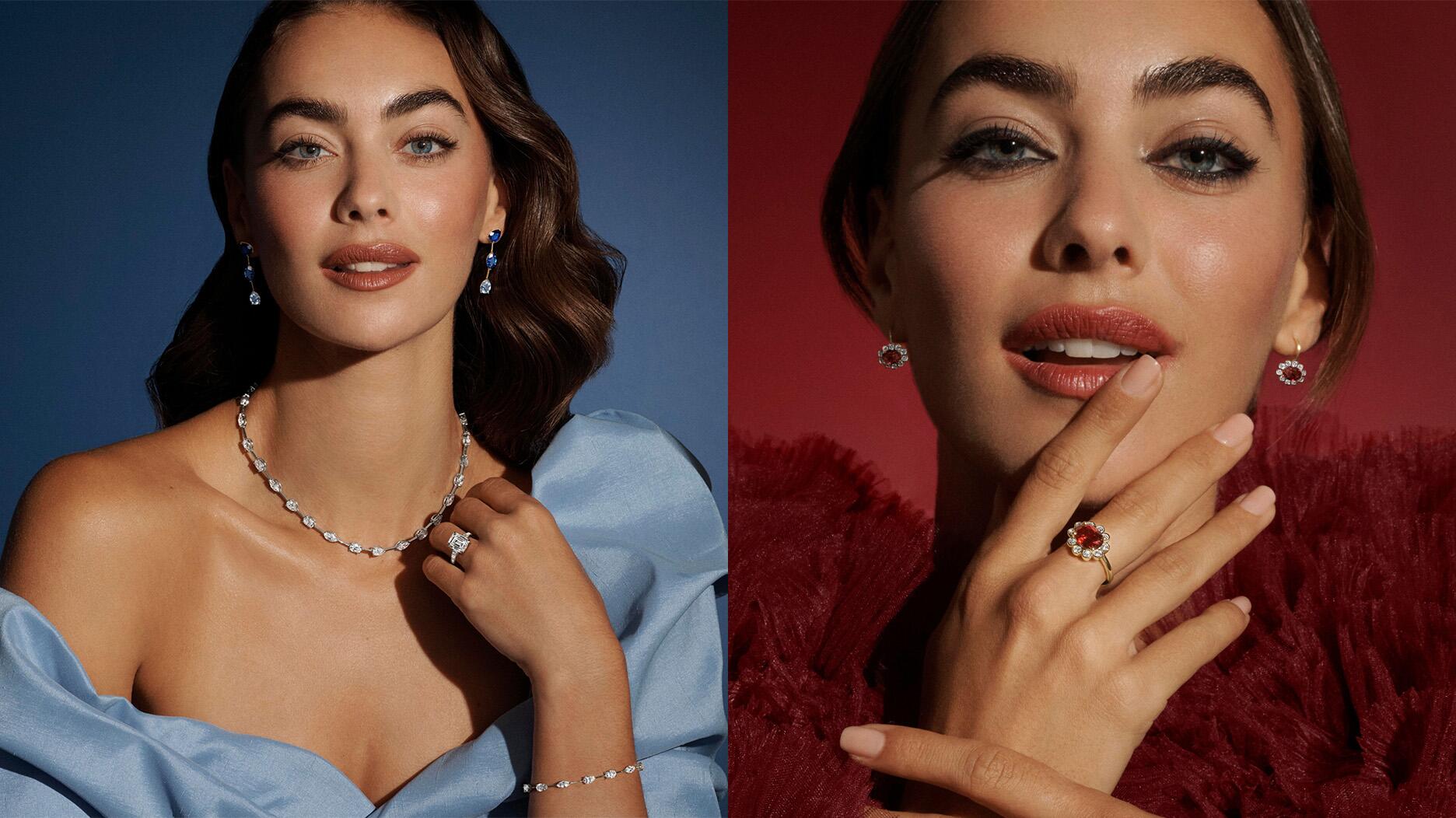
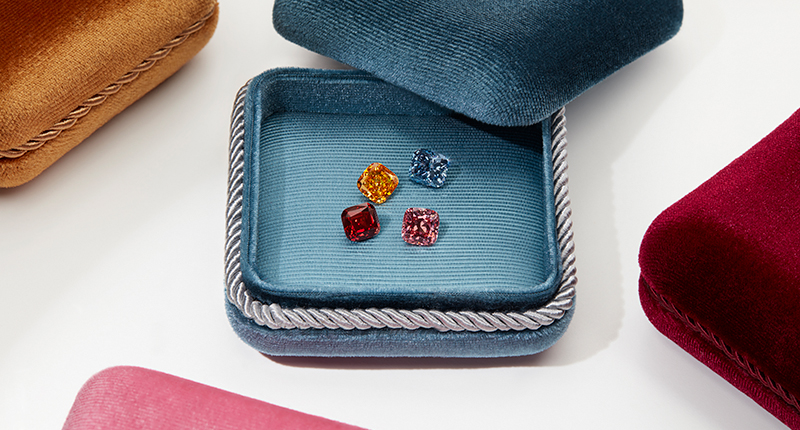
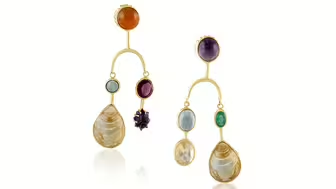
De Beers’ 2018 announcement it was going to start selling lab-grown diamonds under the brand name Lightbox was a bombshell for the industry. Pictured here are a pair of 10-carat white gold Lightbox earrings set with 1.5 carats of blue lab-grown diamonds.
Some retailers won’t touch lab-grown diamonds. They see them as inferior products that aren’t rare and are an affront to natural stones, which formed deep beneath Earth’s surface billions of years ago.
Click here to read the full story in the Market Issue.
Others see them as an industry savior, a bridge to the future, a way to win back the young consumers the industry has ceded to electronics and handbags and hang gliding trips over the Grand Canyon. Think De Beers’ game-changing Lightbox brand, which sells on-trend fashion jewelry set with lab-grown diamonds priced at $800 per carat.
For admirers, lab-grown diamonds are David to the industry’s Goliath, or Prince Charming to the industry’s Sleeping Beauty, awakening it after years of slumber.
“This industry was asleep,” says Roland Lorie, CEO of International Gemological Institute, which has been grading lab-grown diamonds since about 2008. (The lab’s first customer was Gemesis, an early lab-grown diamond brand that relaunched as Pure Grown Diamonds back in 2014.)
“For the last 10, 20 years, this industry did not come to the level of most other industries. And today the industry realizes and understands we need to be up-to-date, we need to be like other industries.
“And I think this is happening, thanks to lab-grown, thanks maybe to other things. But finally, it’s starting to happen,” says Lorie.
The diamond industry fell behind in marketing and in product innovation while, on the consumer-facing end of the pipeline, jewelers failed to evolve quickly enough to account for changing consumer tastes and advances in technology while other product categories marched ahead.
“There’s huge potential … this is truly a product that can come in and not only capture a share of the existing market but help expand the market by creating a real bridge.” — Chris Casey
Into the fray charged lab-grown stones—diamonds made in a factory in a few weeks that are less expensive and that are free from the specter of conflict that haunts their natural counterparts.
They come at a time when consumers are armed with information, open to trying new things and deliberate about how they spend their disposable income, and they bring with them with a cavalcade of questions.
Who will buy them? What will they buy? How much will they buy? And, who will it hurt the most?
Lorie compares questions about the future of lab-grown diamonds—which only hit the market in mass quantities about two years ago—to the transition from adolescence to early adulthood.
“I do not know how a [person] who is 15 years old now will be acting five years from now,” he says. “It’s too early.”
Adding an extra layer of unknown is the impact the pandemic had, and will continue to have, on consumer behavior.
Will lab-grown diamonds become more attractive to consumers because they are less expensive, or will the months of isolation and uncertainty make the natural diamond message, which emphasizes rarity and preciousness, stand out?
Industry analyst and researcher Edahn Golan offered this even-handed analysis: “It’s mixed. Those financially hurt by the pandemic and still desire a diamond may consider the lower-cost alternative while keeping the size/color/clarity combination they desire.
“That said, I believe that the lockdown, especially in the major metro areas, created a sense of closeness, desire to solidify relationships, and a greater feeling that life is precious. This could drive consumers to seek the more reliable, traditional diamond as a symbol of [something] everlasting.”
Some Statistics, and Some Reasons In the United States, lab-grown diamond sales account for 1.5 percent of total diamond sales at specialty jewelry retailers (meaning stores like Kay Jewelers and Tiffany & Co., which specialize in fine jewelry), according to Golan.
American jewelers are selling more engagement rings and wedding bands set with lab-grown diamonds than any other product using the stones, with bridal jewelry sales accounting for 87 percent of all lab-grown diamond sales by value as of April 2020.
The average gross margin on lab-grown diamonds is 52 percent, Golan’s research shows.
But what is driving consumers toward lab-grown diamonds?
Are the diamond growers out-marketing the natural players that badly?
Are consumers, still scarred by Leo’s 2006 turn in “Blood Diamond,” demanding lab-grown diamonds because they are the “ethical” choice?
Or, do they just like them because they can get a bigger, better diamond for their budgets?
While it’s impossible to know what exactly is going through the mind of every consumer out there who’s choosing a lab-grown diamond, MVI Marketing’s data points to the latter.
Research conducted by the firm between 2016 and 2019 shows two of the primary factors that lead shoppers to purchase lab-grown diamond jewelry both have to do with value.
Consumers move toward man-made stones because, No. 1, they can buy a bigger diamond for the same amount of money and, No. 2, they can get a better-quality stone for the same amount of money.
Severine Ferrari finds the same when interviewing couples for Engagement101.com and the Propose Too Initiative, the websites she launched and runs as editor-in-chief.
But Ferrari says couples’ interest in getting the most for their money extends beyond the lab-grown vs. natural debate that has consumed the industry.
“There’s been a big shift in general on what’s considered a center stone on an engagement ring. Women are interested in a lot of different options than [your standard white] diamonds—moissanite, sapphires, gray diamonds. They’re very open to something different.
“More and more women are not buying into [the idea of], ‘I need a [white] diamond for my engagement ring.’”
Couples today are “open to a lot of different options, including lab-grown diamonds.” — Severine Ferrari
Ferrari brings forth another interesting observation from her conversations with the recently or soon-to-be engaged. Many of the women she talks with don’t necessarily think the engagement ring they pick right now is going to be the ring that’s on their finger for life.
They think of it more as a starter ring, akin to a starter home. It’s a place to begin, with the hopes of moving into something bigger and better in the future.
Ferrari points out many couples today have financial obligations that past generations didn’t when they were getting engaged. They might already own a home, for example, or have children together.
The latter may be more common than you think.
U.S. Census Bureau data cited in a 2018 article from the Pew Research Center shows that between 1970 and 2016, the number of unmarried women (either single mothers or women living with a nonmarital partner) having babies rose from 26 births per 1,000 women to 42 births per 1,000 women.
At the same time, the birth rate among married women declined, resulting in unmarried women accounting for four in 10 births in 2016, or 40 percent.
Budgeting for an engagement ring becomes a different exercise when you have kids to support and it’s one of the reasons some couples today are “open to a lot of different options, including lab-grown diamonds,” says Ferrari.
From Scarce to Saturated Though the lab-grown diamond market still represents only a sliver of the total diamond market, the number of suppliers carrying them has exploded in the past couple of years, seemingly ignited by De Beers’ 2018 bombshell announcement it was launching Lightbox.
And jewelers, who are getting more and more calls from vendors asking if they want to carry lab-grown diamonds in their stores, have noticed.
It was late 2016 when Brian Hoover, owner of Avant Garde Jewelers in Austin, Texas, says he first started fielding questions from consumers about lab-grown diamonds in his store.
A Canadian chain had just opened a branch in his fast-growing college town, advertising its “artisan-created diamonds,” and young people began trickling into his store asking, what are these?
The jeweler didn’t know a lot, but he figured he’d better find out.
As a rule, Hoover doesn’t sell anything in his store until he researches it so that he’s prepared to answer questions. “If you look at my store and reputation, my referrals—it’s all about education and trust,” he says.
“It’s so funny. Now all my big diamond companies, they’re onto lab-grown diamonds. A lot of the big boys are going to them.” — Brian Hoover
In spring 2017, he flew up to New York at attend an education session on lab-grown diamonds being held in conjunction with a trade show.
When Hoover went to Las Vegas for the trade shows a few months later, he felt ready to start looking at some stones but found vendors weren’t exactly plentiful.
Among those that were exhibiting at the show, Hoover found only a handful that had the quality and selection he was looking for, he says.
At this year’s JCK Las Vegas show, nearly 70 companies selling lab-grown stones were set to exhibit before COVID-19 forced the cancellation of all the Vegas shows.
Among the companies now selling lab-grown diamonds are a number of familiar names, companies that have been in the industry—and, in some cases, selling natural diamonds—for decades: Benchmark, Chatham, Frederick Goldman, M. Geller, Overnight Mountings, Quality Gold, Richline Group, Stuller and Swarovski.
Others are new brands or offshoots of some of the industry’s largest diamond companies. Altr, for example, is the lab-grown diamond arm of R.A. Riam Group.
It’s a fact that hasn’t gone unnoticed by Hoover, who was hard-pressed to pull together a viable selection of the stones just a few years ago.
“It’s so funny,” he remarks. “Now all my big diamond companies, they’re onto lab-grown diamonds. A lot of the big boys are going to them.”
Retailers new to the category should begin their search for lab-grown diamonds with large, familiar suppliers, recommends Chris Casey, president of the Lab-Grown Diamond Council.
“Start with people you know and ask them if they’re in the lab-grown business,” he says. “Start with who you know, and there are a lot of them.”
He points out that both large and small diamond companies are taking a position in the category.
“There’s huge potential, and we don’t know whether we will realize that potential, we don’t know what it will ultimately be, but this is truly a product that can come in and not only capture a share of the existing market but, to the Lightbox side of things, help expand the market by creating a real bridge.
“Think about relatively affordable diamond product. It’s not been available before, and we should get to that point.”
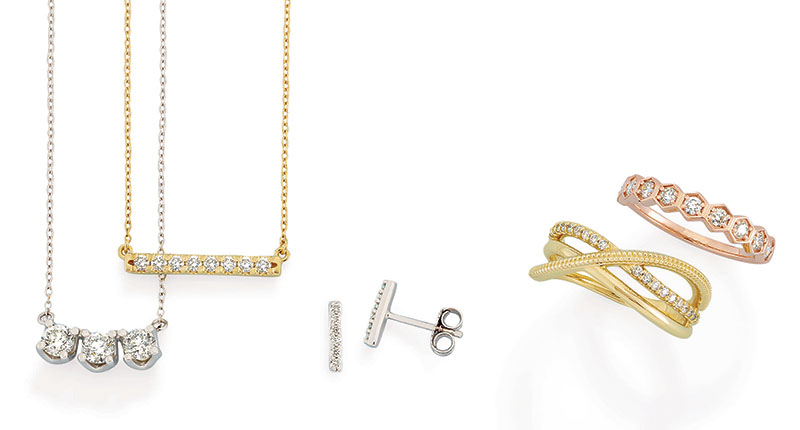
Stuller is among the major industry suppliers that have begun selling lab-grown diamonds, both loose and set into jewelry, in recent years. Pictured here are pieces in its “Modern Brilliance” collection of lab-grown diamond fashion jewelry.
Casey, a former publisher of National Jeweler, and Michael Barlerin, the longtime head of the Silver Promotion Service, started the Lab-Grown Diamond Council last year.
The idea behind the organization is to address the need for lab-grown diamond education (for store owners, sales associates and consumers), research and awareness, and to develop a sustainability program for diamond growers.
It’s this fourth and final pillar Casey says they’ve been spending the most time on so far.
And it’s addressing an area proving to be the most lawless—multiple claims about being “sustainable,” “eco-friendly,” “green,” or any of the other half-dozen nebulous terms that get tossed around in the wild, wild west world of lab-grown diamonds.
MVI Marketing’s consumer research shows that after value, wanting a product that is “eco-friendly” is the second-most important reason consumers choose lab-grown diamonds over mined.
It’s a concern that doesn’t come as a surprise in the age of widespread climate demonstrations and growing anxiety about the future of the planet, but it also begs two questions: what do these terms mean, and who can use them?
Casey says the council is working with SCS Global Services, which creates standards and certifies compliance with those standards across dozens of industries.
SCS worked with the diamond industry, NGOs and the Federal Trade Commission, the agency that guards against false advertising, to develop a set of standards for what “sustainable” means when it comes to diamonds—natural or lab-grown.
“This is not a lab-grown standard,” Casey notes, “this is a diamond standard. Any company, whether it’s lab-grown or mined, can apply [for certification against] the standard.”
At the council’s final kickoff meeting in January, its members finished a preliminary set of standards, and assembled a group of five pilot growers to submit for certification against those standards: WD Diamonds, Lusix, Goldiam, Fenix and Green Rocks.
“There’s all this garbage being talked about, on both sides, out there in the industry,” he says.
Developing this program gives the industry something it can go by, which is independently developed and verified so “we don’t confuse consumers.”
Lab-Grown Talking Points The sustainability certification program seems poised to be helpful to retailers as well, as they work to understand which lab-grown diamonds companies’ claims are legitimate and how they should talk about these stones to their customers.
There are rules governing environmental marketing claims, described in the FTC’s “Green Guides.” The FTC outlines what terms companies can use when advertising to the public, and how to use them in order to avoid getting flagged for false advertising.
Last spring, the commission sent warning letters to eight companies about potentially deceptive diamond advertising. Half the letters pointed out problematic “eco” claims.
There’s nothing wrong with a company claiming its product is “eco-friendly” because it uses less water or energy in the manufacturing process, FTC staff attorney Robert Frisby explained to National Jeweler in an April 2019 interview after news of the warning letters broke.
But its advertising has to include this explanation. A company can’t just slap “eco-friendly” on all its ads; there are too many ways consumers can interpret that.
Frisby said companies also need to have publicly available evidence backing up their claims—and the amount of necessary scientific evidence increases with claims like “carbon neutral.”
Marketers of lab-grown stones also must be careful about saying their products are “green” because their factories exert less environmental impact than a diamond mine.
Jewelers Vigilance Committee President Tiffany Stevens once shared a metaphor that skillfully shoots down that claim.
She put it like this: “One of the recurring issues we see with the environmental claims is the use of relative standards, i.e., Michelle speaks 20 words of Spanish and Tiffany speaks one so Michelle is fluent in Spanish, rather than what the standard actually is under the Green Guides, which is an absolute, i.e., Michelle is either fluent in Spanish or not, regardless of how competent the person standing next to her is.”
First issued in 1992 and most recently revised in 2012, the Green Guides cover all products, from paint to paper to diamond pendants, but they are not the only set of guidelines regulating advertising in the jewelry industry.
Sellers of lab-grown diamonds must make it obvious their product is lab-grown by using “clear and conspicuous” disclosure with the word diamond. When the word “diamond” appears by itself, it still means a mined diamond. — The Federal Trade Commission’s Jewelry Guides
The FTC has an industry-specific set of guidelines, the aptly named Jewelry Guides, that just underwent their first revision in two decades.
Jewelers who want to carry lab-grown diamonds should know and understand them.
The Jewelry Guides dictate that sellers of lab-grown diamonds must make it clear their product is lab-grown by using “clear and conspicuous” disclosure with the word diamond. Those advertising lab-grown diamonds must use the handful of terms the FTC deems acceptable, and they have to put them somewhere consumers can see them.
The recommended terms are: laboratory-grown, laboratory-created or [manufacturer name]-created.
Cultured is acceptable as well, but it has to be “immediately accompanied, with equal conspicuousness” by one of the three terms above; it cannot stand alone.
When the word “diamond” appears by itself, it still means a mined diamond, the Jewelry Guides state.
The Value Discussion There is much chatter in the industry about how lab-grown diamonds “won’t be worth anything” in the future and, like the category overall, it’s a topic that releases a flood of questions without a raft of answers.
Value is subjective and ever-changing, and it’s nearly impossible to predict what’s something going to be worth in the future with 100 percent accuracy.
Will lab-grown diamond prices go the flat-screen TV route, with prices plummeting as manufacturing technology improves and growers pump out more and more identical stones?
Will there be a lab-grown diamond company that rises to the top, positioning itself as a premium brand that can charge a higher price?
And, how will the mass presence of lab-grown diamonds on the market impact the price of natural diamonds in the long run, if at all? If we can grow diamonds above-ground, will diamonds from below ground become less special in the eyes of the consumer, or more?
Golan, the industry analyst, has been tracking wholesale transaction prices of lab-grown diamonds since May 2018, right around the time De Beers dropped the Lightbox bomb.
His data shows that in response to Lightbox’s low-price structure, prices declined continuously from May 2018 before stabilizing in early 2019.
Late in the year, lab-grown diamond prices actually increased as the holiday season got underway and consumer demand picked up.
“If anything, I think that in lab-grown diamonds, there is no value-retention discussion among consumers. Instead, consumers are eyeing value of purchase—getting as much of a diamond for as little as possible.” — Edahn Golan
Golan said traders had “solid” sales to start the year and prices remained stable from December, except for a weakness in smaller goods.
In March, COVID-19 brought the lab-grown diamond business to a standstill, leaving the wholesale transaction price list unchanged for Q1, except for the aforementioned weakness in smaller goods, which Golan said is “an accurate reflection of the trade in the market during the quarter.”
In the long term, he says he expects lab-grown diamond costs to decline because they are a technology-driven product. Improved efficiencies and growing competition will drive down prices, just like they did with flat-screen TVs, which once cost thousands and now can be picked up for $300.
This prediction begs one final question of the market, and that is: Do consumers care how much their diamonds, whether natural or lab-grown, will be worth in the future?
When they pick out that diamond pendant as a pat on the back for a promotion—or their engagement ring, for that matter—are they viewing it as an investment, something they can bank on later if they need cash? Or are they just after the look that suits their taste and budget right now?
It’s yet another question for which there’s no answer currently, though Golan can offer an observation based not on his price list, but on conversations he’s had about the market.
“If anything, I think that in lab-grown diamonds, there is no value-retention discussion among consumers,” he says. “Instead, consumers are eyeing value of purchase—getting as much of a diamond for as little as possible.”