






SurveysOct 16, 2026
How Inflation, Gas Prices Will Affect Holiday Sales The NRF is expecting holiday sales to increase this year, but consumers and retailers alike are facing Grinch-like headwinds.






Editor-in-Chief Michelle Graff gives her three takeaways from the first day of the JA National Convention.


Early Sunday morning, I made my way from my home in Brooklyn to Manhattan to attend the first day of the inaugural JA National Convention, jealously eyeing all the joggers along the East River on my way.
I can’t believe I’m going to spend this gorgeous summer day inside a hotel, I thought to myself as my Lyft driver sped north along an almost-empty FDR Drive.
In the end, my FOMO aside, I ended up truly enjoying the day, and I am not just saying that because Jewelers of America owns this publication.
I thought the speakers were engaging, and the day felt well-planned and organized, with the right balance of sessions to networking/relaxing time.
While there will certainly be more stories to come from the convention in the days ahead, here are three thoughts from the first day.
1. The only thing we have to fear …
is not being able to manage fear, said the opening keynote speaker, author Judi Holler.
Trained in improv, Holler is now a professional speaker and consultant who just wrote a book on managing fear, “Fear Is My Homeboy.”
In her speech, she said being “fearless” shouldn’t be the goal in managing one’s life or business. Instead, she suggested, try “fearing fear less”—learn how to get comfortable with being scared in order to make changes.
“Scary things will not get less scary. Uncomfortable things will not become less uncomfortable, but you will get stronger,” Holler said. “If you want to move forward, you’re going to have to get uncomfortable.”
Her line about getting stronger resonated with me because the same is true in long-distance running (I’m currently training for a marathon, hence my jealousy over those Sunday morning joggers.)
No matter how much you run, you don’t ever reach a level where you don’t feel exhausted, hurt and/or bored at certain points during the run. You just learn how to deal with it.
Holler also talked about the importance of focus—which she called a “massive superpower”—especially in a world where, according to stats she presented:
— Workers spend 70 percent of their days engaging with an iPhone;
— The average worker is interrupted once every 12 minutes;
— Fifty-five percent of workers check email after 11 p.m.;
— And 81 percent check it on their days off.
Holler told the story of a woman who got an incredible amount
(Reading was another “massive superpower” mentioned by Holler. I don’t disagree and I’m sure neither does Peter Smith, who is constantly recommending books in his columns.)
“Who is running your day, who is running your business?” Holler asked the audience. “You or everybody else?”
2. Who is going to win the 2020 election?
Forecaster Charlie Cook delivered the afternoon keynote over lunch, and started off by telling the audience that he was hesitant about making predictions after the 2016 presidential election, which, he joked, “cut a lot of the political prognosticators down to size.”
He did, however, deliver a few forecasts.
Cook said he thinks the “final four” to emerge from the crowded field of Democrats currently running will be former Vice President Joe Biden, Sen. Elizabeth Warren, Sen. Kamala Harris and South Bend Mayor Pete Buttigieg.
Biden has about a 40 percent chance of winning his party’s nomination, which is better than anyone else but also means there is a 60 percent chance someone else will be the nominee.
Regardless of who wins the nomination, he predicted there will be gender and/or racial diversity on the Democratic ticket, noting that the chance of having two white men running is “zero, with a margin of error of zero.”
Turning to incumbent President Donald Trump, Cook broke the numbers down like this.
Thirty-five percent of voters will vote for him no matter what, 45 percent will never vote for him, and then there is that 20 percent in the middle who will make the difference in this election.
He said the main states in play will be Michigan, Pennsylvania, Wisconsin and Florida, while the key issues that will lose Democrats’ votes among this 20 percent include pushing impeachment, being seen as advocating for “open borders” or ending private health insurance, and wanting to give out a bunch of “free” stuff, like “free college” or student loan debt forgiveness for all.
So, who will pull it out in the end? Cook doesn’t have a prediction or, at least, isn’t sharing it right now if he does.
He said: “This is going to be a heck of a race. Who the hell knows?”
3. The definition of luxury has changed.
The final session of the day I attended was “Making the In-Store Experience Memorable” with Ken Nisch, an architect, retail designer and chairman of JGA, which has worked on spaces for Shinola and James Allen, among many others.
He made a number of good points in his presentation, many of which I’ll be following up on for my analysis story in our upcoming “State of the Majors” issue.
One I want to share right now, though, was Nisch’s commentary on how the consumers’ view of what constitutes “luxury” has changed.
He said luxury is no longer about big-veined marble and shiny metal fixtures; it’s more earthy and considered today, and it’s about makers and the process. Where did the material come from, who made it and how did it impact their lives?
“Luxury,” Nisch said, “just isn’t as sparkly as it used to be.”
The JA National Convention continues today at the InterContinental New York Barclay Hotel.
Please say “hello” if you see me there, and let us know your takeaways from the convention in the comments below.

The NRF is expecting holiday sales to increase this year, but consumers and retailers alike are facing Grinch-like headwinds.

Our Piece of the Week gathers the planets, represented by a variety of colored gemstones, in a pair of 14-karat yellow gold earrings.

The New York-based jeweler is moving its Amherst flagship store to a larger location in nearby Snyder.

Experience gemstones with greater precision and comfort than ever before.


Chen, who worked at Cartier and Tiffany & Co., will lead retail sales and operations for the luxury jeweler’s 11 U.S. stores.


For 40 years, sisters Amy and Elise Greenberg have helmed their 126-year-old family business, leading with appreciation and integrity.

It’s a term Smith coined and felt compelled to share following a bad experience with an aborted flight and an unfeeling flight attendant.
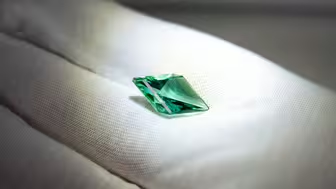
Submit your pieces for a chance to win in this year's competition.


Movado teamed up with the New York-based fine jewelry designer on a new collection of Movado Museum Velura watches.

The two companies are reportedly in talks to join the Global Diamond Consortium, led by former De Beers CEO Gareth Penny, as per Bloomberg.
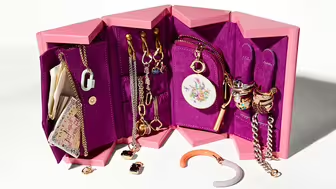
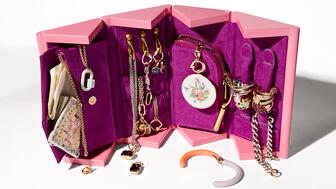
The “Some of the Things” box follows the two larger “Everything” box designs with the look and function of antique sewing and toolboxes.

Fourth-generation jewelers Coleman and Mitchell Clark exemplify the best qualities of their predecessors: humility, modesty, and confidence.

The gem hunter, whose 70-year career was defined by adventure and exploration, is remembered for his steadfast faith and sense of wonder.

Tiffany & Co. continued its full-scale store renovation project while Bulgari’s high jewelry collection generated “record-breaking revenue.”

This year’s sessions feature leading voices from human rights, legal, and conservation organizations.

The high-end jewelry retailer was sold to private investment firm Middle West Partners and a group of longtime clients.

The jewelry designer has partnered with Sofer Jewelry to distribute her 85-piece lab-grown diamond collection.

Dunn, this year’s Single-Store Independent inductee, is passionate about innovation and telling the story of natural diamonds.

The 24-carat fancy intense pink diamond ring could fetch up to $18 million at the November sale.

The “Island Jewel” candle honors New York City and Puerto Rico and raises money for the island’s water relief efforts.
The partnership will give JA members access to preferred pricing, exclusive benefits, technology solutions, education, and resources.

Stores should expect to see the most customers on Nov. 27, and Christmas week is expected to be hectic too, as Dec. 25 falls on a Friday.

The charm, our Piece of the Week, features brown diamond frozen hot chocolate topped with white diamond whipped cream and a ruby straw.

The top lot of Elmwood’s recent fine jewelry sale in London was a 1.84-carat, D color Tiffany & Co. solitaire diamond ring.

The watch company agreed to sell a 95 percent interest to a group comprised of F.P. Journe, Chanel, and Swiss watch exec Pierre Jacques.

This round of tariff refunds is for importers that have sued over IEEPA tariffs in the Court of International Trade and won.

It revisits the brand’s most requested silhouettes, from "Pillow"-set necklaces and bracelets to "Signature"-set rings and earrings.



This site uses cookies to give you the best online experience. By continuing to use & browse this site, we assume you agree to our Privacy Policy