








MajorsSep 08, 2026
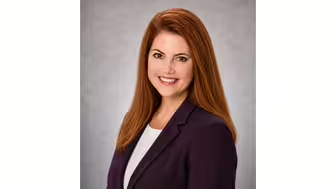
Former Tiffany & Co. Exec Joins Exemplar Luxury GroupGretchen Koback Pursel is the new chief people officer at the company formerly known as Saks Global.





Don’t rely on a single manufacturer for any one product, pick suppliers that work with the store’s delivery needs and payment abilities, and check their references. These were just a few of the tips offered at a session on diversifying a store’s supply chain held Monday at the JA New York Winter show.

New York--The heart of Monday’s educational session on why and how retailers should diversify their supply chain can be summed up with one very well-known idiom: don’t put all your eggs in one basket.
To start the session, Matt Tratner, Jewelers of America’s director of membership and sales, gave an example of a giant company that found itself with a very big problem due to a lack of diversity in its supply chain: auto maker Ford.
When the earthquake and resulting tsunami hit Japan in 2011, it left Ford with a severe shortage of cars and trucks in metallic red and black because the company only had one supplier of Xirallic, the pigment used to make this color, and that supplier was in Japan.
“If it can happen to Ford, it can happen to you,” Tratner said. “Don’t put all your eggs in a single basket.”
He said retailers shouldn’t stop at one source and should pull from different manufacturers, working with two or three different suppliers for the same product. While one manufacturer can serve as the main supplier, he said it’s not a bad idea for retailers to send orders to their secondary and tertiary suppliers from time to time, just to stay in touch with them and keep the relationship fresh.
While he said he believes the best place to find new manufacturers is at a trade show, other methods for sourcing new suppliers are referrals, the Internet and trade associations, such as JA, the Indian Diamond & Colorstone Association, Platinum Guild International and the Cultured Pearl Association.
Once a retailer has selected a new supplier, or suppliers, they need to assess their abilities, and one area that jewelers need to pay particular attention to today is sourcing.
“Sourcing is becoming a very, very big deal,” Tratner said. This is due to a number of issues, including regulations regarding the origin of certain products--for example, the new federal laws regarding so-called conflict gold--and the growing number of synthetic, or lab-grown diamonds, in the supply pipeline.
He said retailers need to know where their suppliers are sourcing their metals, gemstones or other products from and that those sources are ethical. At JA, for example, they make their recommended suppliers sign a code of ethical practices; other industry organizations have similar requirements.
In addition to ethical sourcing, retailers also need to ensure that a supplier’s
Tratner said when trying to choose suppliers, it’s not a bad idea to send the same order to all of them and see which one fills it in a manner that’s most suitable to the store.
For a store’s chosen suppliers, he said retailers need to keep a roster handy and make sure their employees know whom the store deals with, so they never tell a customer they can’t obtain certain product because the associate isn’t aware the store has a supplier that carries it.
Tratner’s session on supply chain of diversity was one of three educational sessions held at the JA New York Winter show on Monday, the second day of the two days of education sponsored by JA.
The show concludes Tuesday at the Jacob K. Javits Convention Center in New York.

Gretchen Koback Pursel is the new chief people officer at the company formerly known as Saks Global.

Bromberg is remembered as a Southern gentleman who always wore a suit and tie and treated others with kindness.

With high durability and a wide range of colors to choose from, sapphires may be the ultimate birthstone, Gizzi claims.
Submit your pieces for a chance to win in this year's competition.


Laughter is often considered a distraction in the workplace, but it has benefits for both staff and management, Peter Smith writes.


The California jeweler is renovating its store in Fresno, with plans to show off the new space in December.

A lifelong practitioner of Pilates, Gabrielle looked to the springs’ tension and suspension when creating this ring, our Piece of the Week.

Retailers are seeking new ways to attract customers, increase traffic, and create revenue – Estate buying events are a popular solution.


The auction house has promoted Remi Guillemin, formerly its head of watches for the Americas and EMEA, to the role.

Zaven Ghanimian discussed the value of human craftsmanship and where the implementation of artificial intelligence does work.

The British actor, known for his roles in “Twilight” and “The Odyssey,” will star in a campaign for the Master Control Chronometre.

The “Confetti Disco,” “Champagne Cheers,” “Tuxedo,” and “Classic Punk” jewelry collections each capture a distinct spirit of celebration.

Nelson Holdo of Newport Beach pleaded guilty to multiple counts of felony grand theft and writing bad checks and was sentenced Monday.

Cat ladies of the jewelry world, unite. Sandy Lerner’s “significant” collection of cat jewelry and other objects is going up for auction.

Arnaud Michon, the former Omega USA President, will now lead Messika’s Americas region during its international development.

The branding references the back-to-back jewelry shows that new parent company Forge will host in Miami's Coconut Grove this November.

The stainless steel Patek Philippe “Calatrava” watch from the 1930s sold for nearly $80,000 at a recent Hansons Cornwall auction.

Engagement rings are important but don’t ignore the customers who are buying jewelry “just because,” Emmanuel Raheb writes.

Former Pomellato CEO Sabina Belli has been named president of Kering Italia amid a shakeup of Kering's new Jewelry division.
The veteran luxury packaging executive was appointed to help the company grow its North American business.


Once the property of an Egyptian queen, the necklace was part of a larger exhibition of VCA jewelry at the Museum of Applied Arts (MAK).

The labs’ separate investigations each determined that the East African country is producing copper-bearing tourmaline.

“Chicago Collects: Jewelry in Perspective” at the Oshkosh Public Museum will feature works by Fabergé, Lalique, and Louis Comfort Tiffany.

The “Worn Well” collection is Catbird's take on classic men's jewelry.
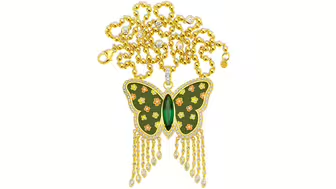
This Buddha Mama butterfly is our Piece of the Week honoring the legend, who embraced the beautiful insect as her symbol.

The former De Beers CEO, and perhaps its next owner, will be a featured speaker at the event, slated for Sept. 4-7 in Italy.

The employee-owned jeweler was named a “Best Place to Work” in Maine, New Hampshire, and for women.



This site uses cookies to give you the best online experience. By continuing to use & browse this site, we assume you agree to our Privacy Policy