





IndependentsSep 04, 2026
Orloff Jewelers Will Soon Unveil a Bigger, Better LocationThe California jeweler is renovating its store in Fresno, with plans to show off the new space in December.




Displaying the best part of your brand, building trust and providing value are essential to making social media profitable, Likeable Local’s Evan Seto explains.


Social media is a powerful tool for any jewelry business’ strategic plan. Just a few years ago it was barely part of the equation, and now it’s an essential aspect of any game plan. Best practices dictate some particular things about social media and how to use it, as the channels can be great for building your brand--but you have to find a voice and stick with it.
Use social media to display the best parts of your brand, whether that’s your jewelry, your customers or your staff and workplace culture. Your brand is on social media already; it’s up to you whether you want to be the one who controls it. Social media can also be a great customer service tool, as that’s where your customers are. Listen to them and interact with them, especially if they interact with you. This way, you’re reaching your customers more effectively in an arena they might be more comfortable in.
Those are your social media best practices, but sometimes you might wonder about your return on investment. I’m here to tell you that all of those things you thought you knew about social media, rip them up and throw them out the window. Okay, don’t actually do that; they’re still very important aspects of a social media business strategy. But what I’m saying is that it’s also okay to use social media to sell and market. Here’s a great example of a jeweler using social media to sell:
(function(d, s, id) { var js, fjs = d.getElementsByTagName(s)[0]; if (d.getElementById(id)) return; js = d.createElement(s); js.id = id; js.src = "//connect.facebook.net/en_US/sdk.js#xfbml=1&version=v2.3"; fjs.parentNode.insertBefore(js, fjs);}(document, 'script', 'facebook-jssdk'));
Make a statement this summer with the Pandora Palm pendant - new to the summer collection. #ArtofYou #Pandora
Posted by Leitzel's Jewelry on Friday, August 7, 2015
Here’s where you need to be careful. There is a large segment of the population that becomes uncomfortable and/or defensive when they sense somebody is trying to sell them something, and this applies especially to social media. Consider why people are on social media; while it varies from platform to platform, essentially people are there to be in a safe space where they can interact with their friends and connections. This is where those first social media best practices come in--by building your brand on social media, you also build trust between your jewelry business and your potential consumer.
Once that brand trust is established, people will be more amenable to seeing your sales pitch come at them through social media. This
Consider apps like “Game of War” and “Clash of Clans.” You might know them from their massive advertising campaigns, one of which was notorious for starring a certain Sports Illustrated swimsuit model. You might have wondered why there are such massive ad campaigns devoted to free apps. The reason is that the developers want to draw people in. They start them off with a small reward--resources they use to start the game out.
As the user invest more time in the game--time that is extended by having to wait for things to develop--they’re less willing to abandon the game, not because they are necessarily feeling like they’re still deriving value out of the game, but because they don’t want to feel like they completely lost the time they already sunk into it. Thus, inertia. The technical term for this is the sunk cost fallacy, and admittedly, it does seem a bit underhanded and cynical. However, the negative vibes of this example are reflective of the way these companies utilize these strategies. Let’s brighten these up a little bit for your business’ strategy.
What you want to be doing is taking the basic principles of sunk cost. Provide value, even if it’s for free, and get people invested into your brand. Consumers who are invested in you and the success of your brand are more likely to be loyal and supportive customers. It’s fine to use social media for sales, but make sure you’re always providing additional value--things you can offer your customers that doesn’t require them to necessarily give up anything.
In the same way selling can work on social media, social media works for this kind of selling. Social media helps you capture an audience much better than a phone call and email. After all, once you’ve got the like or the follow, they’re connected to you and inertia will keep the vast majority around, in a way that calls and emails don’t hold on to contacts. From there, keep using social media to nurture away, and before you know it, your social media sales pitches are taking hold.
Looking for more social media tips to refine your business’ social media strategy? Check out this free eBook, 7 Proven Strategies to Maximize Twitter for Your Business.
Evan Seto is the marketing apprentice at Likeable Local, a social media marketing platform and app for small and mid-sized businesses. Reach him at evan@likeablelocal.com.

The California jeweler is renovating its store in Fresno, with plans to show off the new space in December.

A lifelong practitioner of Pilates, Gabrielle looked to the springs’ tension and suspension when creating this ring, our Piece of the Week.

The deadline to apply is Nov. 13.
Submit your pieces for a chance to win in this year's competition.


The auction house has promoted Remi Guillemin, formerly its head of watches for the Americas and EMEA, to the role.

Zaven Ghanimian discussed the value of human craftsmanship and where the implementation of artificial intelligence does work.

Jewelers of America also revealed the recipients of the Seymour & Evelyn Holtzman Bench Scholarship and its own scholarship programs.

Retailers are seeking new ways to attract customers, increase traffic, and create revenue – Estate buying events are a popular solution.


The British actor, known for his roles in “Twilight” and “The Odyssey,” will star in a campaign for the Master Control Chronometre.

The “Confetti Disco,” “Champagne Cheers,” “Tuxedo,” and “Classic Punk” jewelry collections each capture a distinct spirit of celebration.

Nelson Holdo of Newport Beach pleaded guilty to multiple counts of felony grand theft and writing bad checks and was sentenced Monday.

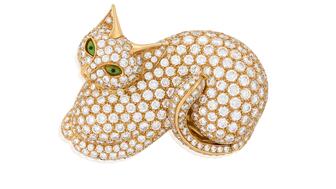
Cat ladies of the jewelry world, unite. Sandy Lerner’s “significant” collection of cat jewelry and other objects is going up for auction.

Arnaud Michon, the former Omega USA President, will now lead Messika’s Americas region during its international development.

The branding references the back-to-back jewelry shows that new parent company Forge will host in Miami's Coconut Grove this November.

The stainless steel Patek Philippe “Calatrava” watch from the 1930s sold for nearly $80,000 at a recent Hansons Cornwall auction.

Engagement rings are important but don’t ignore the customers who are buying jewelry “just because,” Emmanuel Raheb writes.

Former Pomellato CEO Sabina Belli has been named president of Kering Italia amid a shakeup of Kering's new Jewelry division.

The veteran luxury packaging executive was appointed to help the company grow its North American business.


Once the property of an Egyptian queen, the necklace was part of a larger exhibition of VCA jewelry at the Museum of Applied Arts (MAK).
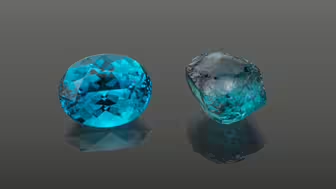
The labs’ separate investigations each determined that the East African country is producing copper-bearing tourmaline.
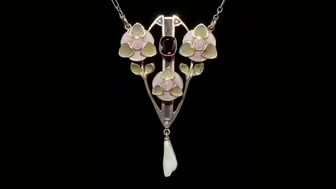
“Chicago Collects: Jewelry in Perspective” at the Oshkosh Public Museum will feature works by Fabergé, Lalique, and Louis Comfort Tiffany.

The “Worn Well” collection is Catbird's take on classic men's jewelry.
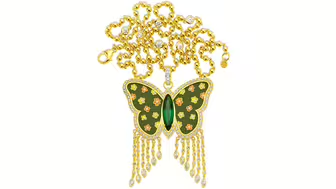
This Buddha Mama butterfly is our Piece of the Week honoring the legend, who embraced the beautiful insect as her symbol.

The former De Beers CEO, and perhaps its next owner, will be a featured speaker at the event, slated for Sept. 4-7 in Italy.

The employee-owned jeweler was named a “Best Place to Work” in Maine, New Hampshire, and for women.

The second iteration of the jewelry collection was inspired by the zodiac and the four elements: earth, water, air and fire.
General License 104B supersedes General License 104A, which was set to expire on Sept. 1.



This site uses cookies to give you the best online experience. By continuing to use & browse this site, we assume you agree to our Privacy Policy