




ColumnistsSep 14, 2026
Sherry Smith: Stop Waiting for December to Save Your ChristmasColumnistsOct 06, 2026
Sherry Smith: Is the Consumer Really Trading Up?
Ahead of the holidays, Smith urges jewelers to take a hard look at who’s buying jewelry, what they’re purchasing, and who’s stopped buying.


Sherry Smith is a principal partner at The Retail Smiths, a consultancy for retailers and vendors. She can be reached at sherrytrs@gmail.com.
If you follow the jewelry industry’s numbers, there is a lot to feel good about.
Sales are up. Average retail prices are up. Higher-ticket merchandise is performing well.
Heading into the all-important fourth quarter, it would be easy to conclude that consumers are simply trading up. But I’m not convinced it’s that simple.
In fact, I think one of the biggest stories in jewelry right now may be that there is no longer one consumer story.
Affluent consumers continue to spend. Lower-income and aspirational consumers are becoming more cautious.
Gold prices have dramatically increased the price of jewelry, and lab-grown diamonds are allowing consumers to buy substantially larger diamonds for considerably less money.
All those things can happen at the same time, and when they are, averages can become deceiving.
McKinsey & Company provides an important place to start examining the situation more closely.
In its The State of Fashion 2026 report, co-authored with The Business of Fashion, the firm estimates that roughly 80 percent of luxury market growth between 2023 and 2025 came from price increases rather than volume gains.
At the same time, approximately 35 percent of aspirational luxury consumers have pulled back or delayed luxury spending.
Bain & Company’s research tells a similar story.
Bain estimates the number of global luxury consumers fell from approximately 400 million in 2022 to 340 million in 2025.
At the same time, big spenders’ share of the personal luxury goods market increased from 30 percent in 2019 to approximately 46 to 47 percent in 2025.
Think about what those two statistics say together. The luxury customer base is getting smaller while its biggest spenders are becoming more important.
That doesn’t mean consumers aren’t buying luxury; they clearly are. But it does suggest that growth is becoming increasingly concentrated among a smaller population of extremely valuable customers.
That should get the attention of every independent jeweler heading into holiday, as the U.S. jewelry numbers show some of the same polarization.
Related stories will be right here …
Sales are up. Average retail prices are up. Higher-ticket merchandise is performing well.
Heading into the all-important fourth quarter, it would be easy to conclude that consumers are simply trading up. But I’m not convinced it’s that simple.
In fact, I think one of the biggest stories in jewelry right now may be that there is no longer one consumer story.
Affluent consumers continue to spend. Lower-income and aspirational consumers are becoming more cautious.
Gold prices have dramatically increased the price of jewelry, and lab-grown diamonds are allowing consumers to buy substantially larger diamonds for considerably less money.
All those things can happen at the same time, and when they are, averages can become deceiving.
McKinsey & Company provides an important place to start examining the situation more closely.
In its The State of Fashion 2026 report, co-authored with The Business of Fashion, the firm estimates that roughly 80 percent of luxury market growth between 2023 and 2025 came from price increases rather than volume gains.
At the same time, approximately 35 percent of aspirational luxury consumers have pulled back or delayed luxury spending.
Bain & Company’s research tells a similar story.
Bain estimates the number of global luxury consumers fell from approximately 400 million in 2022 to 340 million in 2025.
At the same time, big spenders’ share of the personal luxury goods market increased from 30 percent in 2019 to approximately 46 to 47 percent in 2025.
Think about what those two statistics say together. The luxury customer base is getting smaller while its biggest spenders are becoming more important.
That doesn’t mean consumers aren’t buying luxury; they clearly are. But it does suggest that growth is becoming increasingly concentrated among a smaller population of extremely valuable customers.
That should get the attention of every independent jeweler heading into holiday, as the U.S. jewelry numbers show some of the same polarization.
Tenoris reported that jewelry sales increased 8.6 percent during the first half of 2026, while average purchase price shot up 19 percent.
But beneath those upbeat headlines, unit sales at price points below $1,500 continued to decline.
Natural diamond jewelry generated revenue growth despite declining units, while higher average selling prices helped offset that weakness.
Higher-ticket merchandise is performing, but we need to be careful about assuming that means the entire consumer base has simply moved up the price ladder.
Gold is part of the reason. According to the World Gold Council, the price of gold jumped more than 13 percent in August alone, ending the month at $4,563 an ounce.
When the underlying cost of the merchandise rises dramatically, some portion of a retailer’s higher average sale is mathematical, not behavioral.
“Lab-grown diamonds have fundamentally changed the relationship between what a customer spends and what they receive.” – Sherry Smith, The Retail Smiths
There is another mathematical effect at work as well.
If lower-ticket consumers are buying fewer pieces while affluent customers continue purchasing, the average retail sale rises simply because fewer lower-priced transactions are entering into the calculation.
Then there is lab-grown.
This is where the definition of “trading up” becomes even more complicated.
Lab-grown diamonds have fundamentally changed the relationship between what a customer spends and what they receive.
The Knot’s 2026 Real Weddings Study found that lab-grown diamonds accounted for 61 percent of engagement ring center stones purchased in 2025. The average lab-grown center was 1.9 carats, and the average ring cost $4,600.
Tenoris data reported by National Jeweler tells a similar story from actual retail sales.
In 2025, sales of finished lab-grown diamond engagement rings increased 31 percent, with units up 30 percent and average retail sale essentially flat.
Finished natural diamond engagement-ring sales, meanwhile, declined 4 percent, with both units and average retail sale down approximately 2 percent.
The divergence has continued this year.
During the first half of 2026, Tenoris reported double-digit revenue growth in lab-grown diamond jewelry. But unlike the broader jewelry market, where higher prices are doing much of the work, average spending per lab-grown purchase was essentially flat.
Growth came almost entirely from more units being sold.
Meanwhile, lab-grown diamond prices continue to fall. Wholesale lab-grown diamond prices declined 14 percent in the first quarter of 2026, according to Tenoris, with 3-carat rounds down 28 percent.
So, what exactly does “trading up” mean anymore?
A customer may walk out with a 2- or 3-carat lab-grown diamond that would have represented an extraordinary expenditure a decade ago yet spend substantially less than the customer purchasing a smaller natural diamond.
Another customer may purchase essentially the same weight of gold jewelry she purchased several years ago but pay significantly more because gold itself costs more.
And an affluent customer may genuinely be purchasing a more important piece because she has both the financial capacity and the desire to do so.
All three transactions can exist in the same market, which is why I think the most important question for retailers isn’t whether the consumer is trading up.
It’s: Which consumer?
That distinction matters as we head into fourth quarter.
“If your most valuable customers are becoming more important to your business, make sure you know who they are and that your sales team does too.” – Sherry Smith, The Retail Smiths
Start by looking at who is driving your growth.
Don’t just compare this year’s sales to last year’s sales. Look at the customers behind those dollars.
Is a smaller group of customers responsible for a larger percentage of your sales and gross profit?
Are your best customers purchasing more frequently, buying more units or moving into higher price points, or are they simply accounting for more of your business because other customers are purchasing less?
Those are very different scenarios.
If your most valuable customers are becoming more important to your business, make sure you know who they are and that your sales team does too.
They shouldn’t receive the same generic holiday outreach as everyone else. Their communication, merchandise recommendations, and experience should reflect the value of the relationship.
But don’t make the mistake of focusing so heavily on the top of your customer Rolodex that you ignore what is happening underneath it.
McKinsey estimates that aspirational luxury consumers still represent approximately 50 percent of the luxury market’s value.
Bain, meanwhile, reports that luxury’s overall customer base has already contracted significantly as consumers make fewer purchases and increasingly seek smaller indulgences, affordable alternatives, and resale.
That matters.
The customer who isn’t spending $10,000 with you this holiday season hasn’t necessarily stopped valuing jewelry. Her definition of value—or what she is willing and able to spend—simply may have changed.
For some customers, lab-grown diamonds provide access to the size, look, and emotional significance they want at a price they can afford.
For others, a $1,500 gold piece may be today’s important purchase.
Another customer may be willing to spend significantly more but expects something special enough to justify it.
These customers shouldn’t be marketed, merchandised or sold to as though they are the same person.
Perhaps the most important group to identify is the one that doesn’t show up in your sales report at all: the people who have stopped buying.
Look at customers who purchased from you during previous holiday seasons but haven’t returned.
Look at price points where unit sales are declining. Look at customers whose purchase frequency has slowed.
A rising average retail sale easily can mask their disappearance.
That may be one of the greatest risks in a market like this. A retailer can finish the year with higher sales and a higher average ticket and, understandably, feel good about the results, while underneath those numbers, the customer base is quietly becoming smaller and more concentrated.
That’s a very different business than one that is growing through more customers, more transactions, and more units.
Before this holiday season, don’t simply ask whether your sales and average retail sale are up.
Ask:
Who is spending more?
Why are they spending more?
Who is buying less?
And who has stopped buying altogether?
Those four questions may tell you more about the health of your business than your average retail sale ever will.
The biggest story in luxury right now isn’t simply that consumers are spending more; it’s that different consumers are behaving very differently from each other.
Some are genuinely trading up. Some are paying more for essentially the same thing. Some are getting more while spending less. And some are quietly stepping away.
Understanding which customer is doing what and why may be one of the most important things a retailer can know heading into the most important selling season of the year.


More on Columnists

The Latest

CollectionsOct 26, 2026
Bliss Lau’s ‘Vantage’ Point Is the Hawaiian HorizonIn her “Vantage” collection, Lau explores heritage, identity, and inner strength through designs featuring blue-green Guatemalan jade.


MajorsOct 26, 2026
Tiffany & Co. Takes Consumers Behind the ScenesThe jeweler gave the public backstage tours of its flagship store and its design and innovation workshop as part of LVMH’s open house.


Events & AwardsOct 26, 2026
Support JFC’s ‘Monster Mash Challenge,’ If You DareVote for which jewelry professional should dress up as a monster to support Jewelers for Children’s annual Halloween fundraiser.

Brought to you by
A Diamond Is Forever Launches 2026 Holiday Campaign Championing Natural DiamondsA Diamond Is Forever's holiday campaign reimagines natural diamond icons for a new generation celebrating individuality.


MajorsOct 23, 2026
PGI USA Set to Close at Year’s EndThe closure is part of a global restructuring that also includes PGI winding down its operations in Japan, South Korea, and Hong Kong.
Weekly QuizOct 22, 2026
This Week’s QuizTest your jewelry news knowledge by answering these questions.


SourcingOct 23, 2026
Rachel Chalchinsky’s ‘Survivor Tribute’ RingThe ring, our Piece of the Week, was designed by eight-year breast cancer survivor Rachel Chalchinsky of Color Source Gems.

TechnologyOct 23, 2026
JA Unveils New Website, LogoThe website offers enhanced member benefit access, industry directories, educational resources, a job board, and access to the MJSA Journal.

Brought to you by
Open an Account, Get $50 Off Your First Order. No Code Needed.Built on Relationships. Refined by Craft.


FinancialsOct 23, 2026
Kering’s Jewelry Sales Up Double Digits in Q3Boucheron and Pomellato had a strong third quarter, with Kering looking at jewelry as an increasingly important part of its portfolio.

CrimeOct 22, 2026
Jeweler Shot and Killed in His Suburban Cincinnati Store Tara Sinchuri was the owner of Everest Jewels in Fairfield, Ohio, and a father of three. He was found dead in his store on Tuesday.

MajorsOct 22, 2026
Neiman Marcus Has Gifts for the Jewelry Lover Who Has EverythingBespoke experiences from Buccellati and Verdura are on the retailer’s 2026 “Fantasy Gifts” list.

Events & AwardsOct 22, 2026
JIS Fall 2026 Reports Record-Breaking Attendance The number of participants at the fall show was up 12 percent.

CollectionsOct 22, 2026
Billie Eilish, Finneas Co-Design Collection for John HardyThe Academy and Grammy award-winning siblings have collaborated with John Hardy on a new jewelry line inspired by their personal style.

PodcastsOct 21, 2026
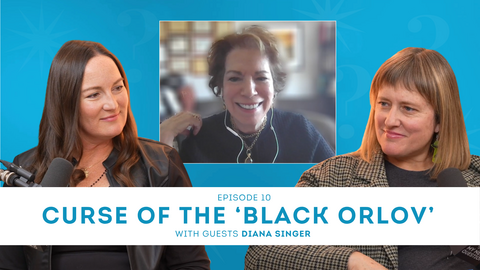
Episode 10: This Episode Is Haunted Diana Singer shared the stories of two “cursed” diamonds on this month’s podcast, which was inexplicably riddled with technical issues.

IndependentsOct 21, 2026
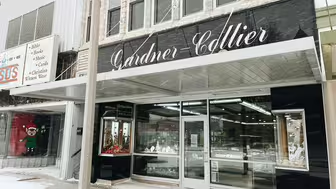
Gardner-Collier Jewelry to Close After 9 Decades in BusinessThe family-owned jeweler has three locations across Missouri and Iowa.

SourcingOct 21, 2026
Venetia Mines Final Carats Ahead of 2-Year ShutdownThe De Beers-owned diamond mine in South Africa is being put on ice as part of a round of previously announced cost-cutting measures.

CollectionsOct 21, 2026
Helzberg, Nordstrom Carrying New Jewelry Collection From Off-WhiteThe collection centers designs with clean geometric lines, chunky sculptural pieces, and recognizable details from the luxury fashion brand.
SourcingOct 21, 2026
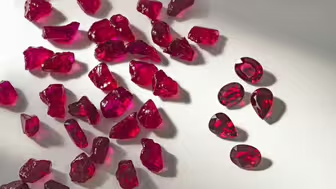
Gemfields’ Mixed-Quality Ruby Auction Earns $52MThe miner said it saw particularly strong prices for larger, fine-quality rubies at the sale.

CrimeOct 20, 2026
Security Guard Charged With Murder in Shooting at Texas MallThe guard opened fire on a man who was smashing a jewelry display case at La Gran Plaza in Fort Worth last week, police said.
IndependentsOct 20, 2026
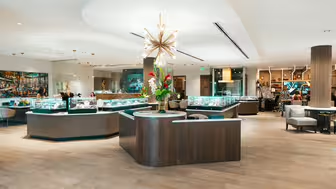
David Gardner’s Jewelers Unveils Newly Expanded, Revamped ShowroomThe Texas jeweler added 2,000 square feet to its reimagined showroom, complete with a new design studio and an event space.
SourcingOct 20, 2026
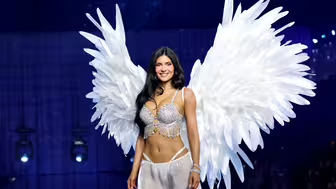
The $50M Victoria’s Secret ‘Fantasy Bra’ By The NumbersJacob & Co.'s diamond masterpiece is the most expensive Fantasy Bra ever worn on the Victoria’s Secret Fashion Show runway.

CollectionsOct 20, 2026
Mignon Faget’s Collection Chooses Handmade Over AIThe “Atelier” collection was inspired by the tools, rituals, and objects in an artist’s studio as a quiet rebuttal to an automated world.
MajorsOct 19, 2026
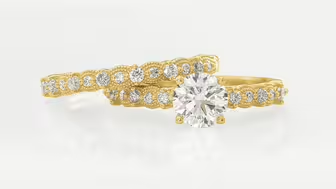
The Knot to Acquire Rival Wedding Planning Platform ZolaThe pending acquisition is an “exciting opportunity” for wedding vendors to grow their business, said The Knot Worldwide’s CEO.

SourcingOct 19, 2026
Jewelry Design Competition Show Airs in Thailand"The Secret Gems" features eight Thai jewelry brands paired with a team of young craftspeople who create jewelry together to win challenges.

CollectionsOct 19, 2026
John Hardy Enters the Medallion Chat With Talisman Collection The brand’s “Modern Talisman” capsule collection introduces pendants inspired by the mythology, natural world, and spiritual ethos of Bali.
IndependentsOct 19, 2026
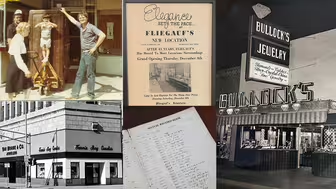
The Stories of 5 Jewelers Celebrating Their Centennials in 2026Independent jewelers from New Mexico to New Jersey answer the question: What has kept your store in business for 100 years?
SurveysOct 16, 2026
How Inflation, Gas Prices Will Affect Holiday Sales The NRF is expecting holiday sales to increase this year, but consumers and retailers alike are facing Grinch-like headwinds.