







ColumnistsSep 08, 2026
Peter Smith: Humor Is No Laughing MatterColumnistsSep 14, 2026
Sherry Smith: Stop Waiting for December to Save Your Christmas
The stores that have a great December are the ones that made good decisions in August, September, and October, Sherry Smith writes.


Sherry Smith is a principal partner at The Retail Smiths, a consultancy for retailers and vendors. She can be reached at sherrytrs@gmail.com.
By the time most retailers start thinking seriously about Christmas, Christmas has already been decided. Not by the calendar, but by the decisions they made months earlier.
The stores that have a great December are rarely the ones working hardest in December.
They’re the ones that made better decisions in August, September, and October, before a single strand of tinsel went up.
Christmas doesn’t start in November, and it isn’t won in December. It’s decided in August.
That idea was the foundation of a recent episode of The Resilient Retail Club podcast, hosted by retail strategist Catherine Erdly, and it’s a mindset shift independent jewelers should sit with right now.
Here’s why.
Q4 carries too much weight to wing it.
Industry estimates consistently indicate that 30 to 40 percent of annual retail revenue is generated during the holiday quarter.
For independent jewelers, December alone typically accounts for somewhere in the 19 to 25 percent range of annual sales. The U.S. Census Bureau recently pegged the figure at more than 18 percent for jewelry stores specifically, with industry estimates running a bit higher still.
That level of sales concentration doesn’t leave room for improvisation. A modest miscalculation in October compounds by December.
A late floor set or a delayed marketing push doesn’t just cost you those days. Research from Field Agent and SASR found that a late seasonal reset can cut early sales by as much as 25 to 40 percent before the display even has a chance to perform.
Meanwhile, products that build early sales momentum tend to keep it. NielsenIQ has found that items ranking in the top sales quintile in the first weeks are 1.7 times more likely to sustain that performance for the rest of the holiday season.
Translation: the retailers who show up ready in October aren’t just early. They’re compounding an advantage that late movers never catch up to.
Our own channel felt this last December.
According to Tenoris, independent jewelers’ sales rose 5.4 percent year-over-year in December 2025—but that growth was almost entirely a price story, not a demand story.
Consumers bought roughly 10 percent fewer pieces than the prior December while paying about 17 percent more per item.
A rising average ticket can mask a real decline in units and traffic underneath it.
If your December “worked” last year, it’s worth checking to see which of those two forces did the heavy lifting.
The consumer isn't waiting for you to get ready.
Shoppers have quietly moved the finish line.
The National Retail Federation has found that roughly half of U.S. adults now begin their holiday shopping in October or earlier, and a growing share say they’re shopping earlier specifically to spread out their budgets and beat both inflation and inventory shortages.
If your assortment, your marketing calendar, and your staffing plan are still being figured out in November, you’re not late to the season. You’re late to your own customer.
The stores that have a great December are rarely the ones working hardest in December.
They’re the ones that made better decisions in August, September, and October, before a single strand of tinsel went up.
Christmas doesn’t start in November, and it isn’t won in December. It’s decided in August.
That idea was the foundation of a recent episode of The Resilient Retail Club podcast, hosted by retail strategist Catherine Erdly, and it’s a mindset shift independent jewelers should sit with right now.
Here’s why.
Q4 carries too much weight to wing it.
Industry estimates consistently indicate that 30 to 40 percent of annual retail revenue is generated during the holiday quarter.
For independent jewelers, December alone typically accounts for somewhere in the 19 to 25 percent range of annual sales. The U.S. Census Bureau recently pegged the figure at more than 18 percent for jewelry stores specifically, with industry estimates running a bit higher still.
That level of sales concentration doesn’t leave room for improvisation. A modest miscalculation in October compounds by December.
A late floor set or a delayed marketing push doesn’t just cost you those days. Research from Field Agent and SASR found that a late seasonal reset can cut early sales by as much as 25 to 40 percent before the display even has a chance to perform.
Meanwhile, products that build early sales momentum tend to keep it. NielsenIQ has found that items ranking in the top sales quintile in the first weeks are 1.7 times more likely to sustain that performance for the rest of the holiday season.
Translation: the retailers who show up ready in October aren’t just early. They’re compounding an advantage that late movers never catch up to.
Our own channel felt this last December.
According to Tenoris, independent jewelers’ sales rose 5.4 percent year-over-year in December 2025—but that growth was almost entirely a price story, not a demand story.
Consumers bought roughly 10 percent fewer pieces than the prior December while paying about 17 percent more per item.
A rising average ticket can mask a real decline in units and traffic underneath it.
If your December “worked” last year, it’s worth checking to see which of those two forces did the heavy lifting.
The consumer isn't waiting for you to get ready.
Shoppers have quietly moved the finish line.
The National Retail Federation has found that roughly half of U.S. adults now begin their holiday shopping in October or earlier, and a growing share say they’re shopping earlier specifically to spread out their budgets and beat both inflation and inventory shortages.
If your assortment, your marketing calendar, and your staffing plan are still being figured out in November, you’re not late to the season. You’re late to your own customer.
“The statement pieces you bring in to ‘pop’ during the holidays only earn their shelf space if they sell.”
– Sherry Smith, The Retail Smiths
The exercise most retailers skip is reviewing last December honestly.
Before you can build a smarter Christmas 2026, you must be honest about Christmas 2025, not from memory but from the data.
Big retail organizations run a formal “lessons learned” exercise every January while the season is still fresh.
If you didn’t do this exercise then, mid-August would have been your next best window and if that passed you by, then do it right now.
Sit down with 30 to 60 minutes and your real numbers and work through it, category by category.
Look at the following.
What actually drove your sales. Break Q4 down by month or look at it as a whole.
What percentage of your Christmas revenue came from your top sellers? If you isolated the items that made up 80 percent of your sales, could you name them?
Did you have your core covered? Bread-and-butter categories don’t sell themselves if they’re not in stock.
A store that sells out of its dependable, everyday gift-price-point pieces in the second week of December has a planning problem, not a demand problem.
Did you represent your aspirational pieces and did they move? The higher price-point, statement pieces you bring in to “pop” during the holidays only earn their shelf space if they sell.
If they didn’t, was it the wrong piece, the wrong price, or simply not enough exposure to the right customer?
What surprised you? Note both the good and the bad: items you were confident about that sat, and items you were timid on that sold out.
The sellouts deserve real scrutiny. What do you wish you’d bought two or three times as much of, and is that demand still relevant this year, or was it a one-off trend?
What drove your slow sellers to underperform? Wrong vendor, wrong price point, wrong color, wrong story. Know the “why,” not just the “what,” so you don’t repeat the decision.
Did your marketing and events work? Be honest. Which campaigns drove real, measurable sales, and which were nice for a few social posts but didn’t move the needle?
Which in-store events earned their labor cost, and which should be retired this year to protect your team from burnout?
If you can’t answer most of these from memory, that’s the point of the exercise.
Pull your sell-through reports, your email marketing history, your Instagram archive. The data will tell you far more than your recollection of a chaotic December.
Build a marketing binder; yes, an actual binder.
I’m a digital girl by nature, but this is one piece of low-tech infrastructure I kept running my own stores, and it’s the first thing I recommend to clients tackling this exercise.
Set up a binder with a tab for each month. Behind each tab, put a sheet protector and a few sheets of notebook paper.
The sheet protector holds the physical evidence of that month, a printed proof of the email blast, the direct mail piece, a screenshot of the social posts, the flyer from the in-store event.
The notebook paper is where you write your notes immediately after each promotion or event runs: what worked, what didn’t, and what you’d change.
Keep a printed copy of your annual marketing budget in the front of the binder. I keep mine as a digital worksheet that I update monthly, then print and drop in the front so it’s always in view when I’m making decisions.
The value isn’t nostalgia for paper. It’s that when you sit down in August to do the lessons-learned exercise above, you’re not hunting through a hard drive, three email accounts, and the camera roll on your phone trying to reconstruct what you did last December.
You flip to the tab, and it’s all there: the piece, the note, the result, side by side. That’s the difference between an honest review and a guess.
Pick one goal and let it drive everything else.
Once the lessons-learned work is done, resist the urge to fix everything at once.
Choose a single, clear goal for this Christmas. It might be a revenue target. It might be growing average transaction value.
Increasingly, for independents carrying too much aged inventory, it should be about profit and sell-through rather than top-line turnover alone, a Christmas that leaves you with clean, current stock in January instead of boxes of leftover product tying up cash.
Whatever the goal, every buying decision, every marketing dollar, and every staffing choice between now and December should be able to answer to it.
Plan for whether you can deliver it.
A sales goal is only real if your operation can support it.
Do you have the staff to serve the traffic you’re forecasting?
Enough packaging and supplies? A website that can handle the volume?
Coverage for when illness inevitably sweeps through a short-staffed team in mid-December?
Enough storage to hold the inventory your plan requires?
Demand you can’t fulfill isn’t a win. It’s expensive, and it’s the fastest route to a burnt-out team and a January no one wants to repeat.
Here is the bottom line.
Christmas is decided in the unglamorous work of reviewing what happened last year, choosing one goal instead of 10, and building a plan that can support it.
The retailers who treat August and September as prep season, not the off-season, are the ones who walk into January already looking forward to next Christmas instead of recovering from this one.
So, without looking, can you name your top 10 Christmas sellers from last year?
Editors' Picks
Sponsored by


More on Columnists



The Latest

CrimeOct 22, 2026
Jeweler Shot and Killed in His Suburban Cincinnati Store Tara Sinchuri was the owner of Everest Jewels in Fairfield, Ohio, and a father of three. He was found dead in his store on Tuesday.


MajorsOct 22, 2026
Neiman Marcus Has Gifts for the Jewelry Lover Who Has EverythingBespoke experiences from Buccellati and Verdura are on the retailer’s 2026 “Fantasy Gifts” list.


Events & AwardsOct 22, 2026
JIS Fall 2026 Reports Record-Breaking Attendance The number of participants at the fall show was up 12 percent.


Brought to you by
A Diamond Is Forever Launches 2026 Holiday Campaign Championing Natural DiamondsA Diamond Is Forever's holiday campaign reimagines natural diamond icons for a new generation celebrating individuality.


CollectionsOct 22, 2026
Billie Eilish, Finneas Co-Design Collection for John HardyThe Academy and Grammy award-winning siblings have collaborated with John Hardy on a new jewelry line inspired by their personal style.

Weekly QuizOct 22, 2026
This Week’s QuizTest your jewelry news knowledge by answering these questions.



PodcastsOct 21, 2026
Episode 10: This Episode Is Haunted Diana Singer shared the stories of two “cursed” diamonds on this month’s podcast, which was inexplicably riddled with technical issues.


IndependentsOct 21, 2026
Gardner-Collier Jewelry to Close After 9 Decades in BusinessThe family-owned jeweler has three locations across Missouri and Iowa.

Brought to you by
Open an Account, Get $50 Off Your First Order. No Code Needed.Built on Relationships. Refined by Craft.


SourcingOct 21, 2026
Venetia Mines Final Carats Ahead of 2-Year ShutdownThe De Beers-owned diamond mine in South Africa is being put on ice as part of a round of previously announced cost-cutting measures.

CollectionsOct 21, 2026
Helzberg, Nordstrom Carrying New Jewelry Collection From Off-WhiteThe collection centers designs with clean geometric lines, chunky sculptural pieces, and recognizable details from the luxury fashion brand.

SourcingOct 21, 2026
Gemfields’ Mixed-Quality Ruby Auction Earns $52MThe miner said it saw particularly strong prices for larger, fine-quality rubies at the sale.

CrimeOct 20, 2026
Security Guard Charged With Murder in Shooting at Texas MallThe guard opened fire on a man who was smashing a jewelry display case at La Gran Plaza in Fort Worth last week, police said.

IndependentsOct 20, 2026
David Gardner’s Jewelers Unveils Newly Expanded, Revamped ShowroomThe Texas jeweler added 2,000 square feet to its reimagined showroom, complete with a new design studio and an event space.

SourcingOct 20, 2026
The $50M Victoria’s Secret ‘Fantasy Bra’ By The NumbersJacob & Co.'s diamond masterpiece is the most expensive Fantasy Bra ever worn on the Victoria’s Secret Fashion Show runway.

CollectionsOct 20, 2026
Mignon Faget’s Collection Chooses Handmade Over AIThe “Atelier” collection was inspired by the tools, rituals, and objects in an artist’s studio as a quiet rebuttal to an automated world.

MajorsOct 19, 2026
The Knot to Acquire Rival Wedding Planning Platform ZolaThe pending acquisition is an “exciting opportunity” for wedding vendors to grow their business, said The Knot Worldwide’s CEO.

SourcingOct 19, 2026
Jewelry Design Competition Show Airs in Thailand"The Secret Gems" features eight Thai jewelry brands paired with a team of young craftspeople who create jewelry together to win challenges.

CollectionsOct 19, 2026
John Hardy Enters the Medallion Chat With Talisman Collection The brand’s “Modern Talisman” capsule collection introduces pendants inspired by the mythology, natural world, and spiritual ethos of Bali.
IndependentsOct 19, 2026
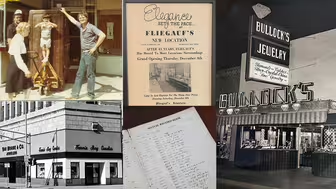
The Stories of 5 Jewelers Celebrating Their Centennials in 2026Independent jewelers from New Mexico to New Jersey answer the question: What has kept your store in business for 100 years?

SurveysOct 16, 2026
How Inflation, Gas Prices Will Affect Holiday Sales The NRF is expecting holiday sales to increase this year, but consumers and retailers alike are facing Grinch-like headwinds.

CollectionsOct 16, 2026
Christina Puchi’s Earrings Hold the UniverseOur Piece of the Week gathers the planets, represented by a variety of colored gemstones, in a pair of 14-karat yellow gold earrings.

IndependentsOct 16, 2026
Reeds Jewelers Expands, Relocates FlagshipThe New York-based jeweler is moving its Amherst flagship store to a larger location in nearby Snyder.

MajorsOct 16, 2026
Katy Chen Appointed Executive Vice President of Graff USA Chen, who worked at Cartier and Tiffany & Co., will lead retail sales and operations for the luxury jeweler’s 11 U.S. stores.

IndependentsOct 15, 2026
Retailer Hall of Fame 2026: Amy and Elise Greenberg For 40 years, sisters Amy and Elise Greenberg have helmed their 126-year-old family business, leading with appreciation and integrity.

WatchesOct 15, 2026
Stephanie Gottlieb’s New Movado Watches Are Made for Your Wrist StackMovado teamed up with the New York-based fine jewelry designer on a new collection of Movado Museum Velura watches.

SourcingOct 15, 2026
Signet Jewelers, Richemont May Join Bidder for De Beers, Report SaysThe two companies are reportedly in talks to join the Global Diamond Consortium, led by former De Beers CEO Gareth Penny, as per Bloomberg.
CollectionsOct 15, 2026
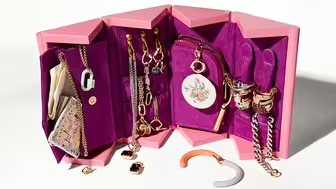
Wolf x Marla Aaron's New Jewelry Box Is for Some (Not All) of Your ThingsThe “Some of the Things” box follows the two larger “Everything” box designs with the look and function of antique sewing and toolboxes.