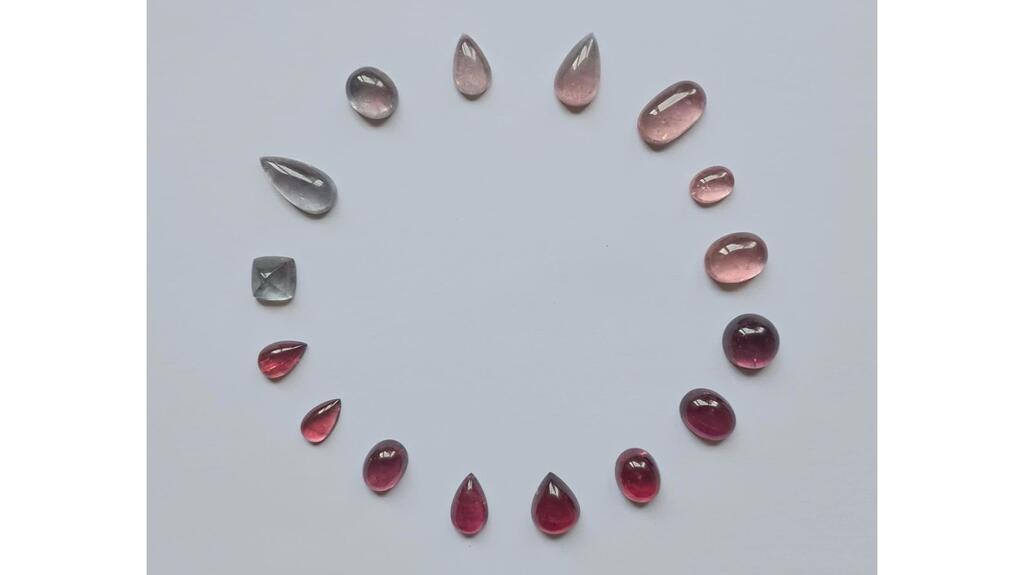
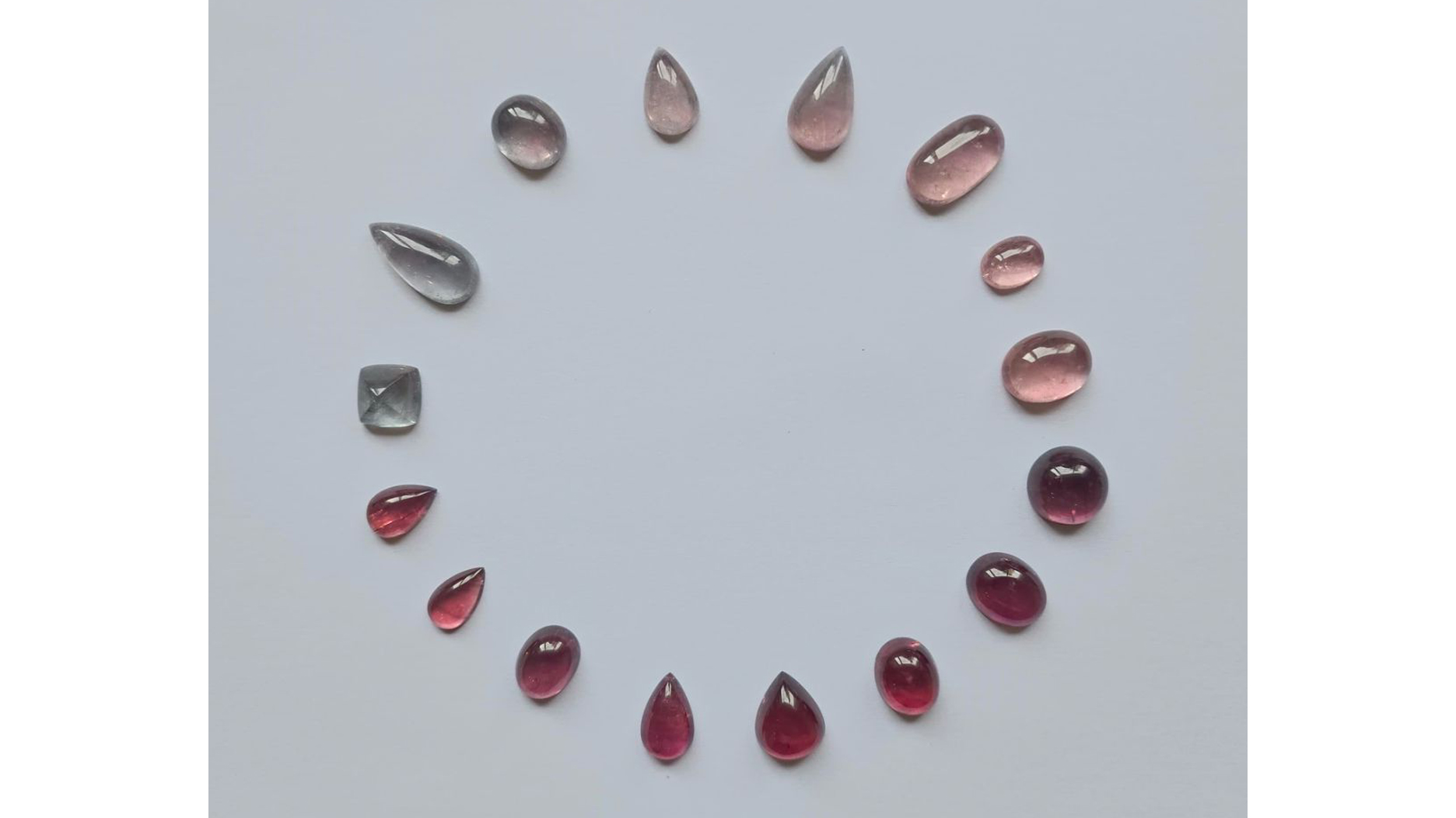
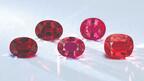
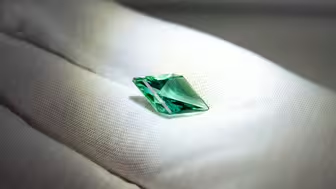
A peridot [left] and sapphires from Tanzania from Anza Gems, a wholesaler that partners with artisanal mining communities in East Africa
Tucson, Ariz.—Every year, Gemworld President Stuart Robertson and Brecken Branstrator, editor-in-chief of GemGuide, give an update on the state of the colored stone market at AGTA Gemfair Tucson.
The overview, which is typically lighthearted, began on a more serious note this year.
Robertson opened the talk, held Feb. 3, the second day of the show, with a look at the current economic factors that are directly impacting the industry.
He mentioned first the recent drop in consumer confidence—a data point Robertson said serves as an indicator of the strength of independent jewelers—which hit its lowest level since 2014 in January.
“Mom-and-pop independent jewelers drive the jewelry industry in the U.S.,” he said. “That is the bread and butter, that is the backbone. It is the neighborhood stores.”
He highlighted high prices on household staples, reminding the audience that jewelry is a non-essential product, meaning some consumers may opt to buy less expensive jewelry, or no jewelry at all, if they are spending more on everything else.
“What’s active today is either the really high end, scarce product, or it is the low end. The middle of the road that was the bread and butter of our industry has been very stagnant now,” Robertson said.
He also touched on the impact of tariffs, citing a study published recently by the Kiel Institute for the World Economy that found that 96 percent of the tariffs collected by the U.S. government have been paid by U.S. consumers.
He predicted the AGTA show would be an anomaly and said he was anticipating a strong show despite tariff concerns because many of the goods being traded at the show were in the United States before tariffs took effect.
“This show’s going to be a pretty good show, but that’s not going to be a true reflection of what’s happening, because we’re depleting at a rapid rate now what’s already here,” he said.
A new offering called "winter tourmaline" from the Cruzeiro mine, located in Brazil, that the miner debuted at the GJX show
Robertson said he also had discussions with the dealers across the street at the Gem & Jewelry Exchange (GJX) show. Those conversations revealed a different story, one where the impact of the tariffs already was apparent.
Some GJX dealers elected not to bring gemstones to the show that weren’t already in the U.S., Robertson said, but those who did struggled to close sales.
“Individuals that had U.S.-based offices and are selling goods that have been in the country from their stock are doing well. People that, for the first time, brought goods in on a carnet are having difficulty, because for the last five decades, this has been a show where if you buy something, you typically get to leave with it,” he said.
A carnet is an international customs document that allows travelers to temporarily export or import goods for commercial purposes without having to pay duty or value-added taxes on the goods.
Goods in the U.S. on a carnet cannot be delivered on the spot if sold; they must be exported and then reimported with all applicable tariffs paid.
Robertson said he knows at least one dealer from a Brazilian firm who had their goods on a carnet at the show for the first time. The tariff on goods imported into the U.S. from Brazil, a major supplier of tourmaline along with other gemstones, is currently 50 percent.
He also shared the experience of another dealer from Sri Lanka (20 percent tariff) who also had goods on a carnet at the show for the first time.
“As soon as people ask, he gives the pricing but explains he can’t deliver it, he’ll mail it back. And it kills the deal. Because the price is not really the price, because when it comes back in now, there’s going to be a customs payment due. So, we don’t know what the prices are going to be on a lot of material.”
Robertson also mentioned India (50 percent tariff, though a trade deal that will decrease the rate is in the works), another country integral to the gem trade.
Although India’s Gem and Jewellery Export Promotion Council reported a 44 percent year-over-year decline in gem and jewelry exports to the U.S., the country’s overall export volume remained virtually unchanged, he said.
“They simply were getting demand from other markets for those goods,” Robertson said. “So, these [tariffs] are not impacting the suppliers; it’s only impacting us.”
The rising price of metal is also having an impact on the industry. The price of gold is double what it was this time last year, and the price of silver has tripled.
The spikes are not driven by supply and demand from the jewelry industry.
Robertson explained, “A lot of this big run-up in metal prices was a direct result of the investing into metals as an alternative protection, because people are increasingly trying to figure out a defense to what they perceive to be economic chaos.”
“We still have a very high-end level of this industry that is consuming solid [gold] pieces and very expensive pieces, but that’s not what most of us have as customers,” — Stuart Robertson, Gemworld
As a result, some designers are getting creative with alternative materials, even setting higher-quality gemstones in metals like titanium and steel.
Other brands are exploring cost-effective ways to make gold-forward pieces. At the January Vicenzaoro show in Italy, Robertson said he saw signs advertising gold jewelry in “8-, 9-, 10-, 12-, 14-, 18-, or 22-karat gold.”
There were also promotions for “super-lightweight” styles, though Roberston noted concerns about the durability of these pieces.
“We still have a very high-end level of this industry that is consuming solid [gold] pieces and very expensive pieces, but that’s not what most of us have as customers. So, we do have some concerns about where things are going,” he said.
Over the past 20 years, prices for most colored gemstone varieties have been climbing. The category has evolved, and colored gemstones have more market share now.
“Small gallery-based designers, major jewelry brands, and colored stones are becoming the main profit centers [for the industry],” he said.
Robertson said it’s “a very good time” to be in the colored gemstone trade, despite the challenges, as younger generations have a broader definition of what constitutes fine jewelry.
“The industry is seeing greater use of non-traditional mediums. Designers no longer focus exclusively on gold, silver, and platinum, but are now exploring new materials, and doing more of this with limited designs. This curates a sense of demand always exceeding supply. It’s a smart move.”
Storytelling marketing that highlights origin and sourcing processes is also a continuing trend, Robertson said.
“The story about an item and how it’s sourced is now an important incentive for many consumers. Consumers’ belief they are helping to support communities where raw materials are mined is a popular and growing reason for people to interact in our industry.”
Related stories will be right here …
During her portion of the presentation, GemGuide Editor-in-Chief Branstrator touched on some of the trending colors, shapes, and designs while noting that defining patterns has proved to be a bit more difficult.
“We’ve never seen anything quite like the varied buying that’s been happening the past few years, [as buyers] find their way into new and interesting materials as they are looking for color substitutions and more affordable pricing for their customers,” she said.
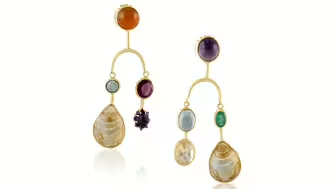
Titanium, porcelain, ceramic, leather, and wood are some of the materials that have been showing up in designer collections lately, along with beads incorporated into gold chains.
In some cases, the use of alternative materials is a way to cut down on the use of gold.
Last year, designer Marla Aaron debuted a capsule collection of gold and porcelain jewelry created in collaboration with German porcelain-maker Nymphenburg Porcelain.
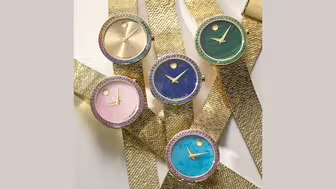
Opaque and hard stones, as opposed to enamel, are being used for inlay styles and even watch faces.
When it comes to faceted stones, pieces with big, colorful gemstone combinations, as well as elongated shapes, are doing well, Branstrator said.
Zircon is strong this year, particularly in orange and brown tones, and is priced favorably when compared with other stones in the market.
Buyers’ appetite for garnet is strong, notably in orange, and it is also favorably priced.
Demand for tourmaline has dropped a bit, Robertson added, but there is still some appetite for Brazilian material, although the finer stones are scarce.
“Most of what you see in the larger, really nice Brazilian material, that’s not new. It’s recycled back into the trade,” Roberston said.
He mentioned hearing favorable comments regarding peridot, and dealers told him citrine and amethyst are selling well.
Colored gemstones also continue to be a popular choice for bridal, with some vendors reporting that bridal pieces are 20 percent of their color sales.
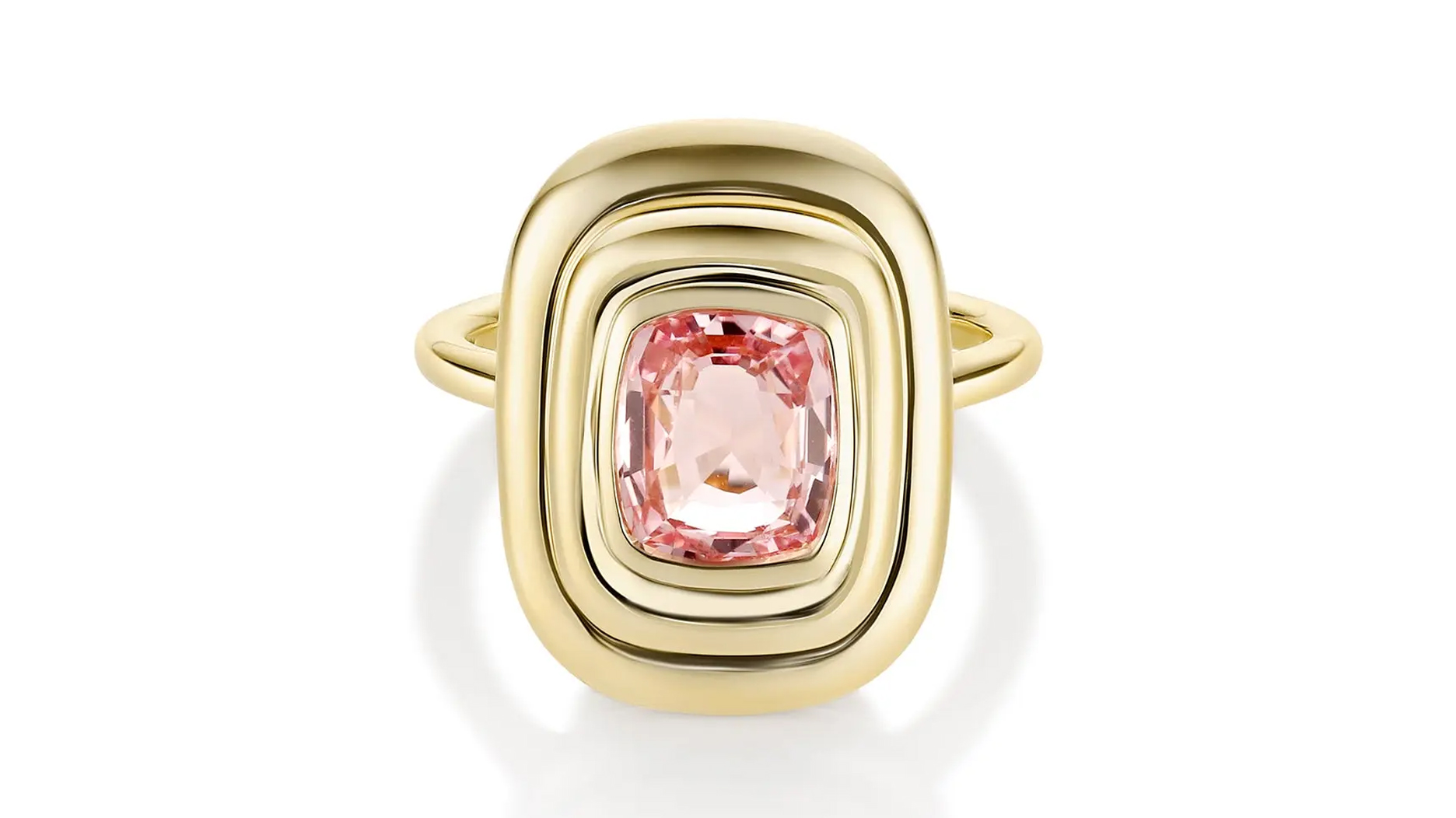
The 2.16-carat padparadscha sapphire “In-Orbit” ring from Marrow Fine ($16,500)
Sapphire and emerald remain the top choices, but consumers also are choosing Montana sapphires, zircon, spinel, and garnets for engagement rings.
“We don’t really even see that as price-related as much as a consumer focus on story and design and finding something that’s unique,” Branstrator said.
Estate and antique jewelry also are hot, for reasons beyond the return of vintage styles.
Some buyers and designers may be looking for these pieces to source stones or even metals at a more affordable price point for repurposing, she said.
For retailers, stocking antique and estate pieces can attract a different type of customer.
It can also be a more cost-effective way for a store to grow their inventory.
Robertson and Branstrator also discussed the mining landscape.
“Everybody’s waiting for the next big find.” — Brecken Branstrator, GemGuide
There have been fewer developments in sourcing countries this year, Branstrator said, though she did mention that Malawi—which produces several gemstones, including sapphires and garnets, as well as rare earth minerals—has banned raw mineral exports.
Artificial intelligence and technology continue to develop for uses in gemstone tracing, origin determination, and treatment detection, Branstrator said, though it is playing less of a role in exploration.
“Everybody’s waiting for the next big find,” she said.
She also noted that the general rising cost of labor is affecting supply.
“Some of the big miners we know are seeing a lot of unrest on the ground with the locals around them, stuff that’s really cutting into supply in an already tight environment. So naturally, that’s just pushing the prices higher as well,” she said.
Robertson added that the increased volume of colored gemstone production from large-scale mining operations also pushes prices higher.
“We mentioned last year that 90 percent of labor accounts for about 10 percent of production now, and that’s the small scale. Large-scale mining has a bigger financial advantage. It’s a more efficient way of mining, but … [when] you introduce your material into the market through invitation-only auctions, there’s a direct correlation to the price,” he said.
Ruby, for example, is priced too high for any segment of the market other than the high-end stores, Robertson said.
This is one factor that has led to more openness toward gem materials of varying qualities, along with a sustainability-driven desire to find uses for all mined material and consumers’ desire for something “different.”
“I would say [unique color presentation] is probably the biggest driver of the Montana sapphire trend that’s very strong again this year. It’s those blended colors, it’s those parti colors. It’s the unusual zoning, because people want something that looks different now,” Robertson said.