

The NRF is expecting holiday sales to increase this year, but consumers and retailers alike are facing Grinch-like headwinds.

Rocks On: Rubies and Name Recognition
The future of the ruby market seems to lie with the stones originating from Africa, but will the trade ever hold them in the same high regard as it does the Burmese stones?

New York--Rubies have long sat atop the gem world, serving as one of the most historically significant stones and commanding at times the highest per-carat price of any gem.
Burmese rubies, in particular, always have been regarded with a certain reverence, encapsulating the best the gemstone has to offer.
Yet in recent years the market has had to find a new direction in which to head, as the Burmese material remains banned for import into the United States due to government sanctions and the source itself dries up.
A few African sources, particularly in Mozambique and Madagascar, are offering the gemstone world new supplies that, a few experts say, are on par in terms of quality with the Burmese stones.
What remains to be seen, however, is how long these supplies will last and how long it will take for the market to fully accept them.
Supply
One of the major challenges for the supply side of rubies is the fact that the import of Burmese rubies remains banned in the U.S., cutting off supply to the American market.
Even if the ban wasn’t in place, the Burmese sources for the gemstone have been drying up, which means there isn’t much new material available on the market anyway, according to Benjamin Hakimi of gemstone supplier Colorline Inc.
However, material from Tanzania, Madagascar and especially Mozambique is reviving the ruby supply and can offer high-quality material comparable to that from Burma for a fraction of the price. Hakimi called these African rubies a “lifesaver” for manufacturers, as it is bringing ample affordable material to market.
According to gemstone dealer John Buechner, when Mozambican rubies that were comparable in color and clarity to the Burmese material came onto the market around 2008, they were selling for about one-sixth the price of Burmese rubies. Today, though, “that gap has narrowed and they are about half the price,” he said, though he noted that the stones still offer a great value.
Hakimi, meanwhile, said that he sees the African material at, on average, about 30 percent cheaper.
There’s also a major player involved in the ruby market now, which will have a lot of influence on where the market is headed.
Gemfields holds a 75 percent stake in the Montepuez mine in Mozambique. It received the license to mine the site in 2012 and held its first ruby auction in
CEO Ian Harebottle told National Jeweler via email that the company has targeted production volumes in 2016 to be largely in line with what they achieved in 2015.
In the company’s financial year ended June 30, 2015, production at Montepuez totaled 8.4 million carats of ruby and corundum.
In the following six-month period to Dec. 31, the company said it mined 2.1 million carats of ruby and corundum with a focus on lower grade--meaning its output contains a smaller portion of valuable minerals--but significantly higher value alluvial ore resources. This resulted in a 341 percent increase in overall volume of higher quality rubies recovered.
According to Harebottle, Gemfields also is focused on the short-term goal of continuing to support the downstream market by absorbing the supply while also trying to stimulate increased global consumer demand, as they have done with Zambian emeralds.
The company said that it will continue to provide a base of support across the pipeline, including sales staff training, consumer education and various direct marketing campaigns.
Demand
As of late, there’s been a bit of a slowdown in buying in the Far East, both Hakimi and Harebottle said, with the latter adding that the decrease in demand from the Chinese market has been partially offset by the signs of recovery coming from America.
Even so, demand for rubies, while perhaps not at the level seen for sapphires, is still very high, especially for the higher quality, unheated material. And while U.S. customers might have a much harder time getting their hands on the Burmese material, overseas buyers still are asking for it.
Most buyers these days also are looking for “pigeon’s blood” rubies, especially in Hong Kong, Jeremy Hakimi of Colorline said. “They’re always looking for royal blue (sapphires) and pigeon’s blood (rubies). Maybe not as much here (in the U.S.), but that’s definitely what most people want.”
Buechner predicted that given the (so far) consistent supply of material on the market due to the more recent sources, along with consumers becoming much more educated about rubies and their rarity, demand for the gemstone in the U.S. will continue to rise and so will price.
And given rubies’ long history and staying power, it’s obvious that while demand might dwindle here and there based on certain economic factors, the stone is here to stay.
“The fact that rubies have such a broad-based appeal means that demand is not dependent on any single market, with considerable potential for growth when appropriately supported by improved availability, design, manufacture, distribution and promotions,” Harebottle said.
Pricing
Benjamin Hakimi said that with the introduction of the new material from Africa, he thought that prices for rubies might soften a bit, but they haven’t; prices have remained stable.
Gemfields also is seeing price and demand stability for the stone, as the market becomes more comfortable with the material that is being produced in its mine and seeing its high quality.
Harebottle told National Jeweler that this stability is further being supported by the company’s method of bringing rubies to market--a “highly transparent” auctioning platform where large amounts of high quality rough is offered on a consistent basis that in turn “results in improved economies of scale, broader-based distribution networks and considerably enhanced marketing potential.”
As a result, he said, the company has seen more high-end jewelry houses beginning to work with and promote Mozambican rubies, such as Cartier using a 15.29-carat Mozambican ruby at the center of its Reine Makéda necklace for the 27th Biennale des Antiquaires in Paris last year.
Hakimi too said that with the African material, it’s just a question of traction and how long it will take for the sources to really gain steam with buyers.
The country is putting out a lot of high quality, untreated material, so that’s not the issue, he said.
While there was a lot of buying at first, there’s been a bit of a slowdown since, especially in Hong Kong, which he thinks has to do with the geopolitical environment there. And, it “just doesn't yet have the name” that Burmese material does.
The lead-glass problem
A big issue that’s been plaguing the ruby market for a while now is lead glass-filled rubies. While these stones might have their place in the market, problems have been stemming from non-disclosure.
Since lead glass-filled rubies--which are different from treated rubies--are vulnerable to damage from something as simple as a common household cleaner, if a seller does not disclose the fact that the stone is a “composite” ruby and it later is ruined, that could “erode confidence in gemstones,” Benjamin Hakimi said.
Fortunately, he added, lead glass-filled rubies are fairly easy to identify ahead of time. (According to the Accredited Gemologists Association, one should look for a heavily crazed or fractured surface, flash effects or gas bubbles using a loupe or a microscope.)
Hakimi also noted that these issues surrounding lead glass-filled rubies are creating “headaches and costs” for Colorline because they now need to send “anything substantial” to a gem lab for certification.
Yet this increased need for ruby reports comes with a silver lining, of sorts.
A number of grading laboratories now are including color terminology on their gem reports, which could be good for jewelers because it could “help them quantify a sale,” Hakimi said. Of course, on the other hand, it could also hurt the sale if the report instead includes “vocabulary that’s not appealing” to a buyer who sees it.
“The bottom line is, you have to look at the (color of the) stone and see if you like it,” he said.
With the addition of color terminology to lab reports also comes the issue of consistency--for example, what one lab might consider a “pigeon’s blood” ruby could be different from what another lab might label as such. (This is an issue being addressed by a few labs, including the Gemmological Institute SSEF and Gübelin Gem Lab, which recently harmonized their standards for color and quality terms.)
Meanwhile, Gemfields’ Harebottle also noted another issue facing not only rubies but gemstones on a broader level.
For centuries, gemstones were regarded as one of the highest-valued possession one could have. Yet in recent years, due in large part to increased global communications and marketing, other luxury items--including shoes, handbags and perfumes--also have managed to enter this realm.
Harebottle said there has been more promotion behind such items, resulting in a decreasing market share for gemstones.
This is a large part of what Gemfields is trying to address with its efforts around the stones it mines, and Harebottle remains hopeful for the future.
“We have little doubt that what we have seen to date for emeralds, rubies and, in fact, all colored gemstones, is just the beginning,” he said.
The Latest

Our Piece of the Week gathers the planets, represented by a variety of colored gemstones, in a pair of 14-karat yellow gold earrings.
The New York-based jeweler is moving its Amherst flagship store to a larger location in nearby Snyder.

Experience gemstones with greater precision and comfort than ever before.


Chen, who worked at Cartier and Tiffany & Co., will lead retail sales and operations for the luxury jeweler’s 11 U.S. stores.


For 40 years, sisters Amy and Elise Greenberg have helmed their 126-year-old family business, leading with appreciation and integrity.

It’s a term Smith coined and felt compelled to share following a bad experience with an aborted flight and an unfeeling flight attendant.
Submit your pieces for a chance to win in this year's competition.

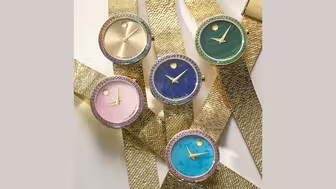
Movado teamed up with the New York-based fine jewelry designer on a new collection of Movado Museum Velura watches.
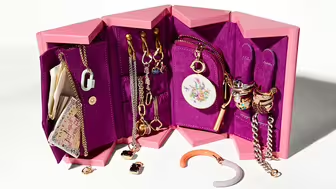
The “Some of the Things” box follows the two larger “Everything” box designs with the look and function of antique sewing and toolboxes.

Fourth-generation jewelers Coleman and Mitchell Clark exemplify the best qualities of their predecessors: humility, modesty, and confidence.

Tiffany & Co. continued its full-scale store renovation project while Bulgari’s high jewelry collection generated “record-breaking revenue.”

This year’s sessions feature leading voices from human rights, legal, and conservation organizations.

The high-end jewelry retailer was sold to private investment firm Middle West Partners and a group of longtime clients.

The jewelry designer has partnered with Sofer Jewelry to distribute her 85-piece lab-grown diamond collection.

Dunn, this year’s Single-Store Independent inductee, is passionate about innovation and telling the story of natural diamonds.

The 24-carat fancy intense pink diamond ring could fetch up to $18 million at the November sale.

The “Island Jewel” candle honors New York City and Puerto Rico and raises money for the island’s water relief efforts.
The partnership will give JA members access to preferred pricing, exclusive benefits, technology solutions, education, and resources.

Stores should expect to see the most customers on Nov. 27, and Christmas week is expected to be hectic too, as Dec. 25 falls on a Friday.

The charm, our Piece of the Week, features brown diamond frozen hot chocolate topped with white diamond whipped cream and a ruby straw.

The top lot of Elmwood’s recent fine jewelry sale in London was a 1.84-carat, D color Tiffany & Co. solitaire diamond ring.

The watch company agreed to sell a 95 percent interest to a group comprised of F.P. Journe, Chanel, and Swiss watch exec Pierre Jacques.

This round of tariff refunds is for importers that have sued over IEEPA tariffs in the Court of International Trade and won.

It revisits the brand’s most requested silhouettes, from "Pillow"-set necklaces and bracelets to "Signature"-set rings and earrings.

The trade-only event includes buying opportunities as well as educational sessions on artisanal mining, the new Paraíba source, and more.

Ara Chanakian, a jeweler at Pattons, took home top honors in every category at Jewelers of Louisiana’s annual jewelry design competition.