Amy and Elise Greenberg are sisters at the helm of Greenberg’s Jewelers, which operates seven locations across Iowa, Nebraska, and South Dakota.
Editor’s Note: This story first appeared in the print edition of the 2026 Retailer Hall of Fame. Click here to see the full issue.
Greenberg’s Jewelers is the largest family-owned jewelry chain in Iowa.
Led by third-generation co-owners Amy and Elise Greenberg, the retailer has seven locations across Iowa, Nebraska, and South Dakota.
Over the past 40-plus years, the sisters have worked together to help the business expand and evolve through their commitment to personalized customer service and the company’s internal culture of integrity and trust, carrying on a legacy that dates to the early 20th century.
Jacob Greenberg, Amy and Elise’s paternal grandfather, founded Greenberg’s Jewelers more than a century ago.
One of four children, Jacob immigrated to the United States from Lithuania by himself around 1900, eventually landing in Iowa, where he had family.
He was 14 years old and already a trained watchmaker.
He later became a railroad-certified watchmaker. Sioux City, Iowa, was a big rail hub at the time and railroad-certified watchmakers were an important part of keeping trains running safely and on time.
He inspected, cleaned, certified, and repaired watches in the window of a crockery shop, a store that sold plates, bowls, cups, and serving dishes.
Jacob eventually took over the crockery shop. As he became better known and more familiar with the jewelry business, he added diamonds to the store’s inventory and tacked on the family name.
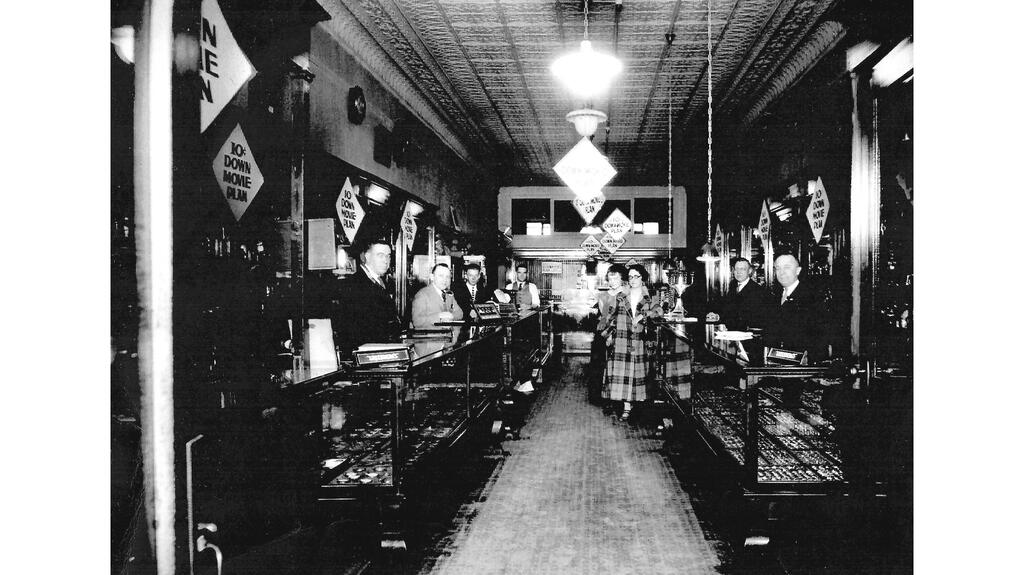
Greenberg’s Jewelers original store in approximately 1920. Jacob Greenberg is pictured on the left side of the store, second from the front in a light gray suit.
In 1942, Jacob’s son Ray Greenberg took over the business, joined by his wife, Ann, in 1953.
Ray and Ann had three daughters. Amy and Elise are the oldest; the youngest, Louise, isn’t in the jewelry business.
“We definitely were the product of retail parents,” Amy says. “We did credit jewelry, and I remember us three girls in the back of the car while my dad was out collecting the payments for the jewelry.”
They tied bows on boxes at Christmas and helped around the store at other times of the year as well.
“We used to do our own catalogs, which was pretty innovative at the time,” Amy says.
“They would hand type all the labels, and we would put them on the little flyers or brochures we were sending out. Then we would have to sort them by ZIP code … There were thousands upon thousands, and we’d put them together and tie twine around them.”
“And [dad] would pay us a penny a piece,” Elise adds.
They also remember spending time with family outside the store, though the seemingly never-ending tasks involved in running a small business crept into home and family life from time to time.
“Dad would sit at the card table and tag merchandise so he could be at home with the family but still get work done,” Elise says. “He would tally up the invoices, and he had an adding machine, and we liked to pull the crank up on the adding machine, because it was all manual.”
Coming Back Around “You can go to school anywhere you want, but you have to leave the state of Iowa.”
Amy remembers being given this directive when she graduated from high school because their parents wanted their girls to experience something different.
Amy attended the University of Arizona in Tucson, Arizona, earning a degree in finance, and Elise earned a degree in accounting from Ohio State University in Columbus, Ohio, later becoming a certified public accountant.
Following graduation, they both took jobs in their respective fields, while back at home Greenberg’s began to evolve.
“My dad said, ‘If we’re going to grow this business, it’s going to take all of us. Would you guys be interested?’” -Elise Greenberg, Greenberg’s Jewelers
In the 1970s, the first regional mall in Sioux City, Iowa, opened, and Greenberg’s was the only local jeweler to go into the mall, encouraged by members of the Leading Jewelers Guild (LJG), an organization the store is still involved with today.
“Everybody [at LJG] was just encouraging my dad, because in California, there were so many malls. In Texas, there were so many malls. In Florida too, and people were just opening lots of multi-door stores,” Elise says.
It was a successful move, and the developer asked if they wanted to see another available space in nearby Sioux Falls, South Dakota.
Elise recalls, “My dad said, ‘If we’re going to grow this business, and I think we can, it’s going to take all of us. Would you guys be interested?’”
Amy and Elise willingly accepted his invitation and joined the family business around 1985.
At the time his daughters joined, Ray was thinking about the future of the business, but like most dedicated retailers, he never left.
“He never really retired. He ended up getting sick, but he would still come in and hang out and look at diamonds … He’d get this twinkle in his eye,” Elise says.
Greenberg’s Jewelers first mall store, which opened in 1980
Ray was a self-taught gemologist.
He loved diamonds and sharing his knowledge with others, including Elise, whom he nicknamed ‘Eagle Eye One,’ and the store’s inventory manager, Lisa Brown, or ‘Eagle Eye Two.’
“We had a lot of ‘eagles’ in the office,” Elise jokes.
Amy most enjoyed working with and learning from her father about merchandising.
“If we put seven pieces in the store, and they’re kind of expensive, and within the first four or five months, we’ve already sold like four or five pieces … I get excited about that,” she says.
Over the years, as they came into their own at the store, Amy and Elise’s bond grew stronger.
“My favorite thing is working with my sister,” Elise says. “We’re so different, but we always have the same goal in mind.
“We may not attack everything the same way, but we always find a way to get to an answer that we’re both happy with. Or can live with, sometimes,” she says.
In Their DNA While many retailers say their employees feel like they’re family, that belief is invariably tested.
Both Ray and Ann suffered from extended illnesses. Ray died from a rare heart condition in 2007, and Ann from Alzheimer’s in 2009.
It was a difficult period of time for the family. Keeping things afloat required both personal perseverance and a dependable team.
“It doesn’t matter what’s happening in your life. You still have a company to run,” Amy says.
“One of the things we’ve learned along the way is to have really good infrastructure in your business. And to trust the people you work with and give them the responsibility and respect to be able to take care of things when we’re not there, and they have. We’ve got a really top-notch team.”
The sisters say the tight relationships within their team are woven into “the company DNA.”
“There is a real culture of integrity with how we relate to our clients and work with our clients. Our team wants to work for a company—and we want to have a company—that has those relationships all the way down the line, from the customer to the top,” Elise says.
“If we’re not achieving that, we’re not reaching our goals.”
Members of the Greenberg’s Jewelers team at the 2026 Purple Heart Soirée, a charity event for the Iowa Chapter of the Alzheimer’s Association
Greenberg’s has several employees who have been with the company for decades.
Brian Maas, the director of operations, has worked at Greenberg’s for 18 years but says he still feels like one of the newest employees.
He says the company’s high retention rate is the product of treating people fairly and paying them well, giving employees no reason to look elsewhere.
“I think everyone feels appreciated for the job they do,” he says. “They’re allowed to do their job and if they need help, someone’s there to help them.”
Maas has three decades of experience in the jewelry industry.
Previously, he worked at Sterling Jewelers, the U.S. subsidiary of Signet Jewelers, which owns Kay Jewelers, Zales, and Jared, among others.
He then worked for an Indianapolis-based family-owned retailer until it was bought and he decided to move on.
At the time, the Maas family had four young children and was established in Indianapolis, and moving was a big consideration.
Related stories will be right here …
He originally declined the interview with Greenberg’s but was persuaded to fly out and give it a chance.
“I met with Elise and Amy and [Amy’s husband] Scott, and once I met them, it was a no-brainer,” he says.
The Maas family relocated to Omaha, Nebraska, the midpoint in the Greenberg’s chain of stores.
“When I came to Greenberg’s, I really had an opportunity to do what I believed in, which was great customer service, great quality of merchandise, and that fit in with [what] Greenberg’s was already doing.”
Maas says the store does business “the old-fashioned way,” which is to say they mail thank you cards and call customers on their birthdays, little extras that fall under the heading of the essential practice of clienteling.
They also stick to their values.
He often thinks about a moment from one of the team’s weekly executive meetings.
They were discussing how to handle a problem or question with a client and Elise asked, “What is the right thing to do?”
“That really stuck with me … They want to do the right thing,” Maas says.
Service That Goes Beyond Jeff Paultz, Greenberg’s sales manager, has been with the store for 40 years, and he’s witnessed the evolution of the business over the years.
The sisters have embraced innovation, and their open-mindedness has served the business well, particularly in an age when so many inflexible retailers have gone the way of the dodo.
“If we did business the way my grandfather did business, we would be like a dinosaur: extinct.” -Elise Greenberg, Greenberg's Jewelers
“[Amy and Elise] have given us the flexibility to do things differently, to always look for new ways to do business, and to accept different ideas. They listen on a daily basis to what’s important to everybody at the store level,” he says.
One thing that has remained is the company’s dedication to great customer service.
“It’s amazing how we have adapted and changed with the times to meet the customers’ needs,” he says.
The retailer’s payment plan offerings, which Paultz prefers to call “investment plans,” stands out to him as an example of a program that’s evolved.
“Those have changed with the times to include interest-free financing and longer terms to help people really afford something they didn’t think they could ever afford. That’s been fantastic,” Paultz says.
Offering credit goes way back at Greenberg’s.
“There’s a picture I have somewhere archived where my grandfather [asked for] 10 cents down and a movie ticket to buy your engagement ring, because an in-law had movie theaters in Sioux City,” Elise says.
Whether it’s a cash sale or a financed purchase, exceptional customer service is a given.
“Every customer is treated with respect and dignity, and there’s a fun environment to help them through some of the most important purchases of their life,” Paultz said.
Greenberg's Jewelers in Ankeny, Iowa
The Greenberg’s team loves to celebrate joyful milestones with their community, but they also know how to support their customers during difficult times.
Brenna Goodman is the assistant manager at the Water Tower Place location, one of the two Greenberg’s stores in West Des Moines, Iowa.
She started with the company just three years ago yet has already experienced their generosity firsthand.
One of the most outstanding examples involves a family that was affected by a devastating EF4 tornado that ripped through Greenfield, Iowa, in 2024.
After the disaster, a former Greenberg’s employee reached out to the retailer to let them know her aunt had lost her wedding set, which had been purchased at Greenberg’s years ago, in the storm.
“Their entire house was destroyed, but the thing that hurt the most, to them, was that she lost her ring,” Goodman recalls.
“The Greenbergs gifted some money towards her new ring purchase, and their whole family came. We had wine for them. We shut down the entire store for them, and it was just very heartfelt and happy, and tears just that whole entire night. We’ll always remember them, and they will be customers for multiple generations.” Another 100 Years As of June 2026, four members of the fourth generation are working in the family business.
Elise’s daughter Alexa Kreisberg, Amy’s daughter Allison Sachnoff, and her son-in-law Drew Fagot work alongside Amy’s son Josh Sachnoff, who has been with Greenberg’s for more than a decade.
“Sitting side by side with my Lexi and working together is beyond wonderful. I never thought I would feel this way,” Elise says. “Now I really know how dad felt, and it’s bringing tears to my eyes.”
It is a relief for Amy and Elise to know the future of the business is secure, as they have been working on a succession plan for five years.
The team is excited to see what the next generation will bring to the table, a testament to their trust in the family.
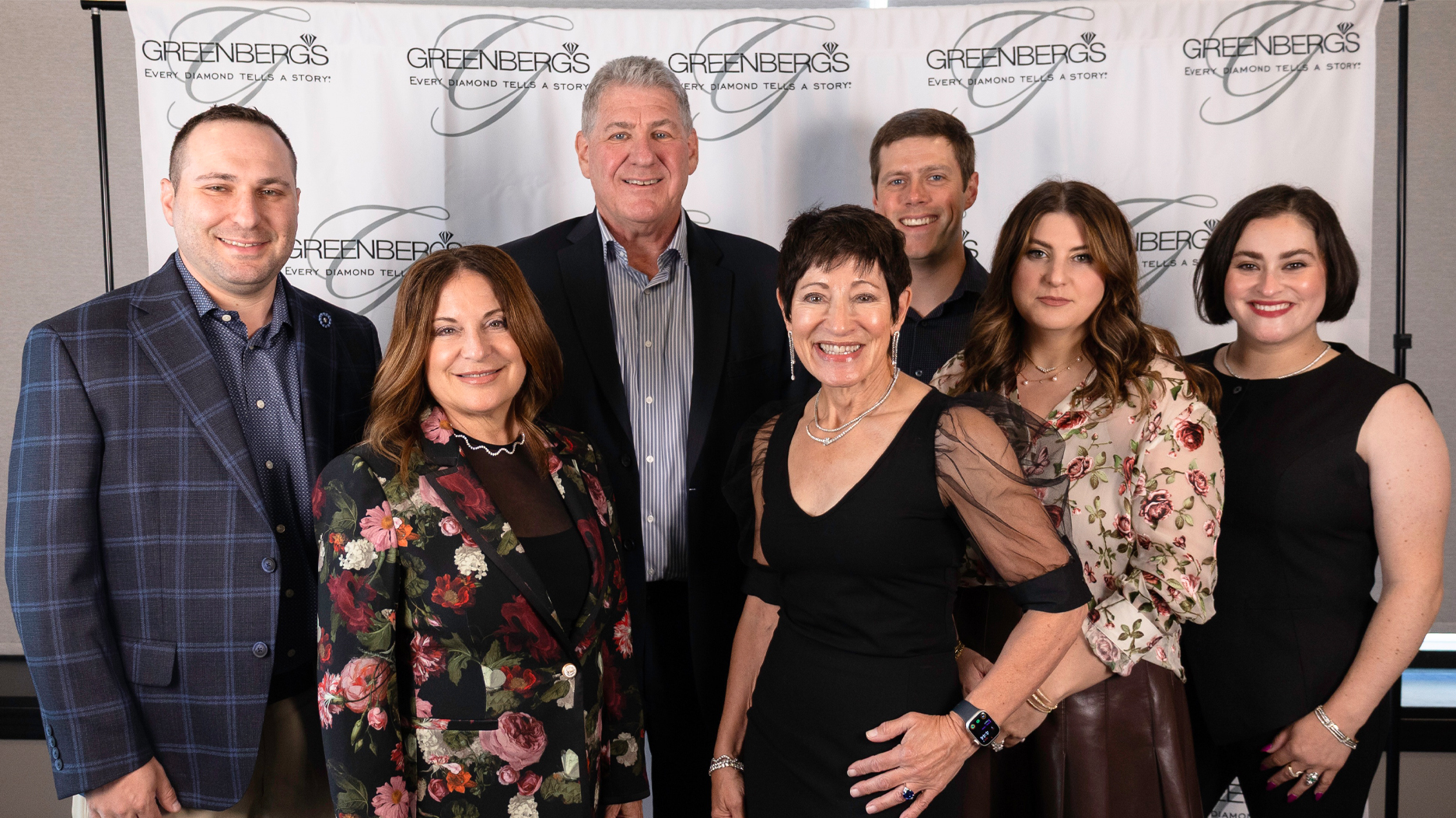
The Greenberg family. Back row: Josh Sachnoff, Scott Sachnoff, and Drew Fagot. Front row: Amy Greenberg, Elise Greenberg, Allison Sachnoff, and Alexa Kreisberg
Brown, the store’s inventory manager (a.k.a. Eagle Eye Two), says their new ideas are refreshing.
“It makes you think too. You have to be more creative in your thinking,” she says.
Greenberg's has endured a lot, from surviving major health disruptions such as the 1918 Spanish flu pandemic and COVID-19, to economic disasters like the Great Depression and the more recent Great Recession. Now they must cope with the inventory and merchandising problems caused by the price of gold soaring to historic highs.
“Everything changes all the time,” Elise says. “If we did business the way my grandfather did business, we would be like a dinosaur: extinct.”
If change is the only constant, the Greenbergs don’t seem to fear it, and neither do their employees, some of whom, like staff accountant Kristy Bovee, have been there through it all.
“[Kristy] started when I was in grade school, and she still works there. She worked with my grandparents, she worked with my parents, and she works with us, and now, she’s going to work with our kids,” Amy says.
Brown has known the next generation of Greenbergs since they were kids and remembers them spending time with her own children at the store, sorting beads and doing other projects.
She says they also took time to do their own thing before deciding to join the family business, a parallel to Amy and Elise’s journey.
“You can see that they want to make the business better and grow, and they’re not just coming into the business because they have to,” Brown says. “They’re coming into the business because they want to, and they want to see it continue to be successful and be here for another 100 years.”