






SurveysJul 30, 2026
Consumer Confidence Slips in JulySurveysAug 21, 2026
These Are 2026’s Hottest Retailers, Says NRF
The retailers at the top of the list offer affordable products and fun, discovery-fueled experiences.


Dick’s Sporting Goods, one of the National Retail Federation’s “Hot 25 Retailers” this year, was highlighted for its “high-quality” shopping experience.
Washington, D.C—The National Retail Federation has unveiled its list of this year’s 25 hottest retailers in the United States.
The “Hot 25 Retailers” list, compiled by market research company Kantar, highlights the fastest-growing retail companies in the U.S., ranking them by increases in domestic sales between 2024 and 2025.
Chinese retailer Miniso, a newcomer to the top 25 list, claimed the No.1 spot.
Miniso stocks everything from popular blind box toys and plushies to skincare and stationery, collaborating with brands like Harry Potter, the Powerpuff Girls, The Peanuts, and Hello Kitty and Friends.
The retailer has been expanding in the U.S., with 53 percent sales growth in the U.S. in 2025.
Dick’s Sporting Goods, also new to the list this year, landed at No. 2 with 49 percent sales growth since acquiring Foot Locker, followed by Japanese retail chain Daiso Sangyo (26 percent), Primark (24 percent), and Five Below (23 percent).
Notably, many of the retailers in the top five offer budget-friendly products, which are increasingly appealing in a K-shaped economy.
“Value is a huge story in this year’s list,” said Rachel Dalton, head of retail insights, Americas, Kantar, in an NRF blog post.
“Many shoppers, including higher-income shoppers, are looking for the best value for them. There’s a lot of looking for deals, looking for the best prices, trading down, and buying private labels.”
The top retailers also encourage fun, discovery-driven shopping experiences.
These stores are also ideal stops for shoppers looking to indulge in “little treat culture,” the trend of getting yourself a little something nice, particularly in response to a bad day or as a pick-me-up.
“The main takeaway for me is that you can do well, irrespective of this economic environment, if you have a product and approach that appeals to the consumer,” said NRF Chief Economist and Executive Director of Research Mark Mathews in another NRF blog post about the list.
In 2025, the top five were JD Sports, Primark, Fast Retailing, Shell, and Abercrombie & Fitch.
Compared to last year’s list, both Daiso Sangyo and Five Below made strong gains this year, jumping from the top 15 last year into the top five, while Primark slipped two spots.
Some of the biggest movers on this year’s list were Ollie’s Bargain Outlet, which jumped to No.7 from No. 21 last year; CVS was at No. 9, from No. 25.; and Japanese retailer Muji took the No. 10 spot, from No. 14 last year.
Mathews described this year’s list as “eclectic,” noting it reflects the changing interests of today’s consumers and the diversity of the U.S. population with several Asian retailers making their mark.
The “Hot 25 Retailers” list, compiled by market research company Kantar, highlights the fastest-growing retail companies in the U.S., ranking them by increases in domestic sales between 2024 and 2025.
Chinese retailer Miniso, a newcomer to the top 25 list, claimed the No.1 spot.
Miniso stocks everything from popular blind box toys and plushies to skincare and stationery, collaborating with brands like Harry Potter, the Powerpuff Girls, The Peanuts, and Hello Kitty and Friends.
The retailer has been expanding in the U.S., with 53 percent sales growth in the U.S. in 2025.
Dick’s Sporting Goods, also new to the list this year, landed at No. 2 with 49 percent sales growth since acquiring Foot Locker, followed by Japanese retail chain Daiso Sangyo (26 percent), Primark (24 percent), and Five Below (23 percent).
Notably, many of the retailers in the top five offer budget-friendly products, which are increasingly appealing in a K-shaped economy.
“Value is a huge story in this year’s list,” said Rachel Dalton, head of retail insights, Americas, Kantar, in an NRF blog post.
“Many shoppers, including higher-income shoppers, are looking for the best value for them. There’s a lot of looking for deals, looking for the best prices, trading down, and buying private labels.”
The top retailers also encourage fun, discovery-driven shopping experiences.
These stores are also ideal stops for shoppers looking to indulge in “little treat culture,” the trend of getting yourself a little something nice, particularly in response to a bad day or as a pick-me-up.
“The main takeaway for me is that you can do well, irrespective of this economic environment, if you have a product and approach that appeals to the consumer,” said NRF Chief Economist and Executive Director of Research Mark Mathews in another NRF blog post about the list.
In 2025, the top five were JD Sports, Primark, Fast Retailing, Shell, and Abercrombie & Fitch.
Compared to last year’s list, both Daiso Sangyo and Five Below made strong gains this year, jumping from the top 15 last year into the top five, while Primark slipped two spots.
Some of the biggest movers on this year’s list were Ollie’s Bargain Outlet, which jumped to No.7 from No. 21 last year; CVS was at No. 9, from No. 25.; and Japanese retailer Muji took the No. 10 spot, from No. 14 last year.
Mathews described this year’s list as “eclectic,” noting it reflects the changing interests of today’s consumers and the diversity of the U.S. population with several Asian retailers making their mark.
The opportunity for exploration and discovery was key to making the top 25 list.
“There’s just that fun experience, where consumers love to discover new things and enjoy shopping,” said Dalton. “You see that theme across the board.”
Limited-time offers, rotating assortments, and creative experiences lead to excitement and return visits, she said.
The discovery experience is driving growth, she said, particularly with retailers that are innovative and quick to jump on social trends.
Dick’s Sporting Goods’ investment in its Dick’s House of Sport concept stores, which can feature batting cages and rock-climbing walls, has been a success, said Dalton.
“There are a lot of opportunities in how they organize their stores, make it easy, and connect to athletes. It’s [a] high-quality experience when shopping,” she said.
While affordable retailers dominate the list, there is a lone luxury brand, RH, at No. 19.
“You have high-income consumers who are looking for luxury,” said Dalton. “Restoration Hardware has done some really interesting things, and it all goes back to that unique experience.”
The home furnishings company doubles as an entertainment space, with rooftop restaurants and wine bars.
Retailers are getting good at experimental retail, said Mathews, and people still value shopping.
The line between in-store and online shopping is increasingly blurred, he noted, and the option customers pick has more to do with convenience than anything else.
Interestingly, how retailers distinguish between online and in-store sales is becoming “increasingly flawed,” he said. While one retailer may categorize a BOPIS (buy online, pick up in store) transaction as in-store, another will call it an online sale.
“The numbers don’t even make any sense anymore,” said Mathews.
“We’ve actually stopped referring to e-commerce in any of our projections or any of our data. It’s really just about the experience.”
Whether online or in-store, the love for shopping is there, but concerns about affordability linger.
Inflation is impacting their psyche and how consumers choose to spend their money, Mathews said.
“And yet, the data shows that despite their unease, the consumer is spending. The dichotomy that we’ve seen over the last several years is that the consumer doesn’t feel great about the economy or inflation, but retail spending has remained robust,” he said.
Consumers are choosing to spend on things that matter to them, with spending on family and loved ones hitting near-record rates, said NRF.
They are easing their spending on dining, travel, and streaming services, but not their retail spending, said Mathews.
The diversity of the U.S. population is also reflected in the line-up.
Dave Marcotte, Kantar senior vice president, noted the Asian influence on the list, with Chinese Miniso and Japanese Daiso Sangyo in the top five.
“[Daiso Sangyo] is a real, bona fide value discount store,” said Marcotte. “But part of what makes it so interesting is its authenticity. I think anyone would walk into a Daiso store in the U.S. and think that a Daiso in Japan would be just like it.”
Japanese culture has had a longstanding influence on young consumers in the U.S., through music, art, and drama, said the NRF.
That wave of cultural appreciation lifted Fast Retailing (No. 6), Muji (No. 10), and U.S.-based Asian supermarket chain 99 Ranch Market (No. 15) onto the list.
Many of these stores are “masters at merchandising,” said Marcotte, and play into the discovery aspect, like with blind boxes.
Marcotte and Dalton both noted the running theme of private label brands throughout the list, which can help build customer loyalty while offering value.
Costco’s (No. 18) Kirkland Signature brand may be one of the most well known.
“Private label is growing. It’s a huge area of focus for many of our clients, as well. Many of them are launching private label as if they are national brands, and they’re doing a lot of the same things in terms of brand building,” said Dalton.
Overall, the list gives retailers the opportunity to see where they stand, said Dalton, and to note the themes and trends.
Retailers’ ability to appeal to consumers with “the right product, the right emotion, the right identity, and the right experience” can overcome any economic environment, said the NRF.
If that’s the focus, retailers will find success, said Mathews.
“Because even if people are feeling tight, they’re willing to trade away other things if they desire what you’re selling,” he said.
See the full list here.
Editors' Picks
Sponsored by
More on Surveys
The Latest


PodcastsOct 21, 2026
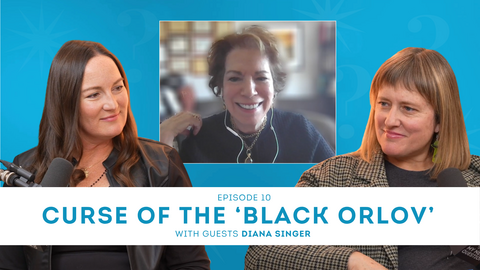
Episode 10: This Episode Is Haunted Diana Singer shared the stories of two “cursed” diamonds on this month’s podcast, which was inexplicably riddled with technical issues.

IndependentsOct 21, 2026
Gardner-Collier Jewelry to Close After 9 Decades in BusinessThe family-owned jeweler has three locations across Missouri and Iowa.

SourcingOct 21, 2026
Venetia Mines Final Carats Ahead of 2-Year ShutdownThe De Beers-owned diamond mine in South Africa is being put on ice as part of a round of previously announced cost-cutting measures.


Brought to you by
A Diamond Is Forever Launches 2026 Holiday Campaign Championing Natural DiamondsA Diamond Is Forever's holiday campaign reimagines natural diamond icons for a new generation celebrating individuality.


CollectionsOct 21, 2026
Helzberg, Nordstrom Carrying New Jewelry Collection From Off-WhiteThe collection centers designs with clean geometric lines, chunky sculptural pieces, and recognizable details from the luxury fashion brand.

Weekly QuizOct 15, 2026
This Week’s QuizTest your jewelry news knowledge by answering these questions.


SourcingOct 21, 2026
Gemfields’ Mixed-Quality Ruby Auction Earns $52MThe miner said it saw particularly strong prices for larger, fine-quality rubies at the sale.


CrimeOct 20, 2026
Security Guard Charged With Murder in Shooting at Texas MallThe guard opened fire on a man who was smashing a jewelry display case at La Gran Plaza in Fort Worth last week, police said.

Brought to you by
Open an Account, Get $50 Off Your First Order. No Code Needed.Built on Relationships. Refined by Craft.

IndependentsOct 20, 2026
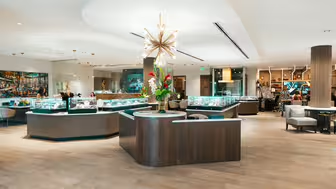
David Gardner’s Jewelers Unveils Newly Expanded, Revamped ShowroomThe Texas jeweler added 2,000 square feet to its reimagined showroom, complete with a new design studio and an event space.

SourcingOct 20, 2026
The $50M Victoria’s Secret ‘Fantasy Bra’ By The NumbersJacob & Co.'s diamond masterpiece is the most expensive Fantasy Bra ever worn on the Victoria’s Secret Fashion Show runway.

CollectionsOct 20, 2026
Mignon Faget’s Collection Chooses Handmade Over AIThe “Atelier” collection was inspired by the tools, rituals, and objects in an artist’s studio as a quiet rebuttal to an automated world.
MajorsOct 19, 2026
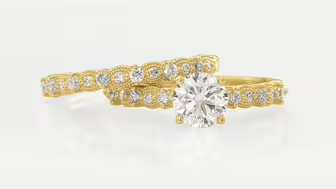
The Knot to Acquire Rival Wedding Planning Platform ZolaThe pending acquisition is an “exciting opportunity” for wedding vendors to grow their business, said The Knot Worldwide’s CEO.

SourcingOct 19, 2026
Jewelry Design Competition Show Airs in Thailand"The Secret Gems" features eight Thai jewelry brands paired with a team of young craftspeople who create jewelry together to win challenges.

CollectionsOct 19, 2026
John Hardy Enters the Medallion Chat With Talisman Collection The brand’s “Modern Talisman” capsule collection introduces pendants inspired by the mythology, natural world, and spiritual ethos of Bali.
IndependentsOct 19, 2026
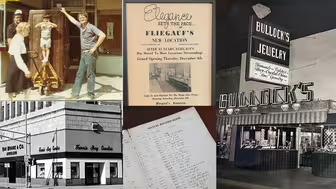
The Stories of 5 Jewelers Celebrating Their Centennials in 2026Independent jewelers from New Mexico to New Jersey answer the question: What has kept your store in business for 100 years?
CollectionsOct 16, 2026
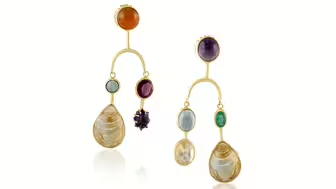
Christina Puchi’s Earrings Hold the UniverseOur Piece of the Week gathers the planets, represented by a variety of colored gemstones, in a pair of 14-karat yellow gold earrings.
IndependentsOct 16, 2026
Reeds Jewelers Expands, Relocates FlagshipThe New York-based jeweler is moving its Amherst flagship store to a larger location in nearby Snyder.

MajorsOct 16, 2026
Katy Chen Appointed Executive Vice President of Graff USA Chen, who worked at Cartier and Tiffany & Co., will lead retail sales and operations for the luxury jeweler’s 11 U.S. stores.

IndependentsOct 15, 2026
Retailer Hall of Fame 2026: Amy and Elise Greenberg For 40 years, sisters Amy and Elise Greenberg have helmed their 126-year-old family business, leading with appreciation and integrity.

ColumnistsOct 15, 2026
Peter Smith: What Is the Culture REP?It’s a term Smith coined and felt compelled to share following a bad experience with an aborted flight and an unfeeling flight attendant.

WatchesOct 15, 2026
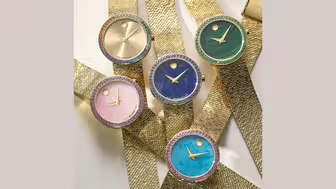
Stephanie Gottlieb’s New Movado Watches Are Made for Your Wrist StackMovado teamed up with the New York-based fine jewelry designer on a new collection of Movado Museum Velura watches.
SourcingOct 15, 2026
Signet Jewelers, Richemont May Join Bidder for De Beers, Report SaysThe two companies are reportedly in talks to join the Global Diamond Consortium, led by former De Beers CEO Gareth Penny, as per Bloomberg.
CollectionsOct 15, 2026
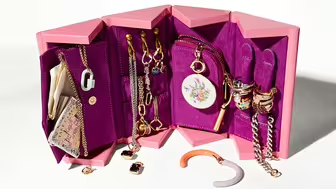
Wolf x Marla Aaron's New Jewelry Box Is for Some (Not All) of Your ThingsThe “Some of the Things” box follows the two larger “Everything” box designs with the look and function of antique sewing and toolboxes.

IndependentsOct 14, 2026
Retailer Hall of Fame 2026: Coleman and Mitchell ClarkFourth-generation jewelers Coleman and Mitchell Clark exemplify the best qualities of their predecessors: humility, modesty, and confidence.

SourcingOct 14, 2026
Manuel Marcial de Gomar, ‘The Emerald Whisperer,’ Dies at 90The gem hunter, whose 70-year career was defined by adventure and exploration, is remembered for his steadfast faith and sense of wonder.
FinancialsOct 14, 2026
LVMH’s Jewelry Brands Turn in ‘Very Good’ Performance in Q3 Tiffany & Co. continued its full-scale store renovation project while Bulgari’s high jewelry collection generated “record-breaking revenue.”

Events & AwardsOct 14, 2026
Chicago Responsible Jewelry Conference Releases 2026 ProgramThis year’s sessions feature leading voices from human rights, legal, and conservation organizations.