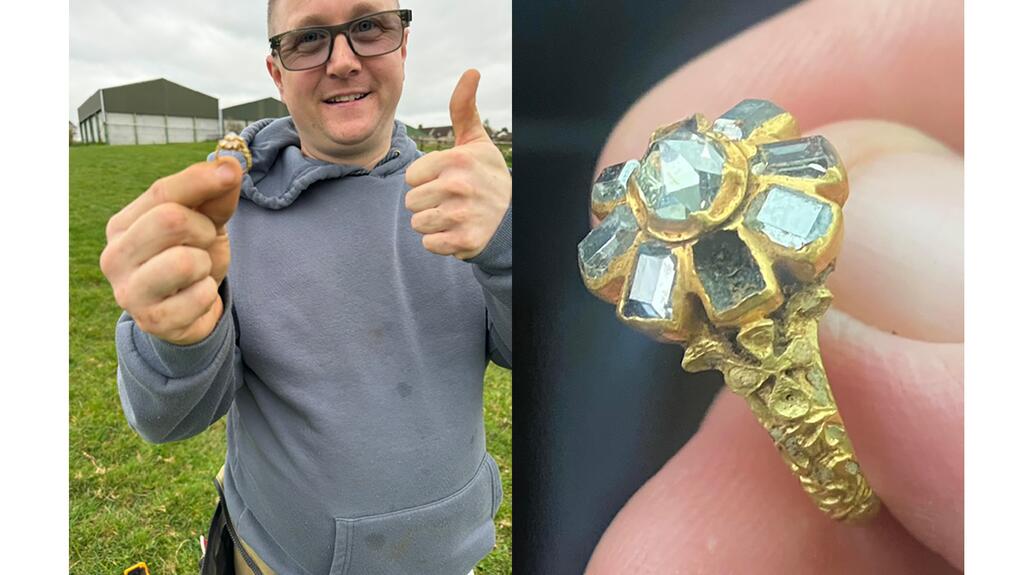
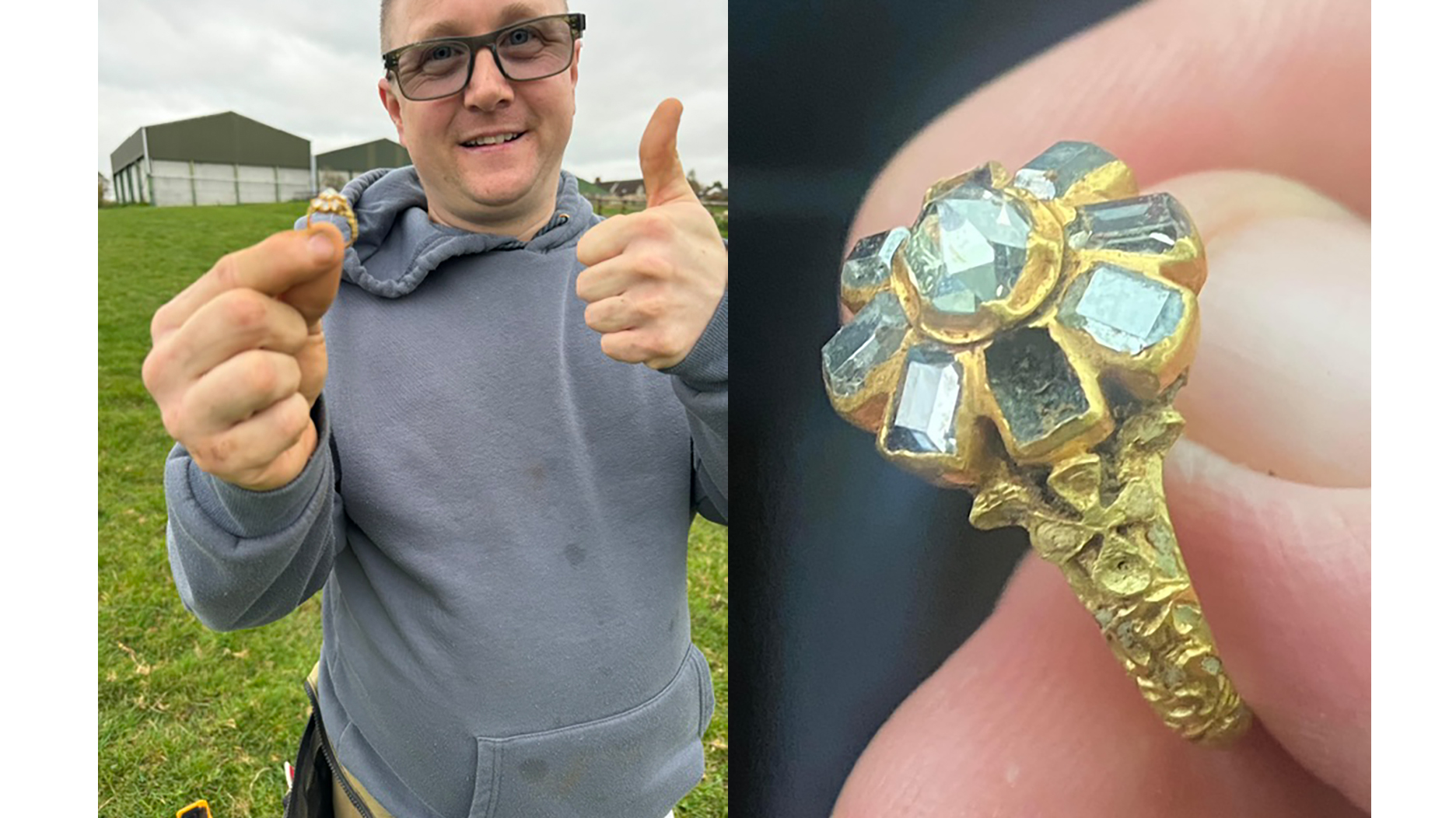
Metal detectorist Stuart Jones discovered “The Evesham Diamond Ring,” likely from the late 16th to early 17th century, last year.
London—A man with a metal detector uncovered a diamond cluster ring in the U.K. that dates to the late 16th to early 17th century, and it’ll soon be up for auction at Noonans in London.
Dubbed “The Evesham Diamond Ring” after the area where it was discovered, the ring could sell for £15,000 to £20,000 ($20,000 to $27,000) at Noonans upcoming “Jewellery, Silver, & Objects of Vertu” auction, scheduled for June 23-24.
The ring was found about two years ago by 42-year-old Stuart Jones of Solihull, England.
Jones has been a metal detectorist for several years, inspired by the incredible treasures others in the metal detecting community have found, Noonans said.
In November 2024, Jones checked out a spot in the village of Wormington near Evesham, Gloucestershire.
It was nearing the end of the day when he found the diamond ring.
“When I recovered the ring, I was absolutely overwhelmed with joy. I was over the moon. Everyone around me was congratulating me and taking photographs while I held the ring,” Jones said.
Stuart Jones called the ring his “once-in-a-lifetime find.” Two diamonds were missing when he found it, but he was able to recover them from the soil, Noonans said.
The ring has a flowerhead bezel, with a cluster of eight “hogback” diamonds surrounding a center rose-cut diamond.
“The hogback diamond is an early form of diamond cut, from when diamond faceting was in its infancy, taken from the side of a diamond crystal to produce a rectangular-shaped cut diamond, sometimes ridged, sometimes with a table facet cut to the top, as in this case,” explained Laura Smith, jewelry specialist at Noonans.
“The diamonds are white but have a slightly gray appearance compared with modern faceted diamonds due to the way they are cut, as in the 16th to 17th century the focus was on external rather than internal reflection.”
The shape is similar, but the top of the hogback is rounded, not flat.
The cluster ring would’ve been quite fashionable at the time.
“Early 17th-century baroque taste required grand rings to make an impression from a distance,” Smith said.
“Fashions in diamond rings moved from solitaires towards groups of small stones arranged in decorative patterns: rosettes, pansies, crosses, fleur-de-lys, etc.”
The underside of the bezel is decorated with a flowerhead in turquoise and white enamel. The shoulders have applied quatrefoil flowerheads and the band is engraved with scrolls and foliage.
Notably, the gold tested as 19.2 karats, said Smith, the exact gold standard set by King Edward I in 1300.
In that time, goldsmiths were forbidden to work with gold less than the “Touch of Paris” standard, which is 80 percent pure gold, or 19.2 karats.
Related stories will be right here …
Frances Noble, head of jewelry at Noonans, said, “We cannot be sure of previous ownership, but as a very fine, and valuable, ring, it is likely to have been the property of someone of considerable wealth and status, possibly even royal status.”
She noted that the area where Jones found the ring was within five miles of two important manor houses that existed in the 16th century.
Snowshill Manor was given by King Henry VIII to Catherine Parr, his sixth and final wife, when they married in 1543. It was later passed on to Parliament member Francis Bulstrode, then purchased in 1561 by Henry Willoughby.
To the west of the site where the ring was found is Wickhamford Manor, which originally belonged to the Abbey at Evesham.
It was seized during the dissolution of the monasteries, said Noonans. Queen Elizabeth I gave it to Parliament member Thomas Throckmorton in 1562.
In 1594, Sir Samuel Sandys, a Parliament member and the son of the archbishop of York, purchased Wickhamford Manor.
Sandys was married to Mercy Culpepper, daughter of Thomas Culpepper, who was a friend of Henry VIII until he was executed for his alleged attempt to seduce Queen Catherine Howard, the king’s fifth wife.
When Jones found the ring near these historical sites, one of the diamonds fell out into his hand and another was missing.
At the suggestion of a metal detecting club administrator, he scooped up the surrounding soil where he had found the ring in hopes of finding the missing diamond.
Jones, who had some experience panning for gold, found the missing stone.
The ring will be sold with all diamonds present, said Smith, but two diamonds are loose in their settings. It is being sold as is, with any modernization or repair work left to the discretion of the buyer.
“Without any doubt, the ring is the best find I have ever made. I describe it as my ‘once-in-a- lifetime find.’ Like many detectorists, I have always dreamed of finding something truly special, but I never imagined I would discover an item of this significance,” Jones said.
The proceeds from the sale of the ring, which has been disclaimed as treasure, will be shared between Jones and the landowner.
U.K. law requires people to report any potential treasures they find to the authorities, giving museums a chance to acquire them before the finder can decide to either keep or sell the item.
“Metal detecting finds always attract a lot of attention when they come up for auction and in this sale, we have 14 metal-detected jewels,” Smith said.
The gold band features engraved floral details and a memento mori skull motif on the front, with traces of black enamel.
The interior is inscribed with “Ri Busby STP ob 5 Ap 95 aet 89” and has a double-struck maker’s mark “G” within a shield punch.
Busby, who served as the headmaster of Westminster school for 55 years, left money to friends in his will to buy remembrance rings, a common practice at the time, said Noonans.
Ninety foliate rings were purchased, with 20 featuring a skull motif, as per archival record at Westminster.