






MajorsJan 26, 2026
Francesca’s To Close All StoresMajorsFeb 04, 2026
What Designers Should Know About Saks Global’s Bankruptcy
From how to get an invoice paid to getting merchandise returned, JVC’s Sara Yood answers some complex questions.


Saks Global, parent company of Saks Fifth Avenue, Neiman Marcus, Bergdorf Goodman and other retailers, filed Chapter 11 last month, leaving vendors with unanswered questions.
New York—Saks Global filed for Chapter 11 bankruptcy protection last month as the retailer continues to struggle under the weight of its debt and declining sales in its department stores.
In the months leading up to the bankruptcy filing, the company’s vendors reported having trouble getting their invoices paid.
The retailer’s liabilities are estimated to be between $1 billion to $10 billion, and it owes money to more than 10,000 creditors, as per court documents.
Its top unsecured creditors include Chanel ($136 million) and Kering ($59.9 million), with jewelry brands like David Yurman and Roberto Coin also owed millions.
The ongoing bankruptcy has left vendors with outstanding invoices and a lot of questions.
Last week, National Jeweler connected with Sara Yood, CEO and general counsel at the Jewelers Vigilance Committee, to help shed some light on the situation.
What is Chapter 11 bankruptcy?
When a company files for Chapter 11 bankruptcy protection, it’s looking to reorganize. It is not the same as a Chapter 7 bankruptcy, in which a company liquidates and ceases to exist.
“It allows the company in bankruptcy to shed certain debts, get rid of certain contracts or commitments, get new financing, and emerge on the other side with a new capital structure,” explained Yood.
As part of the proceedings, Saks Global secured financing of $1.75 billion, including $1.5 billion from an ad hoc group of its senior secured bondholders and $240 million of incremental liquidity from its asset-based lenders.
The funds will be used to strengthen its balance sheets and continue operations, it said.
Does this mean Saks doesn’t have to pay the money it owes its vendors?
Not exactly; a Chapter 11 filing doesn’t absolve Saks from ever paying a jewelry designer or any other vendor.
However, Yood said, jewelry designers may receive less than full value, or no value, on their claims as a result of the proceedings.
Can I still receive money owed to me by Saks?
It is possible to get that money back, but it does depend on the type of claim the designer has.
In general, a creditor has to file proof of a claim, Yood said. When Saks exits bankruptcy, there will be a court-approved reorganization plan.
This plan will outline the repayment of various claims, including the amounts that will be paid.
“It will also depend on what arrangements are negotiated with the debtors by each creditor, including for products supplied during the bankruptcy,” she said.
“Designers should seek counsel from an attorney familiar with bankruptcy practice to understand what rights they have and how best to enforce them.”
Related stories will be right here …
In the months leading up to the bankruptcy filing, the company’s vendors reported having trouble getting their invoices paid.
The retailer’s liabilities are estimated to be between $1 billion to $10 billion, and it owes money to more than 10,000 creditors, as per court documents.
Its top unsecured creditors include Chanel ($136 million) and Kering ($59.9 million), with jewelry brands like David Yurman and Roberto Coin also owed millions.
The ongoing bankruptcy has left vendors with outstanding invoices and a lot of questions.
Last week, National Jeweler connected with Sara Yood, CEO and general counsel at the Jewelers Vigilance Committee, to help shed some light on the situation.
What is Chapter 11 bankruptcy?
When a company files for Chapter 11 bankruptcy protection, it’s looking to reorganize. It is not the same as a Chapter 7 bankruptcy, in which a company liquidates and ceases to exist.
“It allows the company in bankruptcy to shed certain debts, get rid of certain contracts or commitments, get new financing, and emerge on the other side with a new capital structure,” explained Yood.
As part of the proceedings, Saks Global secured financing of $1.75 billion, including $1.5 billion from an ad hoc group of its senior secured bondholders and $240 million of incremental liquidity from its asset-based lenders.
The funds will be used to strengthen its balance sheets and continue operations, it said.
Does this mean Saks doesn’t have to pay the money it owes its vendors?
Not exactly; a Chapter 11 filing doesn’t absolve Saks from ever paying a jewelry designer or any other vendor.
However, Yood said, jewelry designers may receive less than full value, or no value, on their claims as a result of the proceedings.
Can I still receive money owed to me by Saks?
It is possible to get that money back, but it does depend on the type of claim the designer has.
In general, a creditor has to file proof of a claim, Yood said. When Saks exits bankruptcy, there will be a court-approved reorganization plan.
This plan will outline the repayment of various claims, including the amounts that will be paid.
“It will also depend on what arrangements are negotiated with the debtors by each creditor, including for products supplied during the bankruptcy,” she said.
“Designers should seek counsel from an attorney familiar with bankruptcy practice to understand what rights they have and how best to enforce them.”
What is the difference between a secured and an unsecured creditor? Who gets paid first?
A secured creditor is an entity “that [has] made the loan correctly and legally taken all the steps to perfect a security interest in the goods provided and notified any other creditors of their interest,” said Yood.
An unsecured creditor is an entity that is owed money but does not have a security interest in a specific asset.
In general, secured creditors are paid before unsecured creditors in a Chapter 11, said Yood, but the process can be more complex.
Will I get my merchandise back from Saks?
Possibly. It depends on the wording and nature of the agreements with debtors, Yood said.
For a designer to get their merchandise back, it may require an agreement between the various parties and lenders or a court order.
Can I get my money or merchandise back now? Do I have to wait for the bankruptcy proceedings to play out?
Possibly. The best thing to do is to contact a bankruptcy attorney to understand the options available, Yood said.
“The bankruptcy court has approved certain procedures related to funding the debtors’ ongoing operations during the bankruptcy, including some that would allow for repayment of certain claims or portions of claims on terms negotiated with the debtors and stakeholders and approved by the court,” she said.
What are the best ways for a designer to protect themselves when doing business with a retailer?
Yood advised jewelry designers to file a Uniform Commercial Code (UCC) and keep them updated, as they only last for a few years.
The form outlines the designer’s security interest in the products at issue.
“Make sure that any consignment agreements are crystal clear as to the designer maintaining title and ownership to the pieces placed on consignment,” Yood said.
“The jewelry business is inherently risky, but we know [it] relies on memo business, so you have to do things to mitigate that risk.”
JVC’s guide to memo transactions is available here.


MajorsJan 22, 2026
Lugano Diamonds Finds a Buyer
MajorsJan 14, 2026
Saks Files for Bankruptcy, Names New CEOMore on Majors


The Latest

SourcingOct 23, 2026
Rachel Chalchinsky’s ‘Survivor Tribute’ RingThe ring, our Piece of the Week, was designed by eight-year breast cancer survivor Rachel Chalchinsky of Color Source Gems.


TechnologyOct 23, 2026
JA Unveils New Website, LogoThe website offers enhanced member benefit access, industry directories, educational resources, a job board, and access to the MJSA Journal.


FinancialsOct 23, 2026
Kering’s Jewelry Sales Up Double Digits in Q3Boucheron and Pomellato had a strong third quarter, with Kering looking at jewelry as an increasingly important part of its portfolio.

Brought to you by
A Diamond Is Forever Launches 2026 Holiday Campaign Championing Natural DiamondsA Diamond Is Forever's holiday campaign reimagines natural diamond icons for a new generation celebrating individuality.


CrimeOct 22, 2026
Jeweler Shot and Killed in His Suburban Cincinnati Store Tara Sinchuri was the owner of Everest Jewels in Fairfield, Ohio, and a father of three. He was found dead in his store on Tuesday.

Weekly QuizOct 22, 2026
This Week’s QuizTest your jewelry news knowledge by answering these questions.


Events & AwardsOct 22, 2026
JIS Fall 2026 Reports Record-Breaking Attendance The number of participants at the fall show was up 12 percent.

CollectionsOct 22, 2026
Billie Eilish, Finneas Co-Design Collection for John HardyThe Academy and Grammy award-winning siblings have collaborated with John Hardy on a new jewelry line inspired by their personal style.
Brought to you by
Open an Account, Get $50 Off Your First Order. No Code Needed.Built on Relationships. Refined by Craft.


PodcastsOct 21, 2026
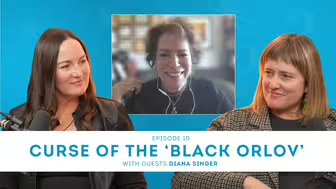
Episode 10: This Episode Is Haunted Diana Singer shared the stories of two “cursed” diamonds on this month’s podcast, which was inexplicably riddled with technical issues.

IndependentsOct 21, 2026
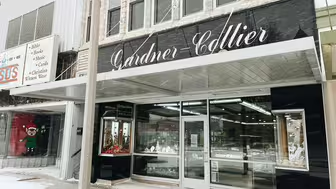
Gardner-Collier Jewelry to Close After 9 Decades in BusinessThe family-owned jeweler has three locations across Missouri and Iowa.

SourcingOct 21, 2026
Venetia Mines Final Carats Ahead of 2-Year ShutdownThe De Beers-owned diamond mine in South Africa is being put on ice as part of a round of previously announced cost-cutting measures.

CollectionsOct 21, 2026
Helzberg, Nordstrom Carrying New Jewelry Collection From Off-WhiteThe collection centers designs with clean geometric lines, chunky sculptural pieces, and recognizable details from the luxury fashion brand.
SourcingOct 21, 2026
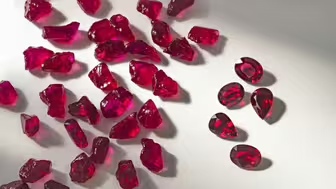
Gemfields’ Mixed-Quality Ruby Auction Earns $52MThe miner said it saw particularly strong prices for larger, fine-quality rubies at the sale.

CrimeOct 20, 2026
Security Guard Charged With Murder in Shooting at Texas MallThe guard opened fire on a man who was smashing a jewelry display case at La Gran Plaza in Fort Worth last week, police said.

IndependentsOct 20, 2026
David Gardner’s Jewelers Unveils Newly Expanded, Revamped ShowroomThe Texas jeweler added 2,000 square feet to its reimagined showroom, complete with a new design studio and an event space.
SourcingOct 20, 2026
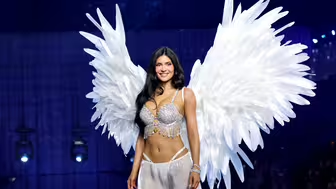
The $50M Victoria’s Secret ‘Fantasy Bra’ By The NumbersJacob & Co.'s diamond masterpiece is the most expensive Fantasy Bra ever worn on the Victoria’s Secret Fashion Show runway.

CollectionsOct 20, 2026
Mignon Faget’s Collection Chooses Handmade Over AIThe “Atelier” collection was inspired by the tools, rituals, and objects in an artist’s studio as a quiet rebuttal to an automated world.
MajorsOct 19, 2026
The Knot to Acquire Rival Wedding Planning Platform ZolaThe pending acquisition is an “exciting opportunity” for wedding vendors to grow their business, said The Knot Worldwide’s CEO.

SourcingOct 19, 2026
Jewelry Design Competition Show Airs in Thailand"The Secret Gems" features eight Thai jewelry brands paired with a team of young craftspeople who create jewelry together to win challenges.

CollectionsOct 19, 2026
John Hardy Enters the Medallion Chat With Talisman Collection The brand’s “Modern Talisman” capsule collection introduces pendants inspired by the mythology, natural world, and spiritual ethos of Bali.
IndependentsOct 19, 2026
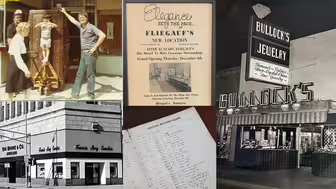
The Stories of 5 Jewelers Celebrating Their Centennials in 2026Independent jewelers from New Mexico to New Jersey answer the question: What has kept your store in business for 100 years?

SurveysOct 16, 2026
How Inflation, Gas Prices Will Affect Holiday Sales The NRF is expecting holiday sales to increase this year, but consumers and retailers alike are facing Grinch-like headwinds.
CollectionsOct 16, 2026
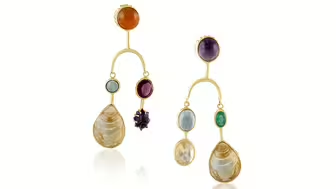
Christina Puchi’s Earrings Hold the UniverseOur Piece of the Week gathers the planets, represented by a variety of colored gemstones, in a pair of 14-karat yellow gold earrings.
IndependentsOct 16, 2026
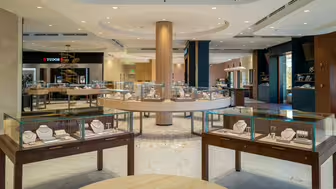
Reeds Jewelers Expands, Relocates FlagshipThe New York-based jeweler is moving its Amherst flagship store to a larger location in nearby Snyder.

MajorsOct 16, 2026
Katy Chen Appointed Executive Vice President of Graff USA Chen, who worked at Cartier and Tiffany & Co., will lead retail sales and operations for the luxury jeweler’s 11 U.S. stores.
IndependentsOct 15, 2026
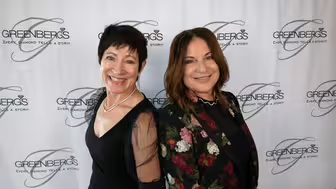
Retailer Hall of Fame 2026: Amy and Elise Greenberg For 40 years, sisters Amy and Elise Greenberg have helmed their 126-year-old family business, leading with appreciation and integrity.

ColumnistsOct 15, 2026
Peter Smith: What Is the Culture REP?It’s a term Smith coined and felt compelled to share following a bad experience with an aborted flight and an unfeeling flight attendant.