






IndependentsSep 04, 2026
Orloff Jewelers Will Soon Unveil a Bigger, Better LocationThe California jeweler is renovating its store in Fresno, with plans to show off the new space in December.




A recent survey by Provoke Insights looks at online shopping vs. off, the in-store experience and consumers’ top concerns about the future.


New York—Consumers have adopted new purchasing patterns in light of the restrictions imposed—and in some cases still in place—across the country.
The question remains, which of these habits will stick even as states reopen, and which won’t?
In its most recent study of 2020 consumer trends, market research firm Provoke Insights aimed to gain a better perspective on consumers’ mindsets and behavior changes pre-, during and post-pandemic.
It conducted a survey among 600 U.S. consumers between the ages of 21 and 65, with sampling based on the latest census data so factors like income, age, gender and geography reflected the country’s population.
The 10-minute survey was fielded between June 5 and 15.
Here’s what it found about how consumers have been shopping since March, and how that could change.
Online Luxury Shopping
Perhaps unsurprisingly, according to survey results, 77 percent of Americans who usually wear jewelry said they haven’t been wearing it as often as they did prior to the start of the pandemic—understandable given the trend of dressing more casually while stay-at-home orders were in place.
As jewelry wearing has declined in frequency, so too has online shopping in the category.
According to Provoke Insights, 22 percent of U.S. shoppers aren’t buying as much jewelry online as they were before the pandemic.
Ten percent said they are buying more jewelry than before.
Among the age groups, Provoke found that millennials are most likely to buy jewelry, watches, handbags and other accessories online right now.
In-Store Luxury Shopping
The study also looked at in-store shopping, which 66 percent of survey-takers said they plan to do when stores reopen.
The question, though, is how often they might do that.
According to the survey, 45 percent of Americans will shop in stores the same amount, while 42 percent are planning to shop at luxury retailers less than before the pandemic and 12 percent said they will shop more.
Members of Generation Z—the generation that follows the millennials—and millennials are more likely to shop in-store once luxury retailers reopen.
RELATED CONTENT: 8 Things to Know About That Next Generation … ZAmong Gen Z, 53 percent said they would shop more or the same amount in luxury retailers, while the remaining 47 percent said they would shop less.
RELATED CONTENT: 7 Tips for Keeping Your Online Business RollingA quarter of luxury shoppers are interested in virtual shopping events—with nearly half of Gen Z and more than a third of millennials indicating they’d be interested—and 27 percent also said they’re interested in scheduling an appointment to be able to shop privately and avoid other customers.

The California jeweler is renovating its store in Fresno, with plans to show off the new space in December.

A lifelong practitioner of Pilates, Gabrielle looked to the springs’ tension and suspension when creating this ring, our Piece of the Week.

The deadline to apply is Nov. 13.
Submit your pieces for a chance to win in this year's competition.


The auction house has promoted Remi Guillemin, formerly its head of watches for the Americas and EMEA, to the role.


Zaven Ghanimian discussed the value of human craftsmanship and where the implementation of artificial intelligence does work.

Jewelers of America also revealed the recipients of the Seymour & Evelyn Holtzman Bench Scholarship and its own scholarship programs.

Retailers are seeking new ways to attract customers, increase traffic, and create revenue – Estate buying events are a popular solution.


The British actor, known for his roles in “Twilight” and “The Odyssey,” will star in a campaign for the Master Control Chronometre.

The “Confetti Disco,” “Champagne Cheers,” “Tuxedo,” and “Classic Punk” jewelry collections each capture a distinct spirit of celebration.

Nelson Holdo of Newport Beach pleaded guilty to multiple counts of felony grand theft and writing bad checks and was sentenced Monday.

Cat ladies of the jewelry world, unite. Sandy Lerner’s “significant” collection of cat jewelry and other objects is going up for auction.

Arnaud Michon, the former Omega USA President, will now lead Messika’s Americas region during its international development.

The branding references the back-to-back jewelry shows that new parent company Forge will host in Miami's Coconut Grove this November.
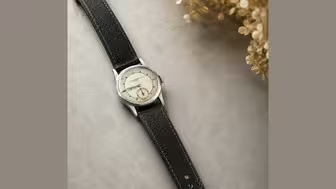
The stainless steel Patek Philippe “Calatrava” watch from the 1930s sold for nearly $80,000 at a recent Hansons Cornwall auction.

Engagement rings are important but don’t ignore the customers who are buying jewelry “just because,” Emmanuel Raheb writes.

Former Pomellato CEO Sabina Belli has been named president of Kering Italia amid a shakeup of Kering's new Jewelry division.
The veteran luxury packaging executive was appointed to help the company grow its North American business.


Once the property of an Egyptian queen, the necklace was part of a larger exhibition of VCA jewelry at the Museum of Applied Arts (MAK).

The labs’ separate investigations each determined that the East African country is producing copper-bearing tourmaline.
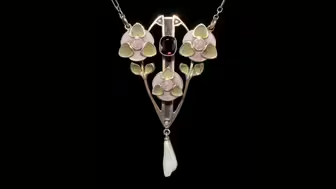
“Chicago Collects: Jewelry in Perspective” at the Oshkosh Public Museum will feature works by Fabergé, Lalique, and Louis Comfort Tiffany.

The “Worn Well” collection is Catbird's take on classic men's jewelry.
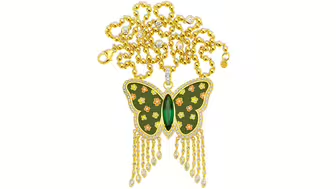
This Buddha Mama butterfly is our Piece of the Week honoring the legend, who embraced the beautiful insect as her symbol.

The former De Beers CEO, and perhaps its next owner, will be a featured speaker at the event, slated for Sept. 4-7 in Italy.
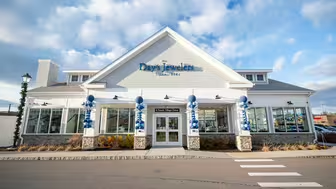
The employee-owned jeweler was named a “Best Place to Work” in Maine, New Hampshire, and for women.

The second iteration of the jewelry collection was inspired by the zodiac and the four elements: earth, water, air and fire.

General License 104B supersedes General License 104A, which was set to expire on Sept. 1.



This site uses cookies to give you the best online experience. By continuing to use & browse this site, we assume you agree to our Privacy Policy