




EditorsJun 17, 2024
Q&A: Al Cook on the Future of De BeersSourcingJun 27, 2024
De Beers’ Rough Diamond Sales Sink 31%
The company sold $315 million in rough in the fifth sales cycle of the year, down from $456 million in the same period last year.


Rough diamonds from De Beers’ Gahcho Kue diamond mine in Canada. The company’s most recent round of rough diamond sales brought in $315 million, down by double-digits both year-over-year and cycle-to-cycle. (©De Beers Group/Photo credit: Ben Perry @ Armoury Films)
Gaborone, Botswana—Rough diamond sales remained slow in the fifth sales cycle of the year for De Beers Group, with the company’s CEO saying he expects the recovery in demand to take time.
The diamond miner and marketer reported Wednesday that rough diamond sales in its fifth sales cycle of 2024 totaled $315 million, down 31 percent from $456 million in cycle 5 2023, and down 18 percent from the previous sales cycle ($383 million).
De Beers’ 2024 rough diamond sales are now about 20 percent behind where they were at this time last year.
Year-to-date, the company has sold $1.95 billion in rough, compared with $2.43 billion following the fifth sales cycle of 2023.
In the company’s statement on its latest rough diamond sales, CEO Al Cook noted that sales generally slow down when it is summer in the Northern Hemisphere.
Cook also acknowledged, however, that diamond demand is in a slump and will take some time to recover, due in part to the slowdown in sales in China.
He said, “The recent annual JCK jewelry show in Las Vegas confirmed a resurgence in retailers’ interest in natural diamonds in the United States but ongoing economic growth challenges in China mean we continue to expect a protracted U-shaped recovery in demand.”
A U-shaped recovery typically refers to a type of economic slowdown in which the return to previous levels of activity takes longer, as opposed to a V-shaped recovery in which the economy rebounds more quickly.
While the slowdown in demand in China has taken its toll, natural diamonds also have lost market share to lab-grown diamonds.
In his most recent market update, published in late May, industry analyst Edahn Golan said in the month of April, 45 percent of diamond engagement rings sold by specialty jewelers were set with lab-grown diamonds.
He did, however, question whether this trend will continue as lab-grown diamond prices fall.
Golan wrote, “Once most lab-grown diamonds are D [color]/FL [clarity] with excellent makes, the only characteristic that will command a higher price will be their size. From a practical standpoint, that has a limit too.
“I can’t imagine many women choosing to wear a 15-carat solitaire ring daily, no matter how much it cost them. So, at some point, lab-grown diamonds just won’t cost enough for an engagement ring, and Americans will most likely gravitate away from them.”
Related stories will be right here …
The diamond miner and marketer reported Wednesday that rough diamond sales in its fifth sales cycle of 2024 totaled $315 million, down 31 percent from $456 million in cycle 5 2023, and down 18 percent from the previous sales cycle ($383 million).
De Beers’ 2024 rough diamond sales are now about 20 percent behind where they were at this time last year.
Year-to-date, the company has sold $1.95 billion in rough, compared with $2.43 billion following the fifth sales cycle of 2023.
In the company’s statement on its latest rough diamond sales, CEO Al Cook noted that sales generally slow down when it is summer in the Northern Hemisphere.
Cook also acknowledged, however, that diamond demand is in a slump and will take some time to recover, due in part to the slowdown in sales in China.
He said, “The recent annual JCK jewelry show in Las Vegas confirmed a resurgence in retailers’ interest in natural diamonds in the United States but ongoing economic growth challenges in China mean we continue to expect a protracted U-shaped recovery in demand.”
A U-shaped recovery typically refers to a type of economic slowdown in which the return to previous levels of activity takes longer, as opposed to a V-shaped recovery in which the economy rebounds more quickly.
While the slowdown in demand in China has taken its toll, natural diamonds also have lost market share to lab-grown diamonds.
In his most recent market update, published in late May, industry analyst Edahn Golan said in the month of April, 45 percent of diamond engagement rings sold by specialty jewelers were set with lab-grown diamonds.
He did, however, question whether this trend will continue as lab-grown diamond prices fall.
Golan wrote, “Once most lab-grown diamonds are D [color]/FL [clarity] with excellent makes, the only characteristic that will command a higher price will be their size. From a practical standpoint, that has a limit too.
“I can’t imagine many women choosing to wear a 15-carat solitaire ring daily, no matter how much it cost them. So, at some point, lab-grown diamonds just won’t cost enough for an engagement ring, and Americans will most likely gravitate away from them.”
De Beers currently reports rough diamond sales results on a monthly basis but announced in Las Vegas that it will be downshifting to quarterly reporting starting in the second half of the year.
The change is one of a number of updates the company announced in Las Vegas as part of “Origins,” its new strategy aimed at cutting costs, streamlining the business, and focusing on natural diamonds, all in an effort to make it more attractive to potential investors or new owners.
Mining giant Anglo American currently holds an 85 percent stake in De Beers, while the government of Botswana owns the remaining 15 percent.
In May, Anglo American confirmed publicly that it is looking to either divest or demerge De Beers, a move expected to have big implications for the diamond industry as a whole.
Cook said in an interview with National Jeweler in Las Vegas that the Anglo American divestment/demerger is expected to take about 18 months.


More on Sourcing


The Latest

CollectionsOct 26, 2026
Bliss Lau’s ‘Vantage’ Point Is the Hawaiian HorizonIn her “Vantage” collection, Lau explores heritage, identity, and inner strength through designs featuring blue-green Guatemalan jade.


MajorsOct 26, 2026
Tiffany & Co. Takes Consumers Behind the ScenesThe jeweler gave the public backstage tours of its flagship store and its design and innovation workshop as part of LVMH’s open house.

Events & AwardsOct 26, 2026
Support JFC’s ‘Monster Mash Challenge,’ If You DareVote for which jewelry professional should dress up as a monster to support Jewelers for Children’s annual Halloween fundraiser.

Brought to you by
A Diamond Is Forever Launches 2026 Holiday Campaign Championing Natural DiamondsA Diamond Is Forever's holiday campaign reimagines natural diamond icons for a new generation celebrating individuality.


MajorsOct 23, 2026
PGI USA Set to Close at Year’s EndThe closure is part of a global restructuring that also includes PGI winding down its operations in Japan, South Korea, and Hong Kong.
Weekly QuizOct 22, 2026
This Week’s QuizTest your jewelry news knowledge by answering these questions.


TechnologyOct 23, 2026
JA Unveils New Website, LogoThe website offers enhanced member benefit access, industry directories, educational resources, a job board, and access to the MJSA Journal.


FinancialsOct 23, 2026
Kering’s Jewelry Sales Up Double Digits in Q3Boucheron and Pomellato had a strong third quarter, with Kering looking at jewelry as an increasingly important part of its portfolio.
Brought to you by
Open an Account, Get $50 Off Your First Order. No Code Needed.Built on Relationships. Refined by Craft.


CrimeOct 22, 2026
Jeweler Shot and Killed in His Suburban Cincinnati Store Tara Sinchuri was the owner of Everest Jewels in Fairfield, Ohio, and a father of three. He was found dead in his store on Tuesday.

MajorsOct 22, 2026
Neiman Marcus Has Gifts for the Jewelry Lover Who Has EverythingBespoke experiences from Buccellati and Verdura are on the retailer’s 2026 “Fantasy Gifts” list.

Events & AwardsOct 22, 2026
JIS Fall 2026 Reports Record-Breaking Attendance The number of participants at the fall show was up 12 percent.

CollectionsOct 22, 2026
Billie Eilish, Finneas Co-Design Collection for John HardyThe Academy and Grammy award-winning siblings have collaborated with John Hardy on a new jewelry line inspired by their personal style.


PodcastsOct 21, 2026
Episode 10: This Episode Is Haunted Diana Singer shared the stories of two “cursed” diamonds on this month’s podcast, which was inexplicably riddled with technical issues.

IndependentsOct 21, 2026
Gardner-Collier Jewelry to Close After 9 Decades in BusinessThe family-owned jeweler has three locations across Missouri and Iowa.

CollectionsOct 21, 2026
Helzberg, Nordstrom Carrying New Jewelry Collection From Off-WhiteThe collection centers designs with clean geometric lines, chunky sculptural pieces, and recognizable details from the luxury fashion brand.
SourcingOct 21, 2026
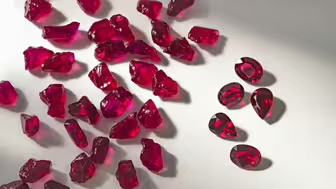
Gemfields’ Mixed-Quality Ruby Auction Earns $52MThe miner said it saw particularly strong prices for larger, fine-quality rubies at the sale.

CrimeOct 20, 2026
Security Guard Charged With Murder in Shooting at Texas MallThe guard opened fire on a man who was smashing a jewelry display case at La Gran Plaza in Fort Worth last week, police said.
IndependentsOct 20, 2026
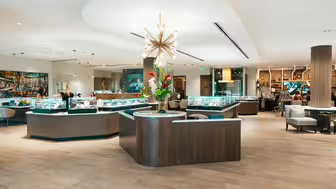
David Gardner’s Jewelers Unveils Newly Expanded, Revamped ShowroomThe Texas jeweler added 2,000 square feet to its reimagined showroom, complete with a new design studio and an event space.
SourcingOct 20, 2026
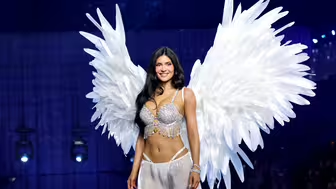
The $50M Victoria’s Secret ‘Fantasy Bra’ By The NumbersJacob & Co.'s diamond masterpiece is the most expensive Fantasy Bra ever worn on the Victoria’s Secret Fashion Show runway.

CollectionsOct 20, 2026
Mignon Faget’s Collection Chooses Handmade Over AIThe “Atelier” collection was inspired by the tools, rituals, and objects in an artist’s studio as a quiet rebuttal to an automated world.
MajorsOct 19, 2026
The Knot to Acquire Rival Wedding Planning Platform ZolaThe pending acquisition is an “exciting opportunity” for wedding vendors to grow their business, said The Knot Worldwide’s CEO.

SourcingOct 19, 2026
Jewelry Design Competition Show Airs in Thailand"The Secret Gems" features eight Thai jewelry brands paired with a team of young craftspeople who create jewelry together to win challenges.

CollectionsOct 19, 2026
John Hardy Enters the Medallion Chat With Talisman Collection The brand’s “Modern Talisman” capsule collection introduces pendants inspired by the mythology, natural world, and spiritual ethos of Bali.
IndependentsOct 19, 2026
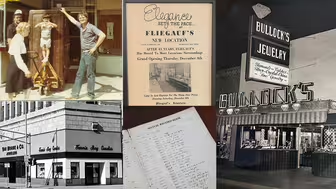
The Stories of 5 Jewelers Celebrating Their Centennials in 2026Independent jewelers from New Mexico to New Jersey answer the question: What has kept your store in business for 100 years?

SurveysOct 16, 2026
How Inflation, Gas Prices Will Affect Holiday Sales The NRF is expecting holiday sales to increase this year, but consumers and retailers alike are facing Grinch-like headwinds.
CollectionsOct 16, 2026
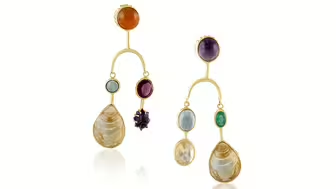
Christina Puchi’s Earrings Hold the UniverseOur Piece of the Week gathers the planets, represented by a variety of colored gemstones, in a pair of 14-karat yellow gold earrings.
IndependentsOct 16, 2026
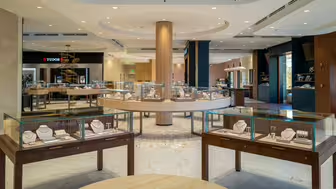
Reeds Jewelers Expands, Relocates FlagshipThe New York-based jeweler is moving its Amherst flagship store to a larger location in nearby Snyder.