




CrimeOct 22, 2026
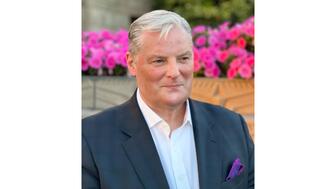
Jeweler Shot and Killed in His Suburban Cincinnati Store Tara Sinchuri was the owner of Everest Jewels in Fairfield, Ohio, and a father of three. He was found dead in his store on Tuesday.





Last week, South Dakota’s highest court shot down Senate Bill 106. Here’s why it matters in the ongoing fight over internet tax.


Unless you’re one of the 800,000-plus residents of South Dakota, it’s unlikely you’ve heard much about Senate Bill 106.
Introduced in the state legislature by a bipartisan group of seven senators and eight representatives last year, S.B. 106 mandates that companies that make more than $100,000 in sales or have more than 200 transactions per calendar year in South Dakota remit sales tax, whether they have a physical presence in the state or not.
In introducing the bill, legislators argued that, first, the state needs the revenue it’s missing from online sales and, second, that the current law of the land, so to speak--Quill Corp. v. North Dakota--needs to be re-evaluated.
Quill is the U.S. Supreme Court ruling from 1992 that prevents states from collecting sales tax from sellers with no physical presence in the state; the overarching argument of internet tax proponents everywhere is that this 25-year-old law is now wildly outdated given how consumers shop today.
S.B. 106 passed both houses with little opposition and South Dakota’s Republican governor, Dennis Daugaard, signed it into law in March 2016.
It wasn’t long after the bill’s passage that three online retailers, Overstock.com Inc., WayFair Inc. and NewEgg Inc., pushed back and the case wound its way through South Dakota’s legal system, landing with the state Supreme Court in short order.
Salt Lake City-based Overstock.com sells a variety of merchandise, including fine jewelry, ranking among the $100 Million Supersellers in the 2016 State of the Majors report and, spoiler alert, in the soon-to-be-published 2017 edition as well.
WayFair, meanwhile, is a Boston-based online seller of furniture and home décor, and City of Industry, California-headquartered NewEgg is an electronics retailer.
In a ruling issued last Wednesday authored by Chief Justice David Gilbertson, the court sided with the e-tailers, stating that: “However persuasive the state’s arguments on the merits of revisiting the issue, Quill has not been overruled. Quill remains the controlling precedent on the issue of Commerce Clause limitations on interstate collection of sales and use taxes.”
Despite the court’s siding with the internet sellers, Chris Fetzer of Haake Fetzer, the firm that lobbies for Jewelers of America on behalf of the industry in Washington, said that the authors of the bill do not view the ruling as a failure.
It is, in fact, exactly what they wanted.
“It was fully expected that it (S.B. 106) would be challenged as illegal. This law was written to be challenged within


Tara Sinchuri was the owner of Everest Jewels in Fairfield, Ohio, and a father of three. He was found dead in his store on Tuesday.

Bespoke experiences from Buccellati and Verdura are on the retailer’s 2026 “Fantasy Gifts” list.

The number of participants at the fall show was up 12 percent.

A Diamond Is Forever's holiday campaign reimagines natural diamond icons for a new generation celebrating individuality.


The Academy and Grammy award-winning siblings have collaborated with John Hardy on a new jewelry line inspired by their personal style.



Diana Singer shared the stories of two “cursed” diamonds on this month’s podcast, which was inexplicably riddled with technical issues.

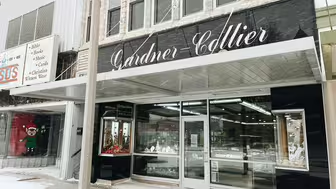
The family-owned jeweler has three locations across Missouri and Iowa.

Built on Relationships. Refined by Craft.


The De Beers-owned diamond mine in South Africa is being put on ice as part of a round of previously announced cost-cutting measures.

The collection centers designs with clean geometric lines, chunky sculptural pieces, and recognizable details from the luxury fashion brand.

The miner said it saw particularly strong prices for larger, fine-quality rubies at the sale.

The guard opened fire on a man who was smashing a jewelry display case at La Gran Plaza in Fort Worth last week, police said.

The Texas jeweler added 2,000 square feet to its reimagined showroom, complete with a new design studio and an event space.

Jacob & Co.'s diamond masterpiece is the most expensive Fantasy Bra ever worn on the Victoria’s Secret Fashion Show runway.

The “Atelier” collection was inspired by the tools, rituals, and objects in an artist’s studio as a quiet rebuttal to an automated world.
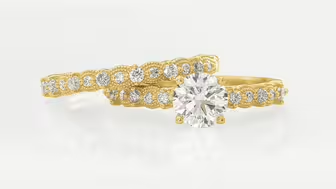
The pending acquisition is an “exciting opportunity” for wedding vendors to grow their business, said The Knot Worldwide’s CEO.

"The Secret Gems" features eight Thai jewelry brands paired with a team of young craftspeople who create jewelry together to win challenges.

The brand’s “Modern Talisman” capsule collection introduces pendants inspired by the mythology, natural world, and spiritual ethos of Bali.

Independent jewelers from New Mexico to New Jersey answer the question: What has kept your store in business for 100 years?

The NRF is expecting holiday sales to increase this year, but consumers and retailers alike are facing Grinch-like headwinds.
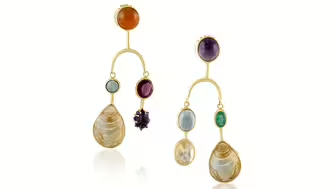
Our Piece of the Week gathers the planets, represented by a variety of colored gemstones, in a pair of 14-karat yellow gold earrings.
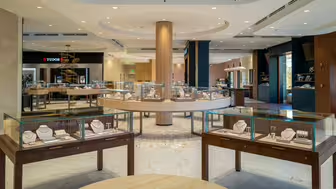
The New York-based jeweler is moving its Amherst flagship store to a larger location in nearby Snyder.

Chen, who worked at Cartier and Tiffany & Co., will lead retail sales and operations for the luxury jeweler’s 11 U.S. stores.

For 40 years, sisters Amy and Elise Greenberg have helmed their 126-year-old family business, leading with appreciation and integrity.
It’s a term Smith coined and felt compelled to share following a bad experience with an aborted flight and an unfeeling flight attendant.

Movado teamed up with the New York-based fine jewelry designer on a new collection of Movado Museum Velura watches.
The two companies are reportedly in talks to join the Global Diamond Consortium, led by former De Beers CEO Gareth Penny, as per Bloomberg.



This site uses cookies to give you the best online experience. By continuing to use & browse this site, we assume you agree to our Privacy Policy