







MajorsSep 22, 2026
Foundrae’s Lawsuit Against Pandora Can Continue, Court RulesA federal judge denied Pandora’s motion to dismiss Foundrae’s claim for copyright infringement of its medallions.






While January’s birthstone is best known for being a deep red, it is the greens of tsavorite and demantoid that are most in demand today.

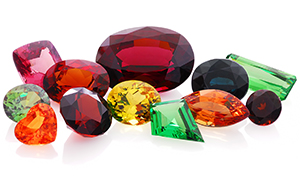
There is a wide number of garnet species, and according to the Gemological Institute of America’s gem encyclopedia, no garnet is ever pure in nature, meaning that often the species mix to create varieties with a wider range of colors and characteristics.
Today, most garnets on the market are sourced from African countries, but some also come from India, Russia and Central and South America.
While pricing and supply trends depend completely on the variety of garnet, prices are rising across the board for most shades of garnet as they become harder to get.
John Dyer of John Dyer & Co. said he expects this trend to continue. In addition to prices rising in response to continued demand, the increasing cost of diesel fuel is making mining a more expensive endeavor, driving up prices even further, he said.
“I really like garnet as a product,” Dyer said. “I’ve been stockpiling a variety of different materials when they’re available because the supply is shrinking every year. In recent years, I’ve been buying more than I’m selling to stock up.”
The greens have it
Demantoid garnets are the most expensive kind of garnet currently on the market, according to the International Colored Gemstone Association. They’re in demand both because of their rarity and exceptional color and luminosity. These stones can range in color from a slightly yellowish-green to a brownish-green with a golden glow.
Demantoid garnets usually are small, rarely exceeding 1 carat and, thereby, most often used as smaller stones in finished jewelry.
They also are special because they are one of only a few cases where an inclusion increases the value of the stone. The appearance of a horsetail inclusion, named for the golden-brown crystal threads of chrysotile that run through the gem and appear as one, makes the stone one of the rarest in the world and greatly can increase
“Demantoids with horsetail inclusions are very difficult to obtain. They’re not readily available in the market these days,” said Brad Goldman of Allan A. Goldman Inc.
Garnet’s other popular green shade, tsavorite, also is in high demand. Because larger pieces of tsavorite tend to have inclusions, buyers prefer clarity over size, leading to a larger number of small cuts of tsavorite available in the market. Tsavorite is very difficult to find in sizes bigger than 1 or 2 carats.
“Tsavorites are a great alternative to emeralds. They’re easier to work with, and despite being rarer than emeralds, they are generally less expensive,” said designer Melissa Kaye, who added that while she’s been “peppering” tsavorites in her latest collection, she has only been offering certain designs with tsavorites due to the challenge of finding them in certain sizes.
“I find color trends can be highly correlated with seasons, but the rich green shades of tsavorite garnets work well year round,” she said. “Tsavorite garnets bridge the line between ‘semi’ and ‘precious’--anything rare or hard to source is always precious.”
These stones rarely need to be treated because its saturated, vivid green color is natural, increasing the value of the stone.
Dyer said, “Tsavorite prices are through the roof. It’s hard to purchase them because there’s a low supply and a lot of demand at the source.”
Warm colors prevail
Mandarin garnet, also called spessartite, also is less available and more expensive than it was a few years ago, according to Dyer. A slight uptick in demand for mandarin garnet also is something a number of buyers and sellers noted at the Tucson gem shows last February.
And yet, even with it being less available and more expensive, the classic stone continues to be a mainstay in the jewelry world, Goldman said.
Dyer noted that he also has seen an upswing in demand for various shades of red garnet, particularly the orange-red gyspy rose variety of the stone, which he said has an exceptional clarity.
Rhodolite garnets and their raspberry hues also are booming in popularity, benefiting from their similarity to popular stones like rubellite while offering an exceptional color and clarity at a lower price point, even though their price has risen 20 to 40 percent over the last few years. In addition, they are more commonly found in larger sizes than its green counterparts.
Goldman said that he expects rhodolite garnets’ star to continue rising in the coming years, thanks to the popularity of purple and pink sparked by Pantone’s 2014 color of the year, “radiant orchid.”
“I think that it will continue to increase in price, and that it will eventually become an even more desired type of stone, as is predicated with colors that are popular in consumer trends.”
Cleaning up
Dyer said that he believes one of the biggest challenges that garnets have come up against in recent years is the rise in demand from markets outside the United States.
Where the U.S. used to be one of the biggest buyers and dealers here could readily get their hands on the stones, a number of other markets have shown more interest lately--like Japan’s desire for the green tsavorite stones--making buyers fight for what is already a dwindling supply of many types of garnet.
Still, the outlook for January’s birthstone is bullish.
Goldman said that one benefit garnets have over other gemstones that could help the stone’s growth in the consumer market is that many of them, with a few exceptions, are untreated; they are found in nature with their exceptional colors and clarities.
“Customers like it when they hear about them and the fact that they’re almost completely natural, where there aren’t many (gemstones like that) these days,” he said.
With today’s consumer being more attracted not only to stones that have been ethically and responsibly mined but also that aren’t treated, garnets could have an even brighter future ahead.

A federal judge denied Pandora’s motion to dismiss Foundrae’s claim for copyright infringement of its medallions.

People aren’t thinking rationally when they are buying luxury products, and we shouldn’t be selling them that way, Peter Smith writes.

The Baltimore Business Journal recognized the entrepreneur for her leadership in business and the jewelry industry.

Experience gemstones with greater precision and comfort than ever before.


The facility is located within SEEPZ and is GCAL by Sarine’s second location in India, joining its existing grading lab in Surat.


The four-day show is slated for Nov. 19-22 at the Metropolitan Pavilion in New York City’s Chelsea neighborhood.

Offered at Sotheby’s Hong Kong, the one-of-a-kind white gold watch now holds the title of most valuable Cartier wristwatch sold at auction.
Submit your pieces for a chance to win in this year's competition.


Bernstein-Gulla has been working in the jewelry industry for 40 years, most recently as chief engagement officer for Hill & Co.

The relocated Glendale store, now at The Americana at Brand, was designed to be a contemporary “timepiece haven” inspired by luxury resorts.


The top lot of the auction house’s Hong Kong jewelry sale was an Art Deco Mauboussin necklace with ruby beads, which sold for $2 million.

Retailers and manufacturers headed to the Capitol this week to discuss tariff exemptions for diamonds and gemstones, among other issues.

Our Piece of the Week is a pair of drop earrings from the “Sway” collection featuring Nanis’ first use of mirror-polished gold.

SynthDetect 2 can scan a full tray in less than five minutes, De Beers said, making it six times faster than its predecessors.

Two metal detectorists discovered the ring, which may have belonged to English noblewoman Matilda of Lancaster, in Suffolk.

The bill has a provision that allows the president to raise tariffs on countries that import Russian oil and gas to as much as 100 percent.

The American Gem Society presented the annual award to a former president of its board.

The “Chrysalis” capsule centers butterfly motifs representing growth, transformation, and the unfolding of who you are.

Jewelers of Louisiana presented Patton, the third-generation president of Pattons Fine Jewelry, with the award at its annual convention.


Two special guests join the podcast to commemorate the 10th anniversary of the designer advocate, mentor, and author’s untimely passing.


McCormack brings sea-inspired motifs from her “Beaches” collection to L’Objet’s tableware, vanity pieces, and first-ever cutlery set.

Nine New Jersey jewelers have been victims of smash-and-grab robberies this year, prompting JSA to circulate a list of recommendations.

Marlin “Brian” Hood, who has been with the store for 20 years, will succeed Ricky Bromberg, who died earlier this month.

The new bridal catalog features the latest jewelry collections and designs from timeless classics to modern silhouettes.

Stars wore either a necklace or earrings at 78th Primetime Emmy Awards but rarely both, Natalie Francisco notes.

Jennifer Shaheen compares this new era of AI-powered SEO to a video game: your website must clear one level before advancing to the next.

The program highlights “Made in Italy” fine jewelry with digital merchandising, sales education, and local marketing support.



This site uses cookies to give you the best online experience. By continuing to use & browse this site, we assume you agree to our Privacy Policy