







CrimeApr 13, 2026
JSA Offers Reward in Oregon Jewelry Store Armed RobberyCrimeApr 17, 2026
FBI Issues Warning to Refineries, Retailers Due to High Price of Gold
The alert states that burglary crews are targeting jewelry businesses and details how jewelers and refineries can protect themselves.


Earlier this month, the FBI issued a bulletin warning retailers and refineries in the Northeast of the heightened risk of burglaries due to the high price of gold. Gold peaked at more than $5,400 an ounce earlier this year. It now sits around $4,800 an ounce.
Newark, N.J.—The high price of gold, which is easily melted and turned into cash, prompted the Federal Bureau of Investigation to issue an alert specifically for precious metal refineries and jewelry retailers.
Published earlier this month, the seven-page bulletin was a collaboration among the FBI’s Newark field office, its Office of the Private Sector, and the Jewelers’ Security Alliance.
In it, the FBI warns that organized burglary crews from South America—mainly Chile, Colombia, and Venezuela—are targeting industrial gold refining facilities, jewelry stores, and other retail entities that consolidate scrap gold in New York and New Jersey.
Jewelry stores in malls and shopping centers are particularly at risk, with the crews often disguising themselves as construction workers while they case the store.
The bulletin mentions one specific incident from September 2025.
An individual identified as the leader of one of these gangs planned a burglary at a gold refinery in the New York/New Jersey area, looping in one member of the crew who specializes in cutting safes.
Though the plan was never carried out, it could have resulted in a $100 million-plus loss.
“These incidents are occurring as the price of precious metals—led by gold—reached a record high in 2026, increasing theft risks across the supply chain and making refineries and transporters primary targets for sophisticated criminal organizations,” the bulletin states.
The price of gold hit an all-time high of $5,414 an ounce earlier this year before taking a dive in mid-March.
Gold was hovering around $4,800 as of press time, according to Kitco.com.
Related stories will be right here …
Published earlier this month, the seven-page bulletin was a collaboration among the FBI’s Newark field office, its Office of the Private Sector, and the Jewelers’ Security Alliance.
In it, the FBI warns that organized burglary crews from South America—mainly Chile, Colombia, and Venezuela—are targeting industrial gold refining facilities, jewelry stores, and other retail entities that consolidate scrap gold in New York and New Jersey.
Jewelry stores in malls and shopping centers are particularly at risk, with the crews often disguising themselves as construction workers while they case the store.
The bulletin mentions one specific incident from September 2025.
An individual identified as the leader of one of these gangs planned a burglary at a gold refinery in the New York/New Jersey area, looping in one member of the crew who specializes in cutting safes.
Though the plan was never carried out, it could have resulted in a $100 million-plus loss.
“These incidents are occurring as the price of precious metals—led by gold—reached a record high in 2026, increasing theft risks across the supply chain and making refineries and transporters primary targets for sophisticated criminal organizations,” the bulletin states.
The price of gold hit an all-time high of $5,414 an ounce earlier this year before taking a dive in mid-March.
Gold was hovering around $4,800 as of press time, according to Kitco.com.
JSA Vice President Scott Guginsky explained that these crews are the same ones that cut through sidewalls and roofs to torch safes and vaults at independent jewelers and large retail chains.
Refineries are a target too.
The gangs are going after gold not only because the price is high but also because it’s more difficult to trace; it can be melted down with no questions asked and converted to cash.
“It’s easier to fence gold than trying to fence diamonds or watches,” Guginsky said in an interview with National Jeweler. “Gold is gold.”
The bulletin notes that the burglary gangs run “detailed” surveillance both inside and outside of businesses during regular operating hours, starting a few days before they try to hit it.
The burglaries typically take place over the weekend or on holidays—a pattern JSA has noted in the past—either late at night or early in the morning.
Guginsky said all these crews use cell phone jamming technology.
According to Stanley Oppenheim, CEO of DGA Security Systems, cell phone jammers are predominately manufactured in China. While technically illegal in the United States, they can be purchased online.
They generally measure about a foot high, 8 inches wide, and 4 inches deep and weigh a couple of pounds, with up to 12 antennas on top.
Cell phone jammers are placed outside of a business that is a burglary target and emit “noise,” meaning static, that floods the store’s cellular telephone network, making it impossible for the store’s alarm system to communicate with the alarm monitoring center.
Now, Oppenheim explained in an interview with National Jeweler, if a jewelry business has UL-rated line security, meaning there is constant communication between the business and the alarm company’s monitoring center to ensure the connection is intact, the presence of a jammer will create an alarm condition by interfering with the communications to the monitoring center.
“Line security is better and also more expensive, because it is polling continuously to make sure the location and the central station are in constant contact,” he said.
Oppenheim said many business owners think they have line security when, in fact, they do not.
He recommended jewelry business owners call their alarm companies to ensure they have UL-rated line security and get the guarantee in writing.
If businesses don’t have line security and burglars use a cell phone jammer, they can break into the store and set off the alarm without worrying about the police showing up, because the monitoring center will not receive the signal.
“The alarm will work; what won’t work is communication. The signal won’t get out,” Oppenheim said.
JSA’s Guginsky recommends jewelry business owners install technology that detects cell phone jammers, like DGA’s JamGuard.
Oppenheim said JamGuard detects the static being emitted by a cell phone jammer in a second or two. It then sends a signal via broadband internet to the monitoring center, which treats it as an alarm condition.
“The idea of JamGuard is to get them before they enter the store,” he said.
The FBI alert contains more than two dozen tips on how to tell if a store is being cased, where to position safes, which safes to buy, what technology jewelers should invest in, and more, all provided by JSA.
Guginsky said the FBI does not normally put out detailed bulletins like this about jewelry industry crime, but the bureau felt it was warranted under the current circumstances.
“The reason they put it out is they think [these crews are] a threat to these industries, the jewelry industry and the refineries,” he said.
“We say at JSA, be proactive, not reactive. Be proactive so you don’t have to be reactive.”


More on Crime




The Latest

SurveysOct 16, 2026
How Inflation, Gas Prices Will Affect Holiday Sales The NRF is expecting holiday sales to increase this year, but consumers and retailers alike are facing Grinch-like headwinds.

CollectionsOct 16, 2026
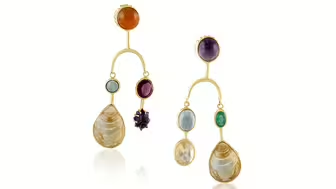
Christina Puchi’s Earrings Hold the UniverseOur Piece of the Week gathers the planets, represented by a variety of colored gemstones, in a pair of 14-karat yellow gold earrings.

IndependentsOct 16, 2026
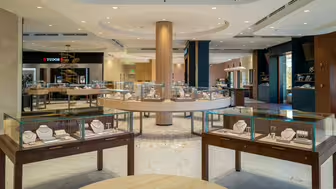
Reeds Jewelers Expands, Relocates FlagshipThe New York-based jeweler is moving its Amherst flagship store to a larger location in nearby Snyder.


Brought to you by
Meet Gemology’s Next Generation Microscope: GIA® Gemolite® NXT Professional EditionExperience gemstones with greater precision and comfort than ever before.


MajorsOct 16, 2026
Katy Chen Appointed Executive Vice President of Graff USA Chen, who worked at Cartier and Tiffany & Co., will lead retail sales and operations for the luxury jeweler’s 11 U.S. stores.
Weekly QuizOct 15, 2026
This Week’s QuizTest your jewelry news knowledge by answering these questions.


IndependentsOct 15, 2026
Retailer Hall of Fame 2026: Amy and Elise Greenberg For 40 years, sisters Amy and Elise Greenberg have helmed their 126-year-old family business, leading with appreciation and integrity.

ColumnistsOct 15, 2026
Peter Smith: What Is the Culture REP?It’s a term Smith coined and felt compelled to share following a bad experience with an aborted flight and an unfeeling flight attendant.

Brought to you by
Your Piece Could Be the One Editors Talk AboutSubmit your pieces for a chance to win in this year's competition.

WatchesOct 15, 2026
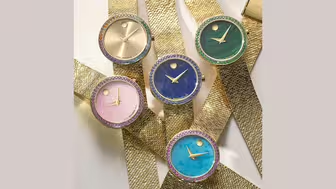
Stephanie Gottlieb’s New Movado Watches Are Made for Your Wrist StackMovado teamed up with the New York-based fine jewelry designer on a new collection of Movado Museum Velura watches.
SourcingOct 15, 2026
Signet Jewelers, Richemont May Join Bidder for De Beers, Report SaysThe two companies are reportedly in talks to join the Global Diamond Consortium, led by former De Beers CEO Gareth Penny, as per Bloomberg.
CollectionsOct 15, 2026
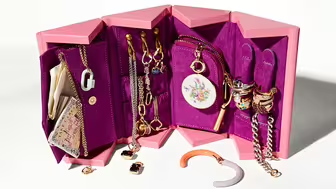
Wolf x Marla Aaron's New Jewelry Box Is for Some (Not All) of Your ThingsThe “Some of the Things” box follows the two larger “Everything” box designs with the look and function of antique sewing and toolboxes.

IndependentsOct 14, 2026
Retailer Hall of Fame 2026: Coleman and Mitchell ClarkFourth-generation jewelers Coleman and Mitchell Clark exemplify the best qualities of their predecessors: humility, modesty, and confidence.

SourcingOct 14, 2026
Manuel Marcial de Gomar, ‘The Emerald Whisperer,’ Dies at 90The gem hunter, whose 70-year career was defined by adventure and exploration, is remembered for his steadfast faith and sense of wonder.

FinancialsOct 14, 2026
LVMH’s Jewelry Brands Turn in ‘Very Good’ Performance in Q3 Tiffany & Co. continued its full-scale store renovation project while Bulgari’s high jewelry collection generated “record-breaking revenue.”

Events & AwardsOct 14, 2026
Chicago Responsible Jewelry Conference Releases 2026 ProgramThis year’s sessions feature leading voices from human rights, legal, and conservation organizations.

MajorsOct 13, 2026
David Webb Owner Purchases Lugano JewelryThe high-end jewelry retailer was sold to private investment firm Middle West Partners and a group of longtime clients.

Lab-GrownOct 13, 2026
Stephanie Gottlieb Takes Lab-Grown Diamond Collection WholesaleThe jewelry designer has partnered with Sofer Jewelry to distribute her 85-piece lab-grown diamond collection.

IndependentsOct 13, 2026
Retailer Hall of Fame 2026: Sean DunnDunn, this year’s Single-Store Independent inductee, is passionate about innovation and telling the story of natural diamonds.

AuctionsOct 13, 2026
Christie's Geneva To Auction 'Bulgari Pink' DiamondThe 24-carat fancy intense pink diamond ring could fetch up to $18 million at the November sale.

IndependentsOct 13, 2026
Greenwich St. Jewelers’ New Candle Smells Like HomeThe “Island Jewel” candle honors New York City and Puerto Rico and raises money for the island’s water relief efforts.
TechnologyOct 13, 2026
GemFind Is a New JA Member Benefit Partner The partnership will give JA members access to preferred pricing, exclusive benefits, technology solutions, education, and resources.

SurveysOct 09, 2026
These Will Be the 10 Busiest Days for In-Store Shopping This Holiday SeasonStores should expect to see the most customers on Nov. 27, and Christmas week is expected to be hectic too, as Dec. 25 falls on a Friday.

CollectionsOct 09, 2026
Elisa Solomon Collabs With Serendipity 3 on ‘Frozen Hot Chocolate’ CharmThe charm, our Piece of the Week, features brown diamond frozen hot chocolate topped with white diamond whipped cream and a ruby straw.

AuctionsOct 09, 2026
8-Carat Blue Diamond Goes Unsold at UK Jewelry Auction The top lot of Elmwood’s recent fine jewelry sale in London was a 1.84-carat, D color Tiffany & Co. solitaire diamond ring.

WatchesOct 09, 2026
Movado to Sell Majority Stake in Ebel for $66.5MThe watch company agreed to sell a 95 percent interest to a group comprised of F.P. Journe, Chanel, and Swiss watch exec Pierre Jacques.

Policies & IssuesOct 08, 2026
Third Wave of IEEPA Tariff Refunds Begins This round of tariff refunds is for importers that have sued over IEEPA tariffs in the Court of International Trade and won.

CollectionsOct 08, 2026
Brent Neale’s New Collection Goes ‘Back to Basics’It revisits the brand’s most requested silhouettes, from "Pillow"-set necklaces and bracelets to "Signature"-set rings and earrings.