





SourcingMar 25, 2026
Rob Bates Steps Down as JCK News Director EditorsMar 30, 2026
Tom Moses Looks Back on His Decades at GIA
Moses, who will leave the lab in May after nearly 50 years, discusses his start in the business, gemstones that stand out, and what’s next.


Tom Moses examining the 2,488-carat “Motswedi” diamond at GIA’s laboratory in Gaborone, Botswana, in July 2025. GIA announced earlier this month that Moses will be leaving the lab in May. Earlier this month, he sat down for an exit interview with Editor-in-Chief Michelle Graff. (Image courtesy of GIA; Photo credit: Wuyi Wang)
When I sat down to talk with Tom Moses early on a Friday morning a couple weeks ago, I learned something that I either had never known or (just as likely) forgot.
Like me, Tom is a fellow former Pittsburgher. He grew up in Butler County, Pennsylvania, less than an hour from my home in neighboring Beaver County.
His introduction to the jewelry industry came via his family.
In 1949, after serving in World War II, Tom’s father, Merril Moses, used the G.I. Bill to attend a watchmaking school in Pittsburgh and then started in the jewelry business as a watchmaker.
“As with most family businesses, [when] I was 13 or something, I was called upon in the evening and on weekends and summers to come to work and do odds and ends,” Tom recalled.
This meant cleaning a lot of glass and vacuuming—or “running the sweeper,” as they say in Western PA—as well as learning how to engrave and repair jewelry.
Along the way, Tom became interested in gemstones and in a little section of GIA’s Gems & Gemology that he remembers as “Notes from New York,” the forerunner to the “Lab Notes” section in the journal today.
Authored by two men now considered legends in gemology, Richard T. Liddicoat and G. Robert Crowningshield, the section consisted of one- or two-paragraph blurbs about gemstones, explaining, for instance, the chemical composition of an emerald.
After college, Tom attended GIA, then in Santa Monica, California, earning his Graduate Gemologist diploma in 1976.
What followed was about a decade of alternating between working at GIA—he was in the Santa Monica lab for a few years in the late ‘70s/early ’80s—and at his family’s jewelry store, Moses Jewelers.
Tom said though his father probably would have preferred he stay with the family business, he never outright asked him to do so. He allowed his son to follow his own path, something Tom came to understand and appreciate when he became a father.
In 1986, he left the family business for the last time to take a job at the GIA lab in New York, working alongside Crowningshield.
“That kind of started the journey. It was a great opportunity to learn and be mentored.”
Related stories will be right here …
Like me, Tom is a fellow former Pittsburgher. He grew up in Butler County, Pennsylvania, less than an hour from my home in neighboring Beaver County.
His introduction to the jewelry industry came via his family.
In 1949, after serving in World War II, Tom’s father, Merril Moses, used the G.I. Bill to attend a watchmaking school in Pittsburgh and then started in the jewelry business as a watchmaker.
“As with most family businesses, [when] I was 13 or something, I was called upon in the evening and on weekends and summers to come to work and do odds and ends,” Tom recalled.
This meant cleaning a lot of glass and vacuuming—or “running the sweeper,” as they say in Western PA—as well as learning how to engrave and repair jewelry.
Along the way, Tom became interested in gemstones and in a little section of GIA’s Gems & Gemology that he remembers as “Notes from New York,” the forerunner to the “Lab Notes” section in the journal today.
Authored by two men now considered legends in gemology, Richard T. Liddicoat and G. Robert Crowningshield, the section consisted of one- or two-paragraph blurbs about gemstones, explaining, for instance, the chemical composition of an emerald.
After college, Tom attended GIA, then in Santa Monica, California, earning his Graduate Gemologist diploma in 1976.
What followed was about a decade of alternating between working at GIA—he was in the Santa Monica lab for a few years in the late ‘70s/early ’80s—and at his family’s jewelry store, Moses Jewelers.
Tom said though his father probably would have preferred he stay with the family business, he never outright asked him to do so. He allowed his son to follow his own path, something Tom came to understand and appreciate when he became a father.
In 1986, he left the family business for the last time to take a job at the GIA lab in New York, working alongside Crowningshield.
“That kind of started the journey. It was a great opportunity to learn and be mentored.”
All told, Tom’s been at GIA for about 45 years, a long stretch by any standard but in his mind, not long enough.
Tom said just a couple years ago, he told a few colleagues that he’s “running out of time” and will never feel like he accomplished enough.
“My mentors were just so good; they were just incredible. I had hoped to get to that level and I just didn’t,” he said.
That seems like an insane statement for somebody as well regarded and respected as Tom, who won the Richard T. Liddicoat Award for Distinguished Achievement in 2002, was elected to the GIA Board of Governors in 2013, and will leave GIA in May with the title chief of gemological research, emeritus.
He also has co-authored more than 100 technical articles for Gems & Gemology and other peer-reviewed journals over the years.
Looking back, though, Tom said he would have liked to have done even more writing and research, but he got involved with the business side of the lab’s operations, helping it to expand internationally.
GIA opened about half a dozen labs overseas between 2005 and 2010.
It was a worthy pursuit but one that took time away from pursuing his passion, gemology, a conflict many professionals face as they ascend in their careers.
The day-to-day responsibilities of running a business eat up much of the day, and more creative pursuits, like designing jewelry or (in my case) writing long-form stories, get pushed to the side.
Still, next to Tom’s computer at his desk at GIA’s New York lab on 47th Street is a microscope. He’s had this instrument for about 20 years so it’s not “the latest or the greatest” but it gives him the opportunity to become “hypnotized” by a gemstone.
“It takes me to a peaceful place where I can focus on the gemstones. I’m still as fascinated [by gemstones] as I was 50 years ago, which is a lucky feeling.”
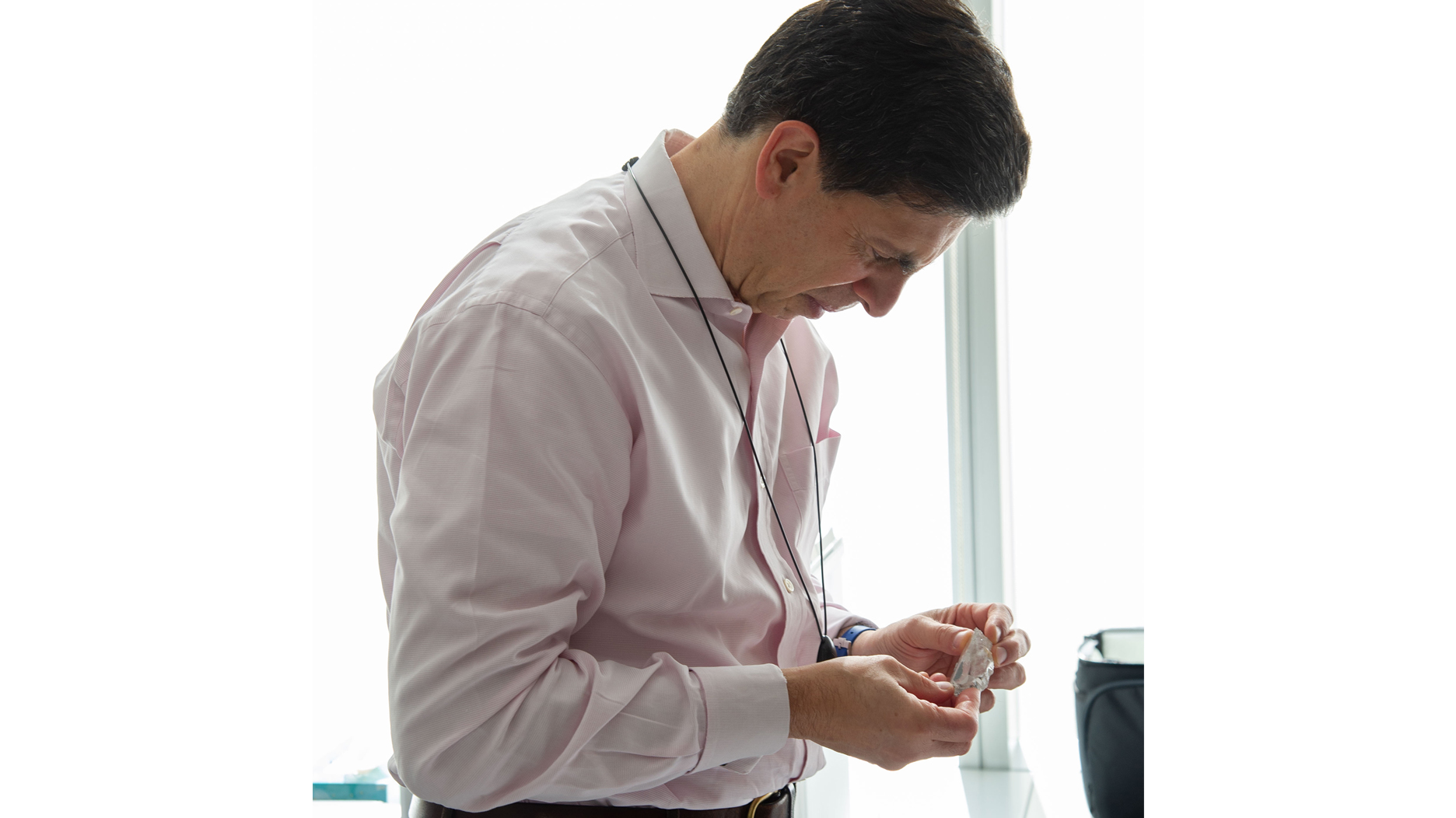
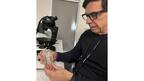
GIA Executive Vice President and Chief Laboratory and Research Officer Tom Moses examining a rough diamond. Moses said he’s never lost his passion for gemstones. “They quit asking me to take vacation because they know I won’t. I’m afraid I’ll miss something.” (Photo credit: Jian Xin (Jae) Liao, © GIA)
The first question that came to mind when I thought about my exit interview with Tom was, what is the most interesting stone you’ve had the opportunity to examine? It’s not a terribly original question, I realize, but this inquiring mind wanted to know.
“That question comes up a lot and I answer differently,” he said.
He mentioned the “La Peregrina” pearl, part of Elizabeth Taylor’s incomparable jewelry collection, which set records when Christie’s auctioned it in 2011.
The pearl had one or two not insignificant scratches on its surface, which Tom believes were from her dog.
There was also the time he got to handle and examine the 2,488-carat stone unearthed in Botswana in August 2024, the “Motswedi” diamond, pictured at the top of the article.
It is the second largest rough diamond ever found and weighs more than a pound.
“The thought about using a pound to talk about a diamond ... it was amazing. It was an incredible diamond,” he said.
“I'm hoping tomorrow I'll [be able to] tell you another story about something that equally impressed me.”
Tom said he first began having conversations with the GIA Board of Governors about transitioning a couple of years ago. It, he acknowledged, is time to move on.
He recalled a conversation he had with GIA founder Robert Shipley more than 40 years ago, who relayed how the board had to kind of “encourage” him to retire when he stepped down in 1952.
He doesn’t want to reach the encouragement stage.
“I don’t ever want to be in a situation where someone really kind of reminds you, it’s time to go. I don’t think I reached that stage, but I think it’s the right time.”
Tom said he’s not retiring but doesn’t have plans to go anywhere else right now. He said he will take a little time away—which for Tom, means a few weeks—before he decides what’s next.
As for that microscope next to his desk, he said he might try to take it with him when he goes.
I won’t tell anyone, Tom. Best of luck.
More on Editors



The Latest

SurveysOct 16, 2026
How Inflation, Gas Prices Will Affect Holiday Sales The NRF is expecting holiday sales to increase this year, but consumers and retailers alike are facing Grinch-like headwinds.

CollectionsOct 16, 2026
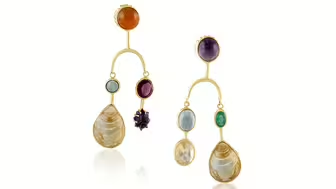
Christina Puchi’s Earrings Hold the UniverseOur Piece of the Week gathers the planets, represented by a variety of colored gemstones, in a pair of 14-karat yellow gold earrings.

IndependentsOct 16, 2026
Reeds Jewelers Expands, Relocates FlagshipThe New York-based jeweler is moving its Amherst flagship store to a larger location in nearby Snyder.


Brought to you by
Meet Gemology’s Next Generation Microscope: GIA® Gemolite® NXT Professional EditionExperience gemstones with greater precision and comfort than ever before.

MajorsOct 16, 2026
Katy Chen Appointed Executive Vice President of Graff USA Chen, who worked at Cartier and Tiffany & Co., will lead retail sales and operations for the luxury jeweler’s 11 U.S. stores.
Weekly QuizOct 15, 2026
This Week’s QuizTest your jewelry news knowledge by answering these questions.

IndependentsOct 15, 2026
Retailer Hall of Fame 2026: Amy and Elise Greenberg For 40 years, sisters Amy and Elise Greenberg have helmed their 126-year-old family business, leading with appreciation and integrity.
ColumnistsOct 15, 2026
Peter Smith: What Is the Culture REP?It’s a term Smith coined and felt compelled to share following a bad experience with an aborted flight and an unfeeling flight attendant.

Brought to you by
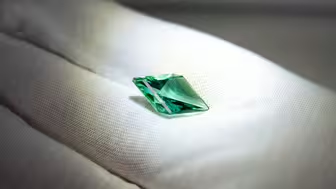
Your Piece Could Be the One Editors Talk AboutSubmit your pieces for a chance to win in this year's competition.

WatchesOct 15, 2026
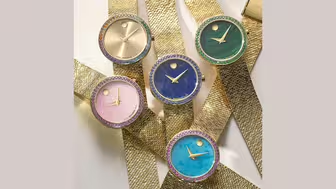
Stephanie Gottlieb’s New Movado Watches Are Made for Your Wrist StackMovado teamed up with the New York-based fine jewelry designer on a new collection of Movado Museum Velura watches.
SourcingOct 15, 2026
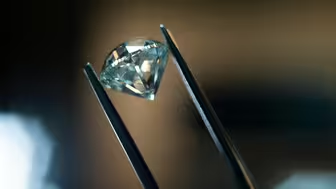
Signet Jewelers, Richemont May Join Bidder for De Beers, Report SaysThe two companies are reportedly in talks to join the Global Diamond Consortium, led by former De Beers CEO Gareth Penny, as per Bloomberg.
CollectionsOct 15, 2026
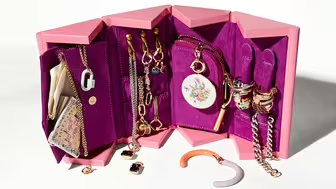
Wolf x Marla Aaron's New Jewelry Box Is for Some (Not All) of Your ThingsThe “Some of the Things” box follows the two larger “Everything” box designs with the look and function of antique sewing and toolboxes.
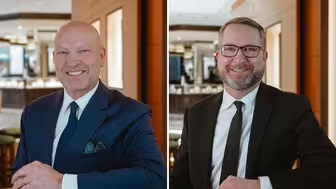
IndependentsOct 14, 2026
Retailer Hall of Fame 2026: Coleman and Mitchell ClarkFourth-generation jewelers Coleman and Mitchell Clark exemplify the best qualities of their predecessors: humility, modesty, and confidence.
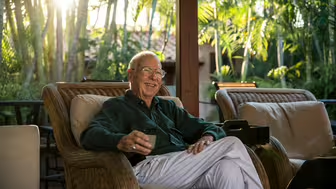
SourcingOct 14, 2026
Manuel Marcial de Gomar, ‘The Emerald Whisperer,’ Dies at 90The gem hunter, whose 70-year career was defined by adventure and exploration, is remembered for his steadfast faith and sense of wonder.

FinancialsOct 14, 2026
LVMH’s Jewelry Brands Turn in ‘Very Good’ Performance in Q3 Tiffany & Co. continued its full-scale store renovation project while Bulgari’s high jewelry collection generated “record-breaking revenue.”
Events & AwardsOct 14, 2026
Chicago Responsible Jewelry Conference Releases 2026 ProgramThis year’s sessions feature leading voices from human rights, legal, and conservation organizations.

MajorsOct 13, 2026
David Webb Owner Purchases Lugano JewelryThe high-end jewelry retailer was sold to private investment firm Middle West Partners and a group of longtime clients.

Lab-GrownOct 13, 2026
Stephanie Gottlieb Takes Lab-Grown Diamond Collection WholesaleThe jewelry designer has partnered with Sofer Jewelry to distribute her 85-piece lab-grown diamond collection.

IndependentsOct 13, 2026
Retailer Hall of Fame 2026: Sean DunnDunn, this year’s Single-Store Independent inductee, is passionate about innovation and telling the story of natural diamonds.

AuctionsOct 13, 2026
Christie's Geneva To Auction 'Bulgari Pink' DiamondThe 24-carat fancy intense pink diamond ring could fetch up to $18 million at the November sale.

IndependentsOct 13, 2026
Greenwich St. Jewelers’ New Candle Smells Like HomeThe “Island Jewel” candle honors New York City and Puerto Rico and raises money for the island’s water relief efforts.
TechnologyOct 13, 2026
GemFind Is a New JA Member Benefit Partner The partnership will give JA members access to preferred pricing, exclusive benefits, technology solutions, education, and resources.

SurveysOct 09, 2026
These Will Be the 10 Busiest Days for In-Store Shopping This Holiday SeasonStores should expect to see the most customers on Nov. 27, and Christmas week is expected to be hectic too, as Dec. 25 falls on a Friday.

CollectionsOct 09, 2026
Elisa Solomon Collabs With Serendipity 3 on ‘Frozen Hot Chocolate’ CharmThe charm, our Piece of the Week, features brown diamond frozen hot chocolate topped with white diamond whipped cream and a ruby straw.

AuctionsOct 09, 2026
8-Carat Blue Diamond Goes Unsold at UK Jewelry Auction The top lot of Elmwood’s recent fine jewelry sale in London was a 1.84-carat, D color Tiffany & Co. solitaire diamond ring.

WatchesOct 09, 2026
Movado to Sell Majority Stake in Ebel for $66.5MThe watch company agreed to sell a 95 percent interest to a group comprised of F.P. Journe, Chanel, and Swiss watch exec Pierre Jacques.

Policies & IssuesOct 08, 2026
Third Wave of IEEPA Tariff Refunds Begins This round of tariff refunds is for importers that have sued over IEEPA tariffs in the Court of International Trade and won.

CollectionsOct 08, 2026
Brent Neale’s New Collection Goes ‘Back to Basics’It revisits the brand’s most requested silhouettes, from "Pillow"-set necklaces and bracelets to "Signature"-set rings and earrings.