







GradingJul 30, 2024
Gübelin Academy Bringing Colored Gemstone Course to NYCSourcingAug 29, 2024
Lotus Gemology Publishes Book on Jade History
“Broken Bangle: The Blunder-Besmirched History of Jade Nomenclature” is an in-depth look at the evolution of jade terminology.


Lotus Gemology’s new book, “Broken Bangle: The Blunder-Besmirched History of Jade Nomenclature” is available now.
Bangkok—Bangkok-based lab Lotus Gemology has announced the release of a new book on the history of jade.
“Broken Bangle: The Blunder-Besmirched History of Jade Nomenclature” provides an in-depth discussion on the “tortuous history” of jade nomenclature with explanations on how current monikers are based on misinformation and misunderstandings.
It also features works from some of China’s contemporary jade and stone carvers accompanied by images of historical documents and photos.
The book is authored by geologist and gemologist Liu Shang-i; Lotus Gemology founder and ruby and sapphire expert Richard W. Hughes; Director of the Gemology Education Center of Shanghai’s Tongji University Zhou Zhengyu; and Lotus Gemology gemologist Kaylan Khourie.
Related stories will be right here …
“Broken Bangle: The Blunder-Besmirched History of Jade Nomenclature” provides an in-depth discussion on the “tortuous history” of jade nomenclature with explanations on how current monikers are based on misinformation and misunderstandings.
It also features works from some of China’s contemporary jade and stone carvers accompanied by images of historical documents and photos.
The book is authored by geologist and gemologist Liu Shang-i; Lotus Gemology founder and ruby and sapphire expert Richard W. Hughes; Director of the Gemology Education Center of Shanghai’s Tongji University Zhou Zhengyu; and Lotus Gemology gemologist Kaylan Khourie.
“Broken Bangle” includes a detailed section on the terms “nephrite” and “fei cui.”
In the mid-1800s, French mineralogist Alexis Damour was analyzing the Chinese gem yù, which is amphibole jade, and he named it “nephrite,” believing that he was looking at the same Mesoamerican pyroxene jade that a 16th century Spanish doctor himself misinterpreted as being used to treat kidney disease (“nephritus”).
In 1863, Damour coined another term for a new mineral species he called “jadeite.”
“Jadeite,” however, had already been known in China for over two centuries as fei cui (pronounced “fay choy”), the umbrella term the country’s trade uses for all pyroxene jades.
Recent studies have shown “jadeite” jade is a rock composed of three mineral components, the pyroxenes jadeite, omphacite, and kosmochlor. These components are very small, and it is nearly impossible to determine a stone’s exact composition.
Following the study, in July 2023, Lotus Gemology revised its lab reports, dropping the names jadeite, omphacite, and kosmochlor in favor of "fei cui.”
In December 2023, GIA also made changes to its jade reports, opting to, when appropriate, list the trade term “fei cui” with a note explaining that the term refers to the materials jadeite, omphacite, and kosmochlor.
“Our understanding of the world is deeply influenced by the names we assign to things. As history, culture, and scientific inquiry evolve, it becomes essential to assign accurate and fitting names to these unique types of jade that embody Chinese heritage. This nomenclature should reflect its cultural significance and resonate with both historical context and contemporary understanding,” said lead author Liu Shang-i.
Co-author Zhou Zhengyu added, “There is an ancient saying in China termed ‘casting a brick to attract jade.’ Any book or article is only a stage of understanding, and this understanding, if it can be better than before, is progress. Our work is certainly not the last word on the subject, but we hope it will help improve people’s understanding of this gem’s fascinating history and inspire others to research the subject further. Not unlike a brick thrown in the hopes of attracting jade.”
“Broken Bangle” will also cover other parts of Chinese culture, including much of the history of the Middle Kingdom.
The book is sponsored by Zhuang Qingfang, The Gemmological Association of Hong Kong, On Tung Jewellery, Junhao Gemology, and Pinde Xuan, along with Lotus Gemology.
The book is limited to 600 copies and can be purchased on Lotus Gemology’s website.


More on Sourcing

The Latest

IndependentsOct 27, 2026
Solomon Brothers Acquires Mervis Diamond ImportersSolomon Brothers, which has three stores in the Metro Atlanta area, said it may continue to acquire other independent jewelers.


IndependentsOct 27, 2026
Gabriel & Co. Supports Charity Partner DKMS With Gala, New JewelsThe fine jewelry brand raised $2.3 million at its annual gala that supports the nonprofit’s fight against blood cancer and blood disorders.

Events & AwardsOct 27, 2026
JFC Announces 2027 ‘Facets’ HonoreesThe annual fundraising event is slated for June 6, 2027, at The Venetian Resort in Las Vegas.

Brought to you by
A Diamond Is Forever Launches 2026 Holiday Campaign Championing Natural DiamondsA Diamond Is Forever's holiday campaign reimagines natural diamond icons for a new generation celebrating individuality.


CollectionsOct 26, 2026
Bliss Lau’s ‘Vantage’ Point Is the Hawaiian HorizonIn her “Vantage” collection, Lau explores heritage, identity, and inner strength through designs featuring blue-green Guatemalan jade.
Weekly QuizOct 22, 2026
This Week’s QuizTest your jewelry news knowledge by answering these questions.

MajorsOct 26, 2026
Tiffany & Co. Takes Consumers Behind the ScenesThe jeweler gave the public backstage tours of its flagship store and its design and innovation workshop as part of LVMH’s open house.


Events & AwardsOct 26, 2026
Support JFC’s ‘Monster Mash Challenge,’ If You DareVote for which jewelry professional should dress up as a monster to support Jewelers for Children’s annual Halloween fundraiser.
Brought to you by
Open an Account, Get $50 Off Your First Order. No Code Needed.Built on Relationships. Refined by Craft.


MajorsOct 23, 2026
PGI USA Set to Close at Year’s EndThe closure is part of a global restructuring that also includes PGI winding down its operations in Japan, South Korea, and Hong Kong.

TechnologyOct 23, 2026
JA Unveils New Website, LogoThe website offers enhanced member benefit access, industry directories, educational resources, a job board, and access to the MJSA Journal.

FinancialsOct 23, 2026
Kering’s Jewelry Sales Up Double Digits in Q3Boucheron and Pomellato had a strong third quarter, with Kering looking at jewelry as an increasingly important part of its portfolio.

CrimeOct 22, 2026
Jeweler Shot and Killed in His Suburban Cincinnati Store Tara Sinchuri was the owner of Everest Jewels in Fairfield, Ohio, and a father of three. He was found dead in his store on Tuesday.

MajorsOct 22, 2026
Neiman Marcus Has Gifts for the Jewelry Lover Who Has EverythingBespoke experiences from Buccellati and Verdura are on the retailer’s 2026 “Fantasy Gifts” list.

Events & AwardsOct 22, 2026
JIS Fall 2026 Reports Record-Breaking Attendance The number of participants at the fall show was up 12 percent.

CollectionsOct 22, 2026
Billie Eilish, Finneas Co-Design Collection for John HardyThe Academy and Grammy award-winning siblings have collaborated with John Hardy on a new jewelry line inspired by their personal style.

PodcastsOct 21, 2026
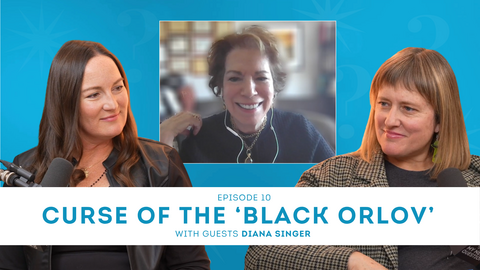
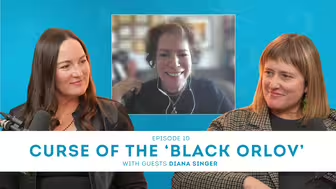
Episode 10: This Episode Is Haunted Diana Singer shared the stories of two “cursed” diamonds on this month’s podcast, which was inexplicably riddled with technical issues.

IndependentsOct 21, 2026
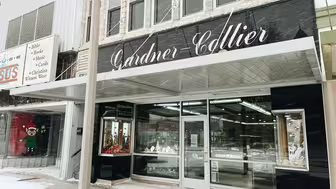
Gardner-Collier Jewelry to Close After 9 Decades in BusinessThe family-owned jeweler has three locations across Missouri and Iowa.

SourcingOct 21, 2026
Venetia Mines Final Carats Ahead of 2-Year ShutdownThe De Beers-owned diamond mine in South Africa is being put on ice as part of a round of previously announced cost-cutting measures.

CollectionsOct 21, 2026
Helzberg, Nordstrom Carrying New Jewelry Collection From Off-WhiteThe collection centers designs with clean geometric lines, chunky sculptural pieces, and recognizable details from the luxury fashion brand.
SourcingOct 21, 2026
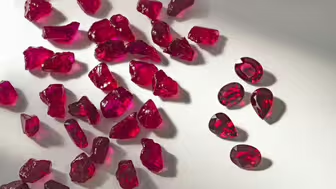
Gemfields’ Mixed-Quality Ruby Auction Earns $52MThe miner said it saw particularly strong prices for larger, fine-quality rubies at the sale.

CrimeOct 20, 2026
Security Guard Charged With Murder in Shooting at Texas MallThe guard opened fire on a man who was smashing a jewelry display case at La Gran Plaza in Fort Worth last week, police said.

IndependentsOct 20, 2026
David Gardner’s Jewelers Unveils Newly Expanded, Revamped ShowroomThe Texas jeweler added 2,000 square feet to its reimagined showroom, complete with a new design studio and an event space.

SourcingOct 20, 2026
The $50M Victoria’s Secret ‘Fantasy Bra’ By The NumbersJacob & Co.'s diamond masterpiece is the most expensive Fantasy Bra ever worn on the Victoria’s Secret Fashion Show runway.

CollectionsOct 20, 2026
Mignon Faget’s Collection Chooses Handmade Over AIThe “Atelier” collection was inspired by the tools, rituals, and objects in an artist’s studio as a quiet rebuttal to an automated world.
MajorsOct 19, 2026
The Knot to Acquire Rival Wedding Planning Platform ZolaThe pending acquisition is an “exciting opportunity” for wedding vendors to grow their business, said The Knot Worldwide’s CEO.

SourcingOct 19, 2026
Jewelry Design Competition Show Airs in Thailand"The Secret Gems" features eight Thai jewelry brands paired with a team of young craftspeople who create jewelry together to win challenges.

CollectionsOct 19, 2026
John Hardy Enters the Medallion Chat With Talisman Collection The brand’s “Modern Talisman” capsule collection introduces pendants inspired by the mythology, natural world, and spiritual ethos of Bali.