




EditorsDec 13, 2021
Out & About: Watching De Beers Grow Diamonds in OregonLab-GrownFeb 02, 2022
GIA Examines Largest Known Diamond Grown Using CVD
It is more than 16 carats and G color/VVS2 clarity as grown, which is unusual in CVD diamonds.


This 16.41-carat princess-cut diamond produced using the CVD process measures 13.97 × 13.87 × 9.56 mm. Recently examined and graded by GIA, it is G color and VVS2 clarity. (Photo credit: Towfiq Ahmed)
Carlsbad, Calif.—Scientists at the Gemological Institute of America recently examined what is believed to be the largest diamond grown using the chemical-vapor deposition process, breaking a record set just last year.
The lab said Tuesday that the diamond is a 16.41-carat princess-cut stone grown by Shanghai Zhengshi Technology Co. Ltd.
The diamond had the “observable characteristics” of diamonds grown using the CVD process, including strong graining throughout—common in CVD stones—that gives the diamond a “wavy” appearance, as visible in the video below.
The lab said Tuesday that the diamond is a 16.41-carat princess-cut stone grown by Shanghai Zhengshi Technology Co. Ltd.
The diamond had the “observable characteristics” of diamonds grown using the CVD process, including strong graining throughout—common in CVD stones—that gives the diamond a “wavy” appearance, as visible in the video below.
The 16.41-carat lab-grown diamond is exceptional for another reason in addition to its size.
The diamond is G color and VVS2 clarity. GIA confirmed through detailed spectroscopic readings it was not treated post-growth to improve its color, which is unusual.
GIA Vice President of Research and Development Dr. Wuyi Wang, who examined the diamond, noted, “We have seen very few CVD diamonds of this quality.”
The 16.41-carat stone breaks the previous record for largest CVD diamond—a 14.60-carat emerald-cut stone produced in India and reported on by the International Gemological Institute in August 2021—by nearly two carats.
And it tops the record-holder before that, a 12.75-carat round brilliant lab-grown diamond, by almost four carats.
In article on the 16.41-carat lab-grown diamond authored by Wang and GIA research associates Stephanie Persaud and Elina Myagkay, the authors noted how the technology behind both CVD and high-pressure, high-temperature growth processes for diamonds has advanced significantly in the last two decades.
Wang noted in a GIA news release that he first examined a CVD diamond back in 2003, and it was less than half a carat, pear shaped and brown.
“This 16.41-carat laboratory-grown diamond demonstrates the advances in CVD growth technology. This achievement has important implications for the many scientific and industrial applications for high-quality laboratory-grown diamonds,” he said.
The article is available on the GIA’s website. It also will be published in an upcoming issue of Gems & Gemology, GIA’s quarterly research journal.
Related stories will be right here …
The diamond is G color and VVS2 clarity. GIA confirmed through detailed spectroscopic readings it was not treated post-growth to improve its color, which is unusual.
GIA Vice President of Research and Development Dr. Wuyi Wang, who examined the diamond, noted, “We have seen very few CVD diamonds of this quality.”
The 16.41-carat stone breaks the previous record for largest CVD diamond—a 14.60-carat emerald-cut stone produced in India and reported on by the International Gemological Institute in August 2021—by nearly two carats.
And it tops the record-holder before that, a 12.75-carat round brilliant lab-grown diamond, by almost four carats.
In article on the 16.41-carat lab-grown diamond authored by Wang and GIA research associates Stephanie Persaud and Elina Myagkay, the authors noted how the technology behind both CVD and high-pressure, high-temperature growth processes for diamonds has advanced significantly in the last two decades.
Wang noted in a GIA news release that he first examined a CVD diamond back in 2003, and it was less than half a carat, pear shaped and brown.
“This 16.41-carat laboratory-grown diamond demonstrates the advances in CVD growth technology. This achievement has important implications for the many scientific and industrial applications for high-quality laboratory-grown diamonds,” he said.
The article is available on the GIA’s website. It also will be published in an upcoming issue of Gems & Gemology, GIA’s quarterly research journal.
Another lab-grown diamond record was set recently, this one for a rough stone that was examined by IGI.
The lab said Jan. 20 that it recently analyzed a 150.42-carat blue diamond grown by biotech company Meylor Global using the HPHT method.
It is the heaviest rough lab-grown diamond on record, breaking the previous benchmark of 115 carats, also set by Meylor Global in September 2020.
The record for a faceted and colorless/near-colorless HPHT-grown diamond is 15.32 carats, tested by GIA in 2018.
The 150-carat diamond is gem-quality, IGI and Meylor confirmed, but Meylor hasn’t decided what it will do with the diamond.
IGI also noted that it recently examined another large lab-grown diamond from Meylor, this one a gray diamond weighing 141.58 carats.
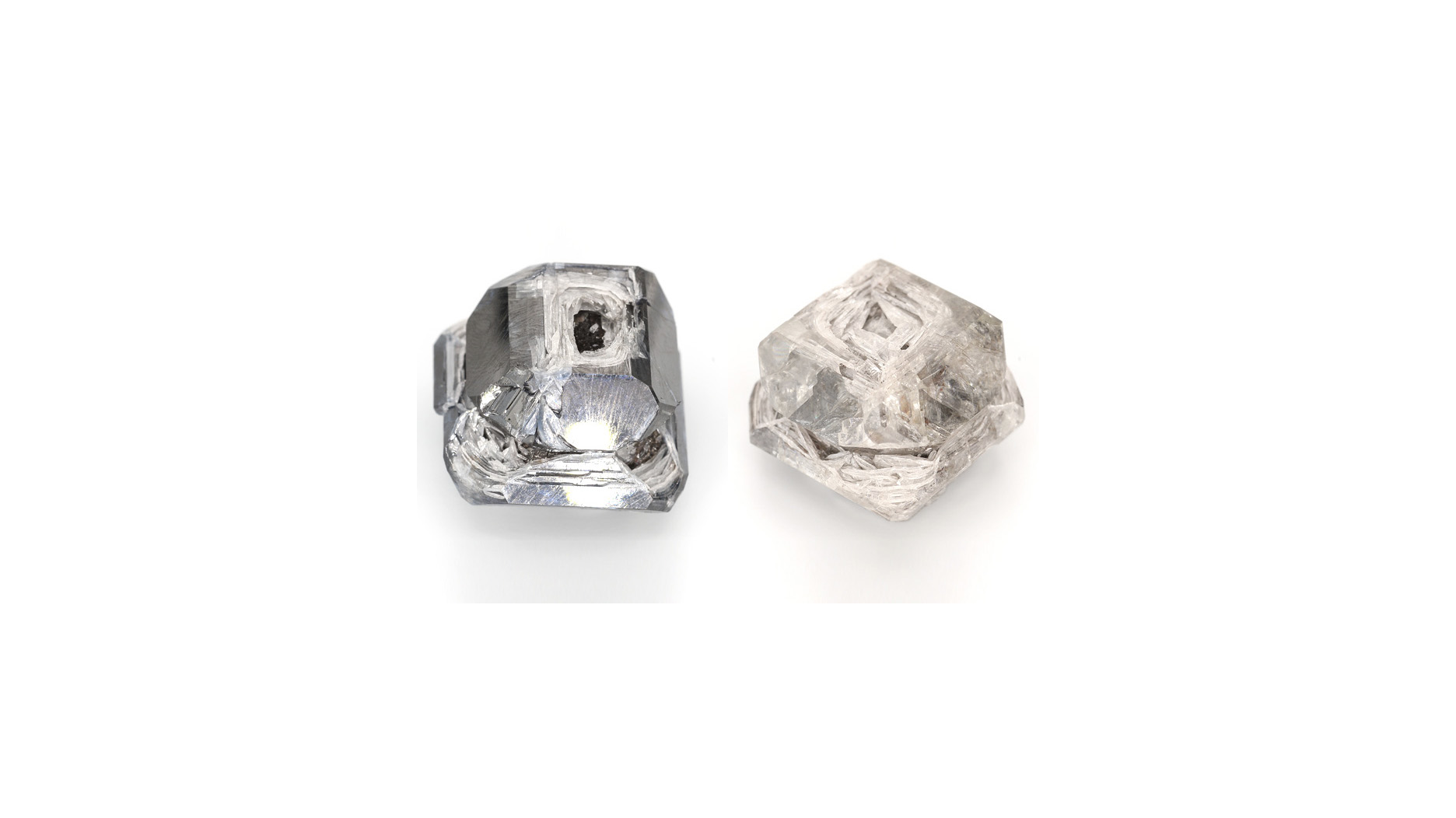
Pictured at right is the 150.42-carat lab-grown rough diamond produced by Meylor Global, while the 141.58-carat stone is pictured at right.
Like GIA, IGI noted that the technology used to grow diamonds continues to improve.
“The acceleration of technology in the lab-grown diamond sector is significant,” said John Pollard, IGI’s recently appointed director of education.
“In addition to record-setting weights, they’re type IIb crystals, a semiconducting category associated with diamond-based electronics. At IGI, we’re seeing new benchmarks from the world’s most advanced producers in jewelry applications and beyond.”


More on Lab-Grown
The Latest

MajorsOct 23, 2026
PGI USA Set to Close at Year’s EndThe closure is part of a global restructuring that also includes PGI winding down its operations in Japan, South Korea, and Hong Kong.

SourcingOct 23, 2026
Rachel Chalchinsky’s ‘Survivor Tribute’ RingThe ring, our Piece of the Week, was designed by eight-year breast cancer survivor Rachel Chalchinsky of Color Source Gems.


TechnologyOct 23, 2026
JA Unveils New Website, LogoThe website offers enhanced member benefit access, industry directories, educational resources, a job board, and access to the MJSA Journal.

Brought to you by
A Diamond Is Forever Launches 2026 Holiday Campaign Championing Natural DiamondsA Diamond Is Forever's holiday campaign reimagines natural diamond icons for a new generation celebrating individuality.


FinancialsOct 23, 2026
Kering’s Jewelry Sales Up Double Digits in Q3Boucheron and Pomellato had a strong third quarter, with Kering looking at jewelry as an increasingly important part of its portfolio.

Weekly QuizOct 22, 2026
This Week’s QuizTest your jewelry news knowledge by answering these questions.


CrimeOct 22, 2026
Jeweler Shot and Killed in His Suburban Cincinnati Store Tara Sinchuri was the owner of Everest Jewels in Fairfield, Ohio, and a father of three. He was found dead in his store on Tuesday.

MajorsOct 22, 2026
Neiman Marcus Has Gifts for the Jewelry Lover Who Has EverythingBespoke experiences from Buccellati and Verdura are on the retailer’s 2026 “Fantasy Gifts” list.
Brought to you by
Open an Account, Get $50 Off Your First Order. No Code Needed.Built on Relationships. Refined by Craft.


Events & AwardsOct 22, 2026
JIS Fall 2026 Reports Record-Breaking Attendance The number of participants at the fall show was up 12 percent.

CollectionsOct 22, 2026
Billie Eilish, Finneas Co-Design Collection for John HardyThe Academy and Grammy award-winning siblings have collaborated with John Hardy on a new jewelry line inspired by their personal style.


PodcastsOct 21, 2026
Episode 10: This Episode Is Haunted Diana Singer shared the stories of two “cursed” diamonds on this month’s podcast, which was inexplicably riddled with technical issues.

IndependentsOct 21, 2026
Gardner-Collier Jewelry to Close After 9 Decades in BusinessThe family-owned jeweler has three locations across Missouri and Iowa.

SourcingOct 21, 2026
Venetia Mines Final Carats Ahead of 2-Year ShutdownThe De Beers-owned diamond mine in South Africa is being put on ice as part of a round of previously announced cost-cutting measures.

CollectionsOct 21, 2026
Helzberg, Nordstrom Carrying New Jewelry Collection From Off-WhiteThe collection centers designs with clean geometric lines, chunky sculptural pieces, and recognizable details from the luxury fashion brand.
SourcingOct 21, 2026
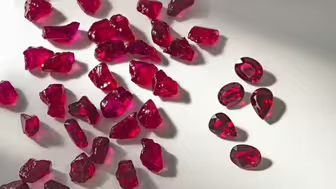
Gemfields’ Mixed-Quality Ruby Auction Earns $52MThe miner said it saw particularly strong prices for larger, fine-quality rubies at the sale.

CrimeOct 20, 2026
Security Guard Charged With Murder in Shooting at Texas MallThe guard opened fire on a man who was smashing a jewelry display case at La Gran Plaza in Fort Worth last week, police said.
IndependentsOct 20, 2026
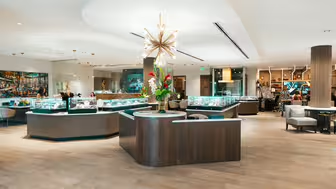
David Gardner’s Jewelers Unveils Newly Expanded, Revamped ShowroomThe Texas jeweler added 2,000 square feet to its reimagined showroom, complete with a new design studio and an event space.
SourcingOct 20, 2026
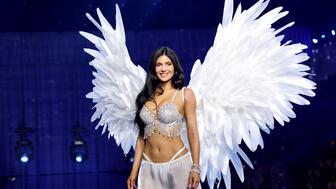
The $50M Victoria’s Secret ‘Fantasy Bra’ By The NumbersJacob & Co.'s diamond masterpiece is the most expensive Fantasy Bra ever worn on the Victoria’s Secret Fashion Show runway.

CollectionsOct 20, 2026
Mignon Faget’s Collection Chooses Handmade Over AIThe “Atelier” collection was inspired by the tools, rituals, and objects in an artist’s studio as a quiet rebuttal to an automated world.
MajorsOct 19, 2026
The Knot to Acquire Rival Wedding Planning Platform ZolaThe pending acquisition is an “exciting opportunity” for wedding vendors to grow their business, said The Knot Worldwide’s CEO.
SourcingOct 19, 2026
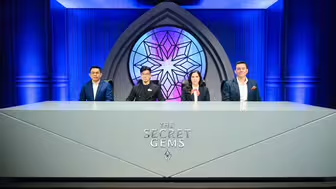
Jewelry Design Competition Show Airs in Thailand"The Secret Gems" features eight Thai jewelry brands paired with a team of young craftspeople who create jewelry together to win challenges.

CollectionsOct 19, 2026
John Hardy Enters the Medallion Chat With Talisman Collection The brand’s “Modern Talisman” capsule collection introduces pendants inspired by the mythology, natural world, and spiritual ethos of Bali.
IndependentsOct 19, 2026
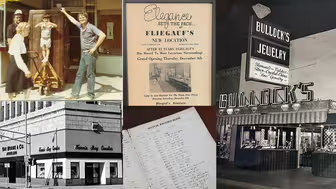
The Stories of 5 Jewelers Celebrating Their Centennials in 2026Independent jewelers from New Mexico to New Jersey answer the question: What has kept your store in business for 100 years?
SurveysOct 16, 2026
How Inflation, Gas Prices Will Affect Holiday Sales The NRF is expecting holiday sales to increase this year, but consumers and retailers alike are facing Grinch-like headwinds.
CollectionsOct 16, 2026
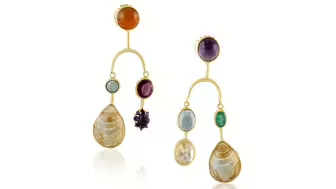
Christina Puchi’s Earrings Hold the UniverseOur Piece of the Week gathers the planets, represented by a variety of colored gemstones, in a pair of 14-karat yellow gold earrings.
IndependentsOct 16, 2026
Reeds Jewelers Expands, Relocates FlagshipThe New York-based jeweler is moving its Amherst flagship store to a larger location in nearby Snyder.
MajorsOct 16, 2026
Katy Chen Appointed Executive Vice President of Graff USA Chen, who worked at Cartier and Tiffany & Co., will lead retail sales and operations for the luxury jeweler’s 11 U.S. stores.