



CrimeOct 22, 2026
Jeweler Shot and Killed in His Suburban Cincinnati Store Tara Sinchuri was the owner of Everest Jewels in Fairfield, Ohio, and a father of three. He was found dead in his store on Tuesday.






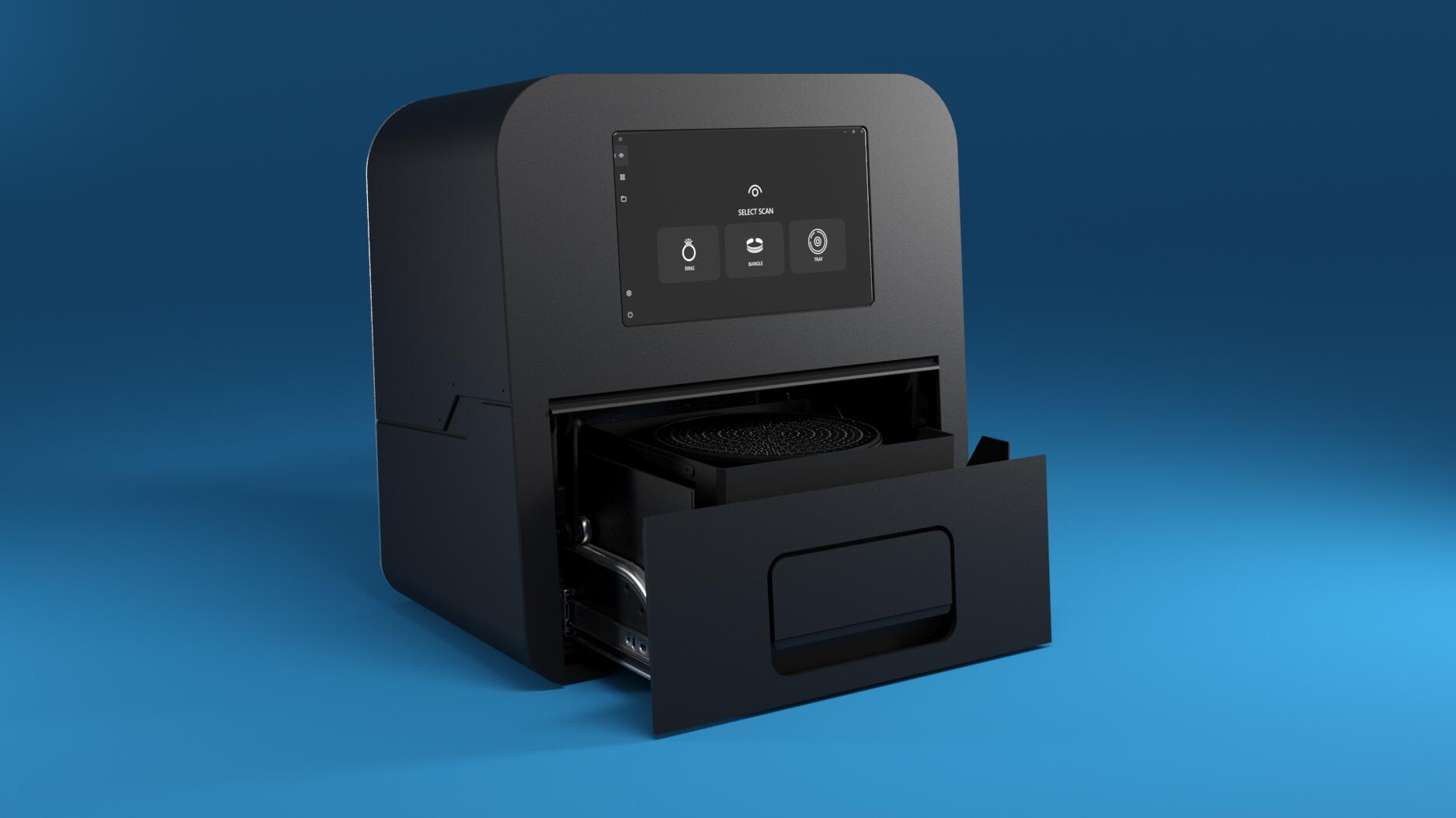
De Beers is now in the manufacturing stage with its melee screener and will lease it to interested sightholders in the second quarter before placing the device in a grading and research facility it operates in Antwerp, making it open to the trade more generally.


London--De Beers is now in the manufacturing stage with its melee screener and will lease it to interested sightholders in the second quarter before placing the device in a grading and research facility it operates in Antwerp, making it open to the trade more generally.
The machine, officially dubbed the Automated Melee Screening Device, or AMS, screens near-colorless or colorless diamonds as small as one point and up to 0.20 carats to determine if they are natural, De Beers said.
Unlike the screening device for synthetic and high-pressure, high-temperature- (HPHT) treated diamonds introduced this week by the Gemological Institute of America that tests one stone at a time, De Beers’ device can take up to 500 carats of melee at once and automatically feeds the stones, table-down, into a measurement station.
Following testing, the diamonds are automatically dispensed into one of five bins:
-- Pass: The stone is not a synthetic or a simulant. Trials have indicated pass rates of 95 to 99 percent for natural melee;
-- Refer: A rare result, this indicates that more testing is needed;
-- Refer Type II: The stone has a low concentration of nitrogen and further testing is required, as it may be synthetic;
-- Non-diamond: The stone is a simulant or synthetic; and
-- Purge: This bin is for when the user needs to empty out the machine because, for example, they placed the wrong packet of diamonds into the device.
Because the machine feeds and sorts stones automatically it can be left unattended, and one person can operate multiple machines at a time.
However, unlike the GIA, De Beers won’t be leasing its device at no cost in exchange for data, or selling it to the general trade, at least not right now.
De Beers said it will offer three-year leases on the device, which was developed by De Beers Technologies UK, to sightholders through the International Institute of Diamond Grading & Research (IIDGR) in Antwerp for $25,000 a year. De Beers declined to say which sightholders would be leasing the machines.
Founded in 2008, the IIDGR is part of the De Beers Group of Companies and is a grading and research center that offers a range of diamond grading services and specializes in developing verification instruments.
In addition to leasing the machines to sightholders, De Beers will install multiple melee screening devices at the IIDGR later

When asked if De Beers plans to sell the device to the trade, a spokeswoman for the diamond miner and marketer said the “initial plan” is to lease the device to sightholders, which are the “current priority at the moment.”
De Beers tested the device last year in a pilot program at the IIDGR. A number of the devices also were deployed to diamond centers worldwide, to measure the impact of different environmental conditions on the machine’s performance, De Beers said.
After receiving what it describes as “strong expressions of interest from many sightholders,” De Beers opted to begin manufacturing the melee screener.
De Beers’ release of information about its automated melee screener comes on the heels of the GIA’s official announcement on Monday that it had developed the DiamondCheck, a screening device for the detection of lab-grown as well as HPHT-treated diamonds as small as one point in size.
The GIA is leasing the machines to diamond bourses around the world at no cost in exchange for data about the stones that get screened. Through GIA Instruments, it is also selling the DiamondCheck to the wider trade for $23,900.
The bourses currently slated to receive a DiamondCheck are in New York, Mumbai, Dubai, South Africa, Hong Kong, Tokyo, Shanghai and Tel Aviv.
Absent from this initial list is the bourse in Antwerp, one of the world’s main trading hubs, though the GIA said Antwerp, along with other diamond centers, likely will receive a DiamondCheck later in the first quarter.

Tara Sinchuri was the owner of Everest Jewels in Fairfield, Ohio, and a father of three. He was found dead in his store on Tuesday.

Bespoke experiences from Buccellati and Verdura are on the retailer’s 2026 “Fantasy Gifts” list.

The number of participants at the fall show was up 12 percent.
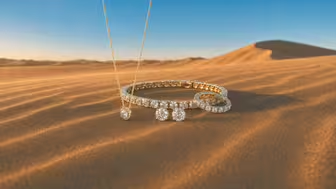
A Diamond Is Forever's holiday campaign reimagines natural diamond icons for a new generation celebrating individuality.


The Academy and Grammy award-winning siblings have collaborated with John Hardy on a new jewelry line inspired by their personal style.



Diana Singer shared the stories of two “cursed” diamonds on this month’s podcast, which was inexplicably riddled with technical issues.

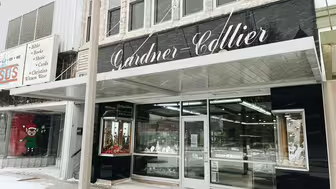
The family-owned jeweler has three locations across Missouri and Iowa.

Built on Relationships. Refined by Craft.


The De Beers-owned diamond mine in South Africa is being put on ice as part of a round of previously announced cost-cutting measures.

The collection centers designs with clean geometric lines, chunky sculptural pieces, and recognizable details from the luxury fashion brand.
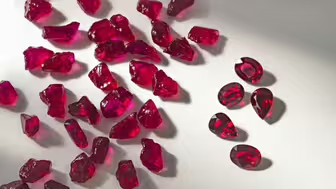
The miner said it saw particularly strong prices for larger, fine-quality rubies at the sale.

The guard opened fire on a man who was smashing a jewelry display case at La Gran Plaza in Fort Worth last week, police said.
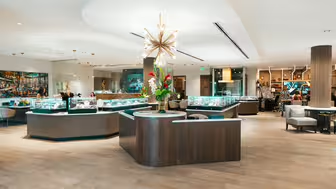
The Texas jeweler added 2,000 square feet to its reimagined showroom, complete with a new design studio and an event space.

Jacob & Co.'s diamond masterpiece is the most expensive Fantasy Bra ever worn on the Victoria’s Secret Fashion Show runway.

The “Atelier” collection was inspired by the tools, rituals, and objects in an artist’s studio as a quiet rebuttal to an automated world.
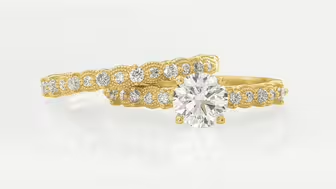
The pending acquisition is an “exciting opportunity” for wedding vendors to grow their business, said The Knot Worldwide’s CEO.

"The Secret Gems" features eight Thai jewelry brands paired with a team of young craftspeople who create jewelry together to win challenges.

The brand’s “Modern Talisman” capsule collection introduces pendants inspired by the mythology, natural world, and spiritual ethos of Bali.

Independent jewelers from New Mexico to New Jersey answer the question: What has kept your store in business for 100 years?

The NRF is expecting holiday sales to increase this year, but consumers and retailers alike are facing Grinch-like headwinds.
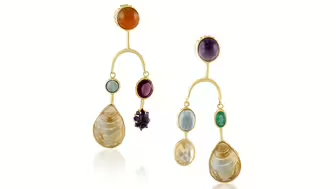
Our Piece of the Week gathers the planets, represented by a variety of colored gemstones, in a pair of 14-karat yellow gold earrings.
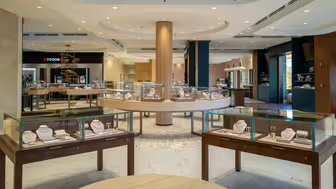
The New York-based jeweler is moving its Amherst flagship store to a larger location in nearby Snyder.

Chen, who worked at Cartier and Tiffany & Co., will lead retail sales and operations for the luxury jeweler’s 11 U.S. stores.

For 40 years, sisters Amy and Elise Greenberg have helmed their 126-year-old family business, leading with appreciation and integrity.

It’s a term Smith coined and felt compelled to share following a bad experience with an aborted flight and an unfeeling flight attendant.
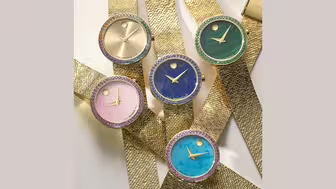
Movado teamed up with the New York-based fine jewelry designer on a new collection of Movado Museum Velura watches.
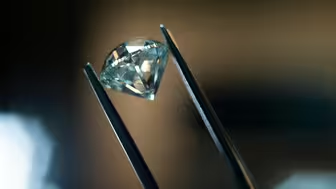
The two companies are reportedly in talks to join the Global Diamond Consortium, led by former De Beers CEO Gareth Penny, as per Bloomberg.



This site uses cookies to give you the best online experience. By continuing to use & browse this site, we assume you agree to our Privacy Policy