





MajorsSep 08, 2026
Former Tiffany & Co. Exec Joins Exemplar Luxury GroupGretchen Koback Pursel is the new chief people officer at the company formerly known as Saks Global.





A watch industry veteran who is also a former running aficionado participated in his final race Saturday, officially closing a chapter in his life dedicated to one of his greatest passions.

Manasquan, N.J.--A watch industry veteran who is also a former running aficionado participated in his final race Saturday, officially closing a chapter in his life dedicated to one of his greatest passions.
Stuart Zuckerman, who began his career at Seiko Time Corp. before going on to serve as a senior executive at Citizen Watch Co. for 22 years, participated in the 30th annual Manasquan Turkey Trot, a one- or five-mile race for participants of all ages that takes place in New Jersey.
Although Zuckerman had completed two marathons and hundreds of regional and local races in his time as a runner, he chose the single-mile race for his final challenge.
That’s because, since the age of 62, he’s been running another race: the one to save his life.
Zuckerman suffers from Frontotemporal Degeneration (FTD), a disease that shares many similarities with Alzheimer’s disease. FTD causes progressive damage to the anterior, or frontal, lobes of the brain, resulting in an ongoing decline in behavior and/or language.
“It started slowly,” said Eric Zuckerman, Stuart’s 33-year-old son who is president of display and packaging company Pac Team America Inc. “My dad was very focused and extremely smart, it was almost intimidating how smart he was. I remember early on he said he couldn’t do math in his head anymore, and he found that alarming.”
People affected with FTD find it difficult to plan or organize activities, behave appropriately in social or work settings, interact with others and care for themselves. The disease, on average, strikes when a person is in their 50s or 60s, but has affected some as young as 30.
Eric recalled other times, pre-diagnosis, when things didn’t seem right with his dad.
Having spent his career working for Japanese brands and at one time traveling to the foreign country nearly once a month, he had become familiar with sushi before it became a culinary trend in the United States. But he had forgotten how to eat it.
At Eric’s wedding he seemed lost, not recognizing or being able to connect with people he had known for more than 20 years. Zuckerman also had always been a sharp dresser, yet he began to struggle to put outfits together.
Eventually, Eric said, they realized it wasn’t apathy that was affecting his father, it was something cognitive.
In February 2010, Zuckerman was diagnosed with FTD. “I remember him saying
Life is very different now for Zuckerman, and his family.
“He’s dependent for everything, and with anyone who has someone who is progressing with any neurological disease, every month, every year there’s new things to deal with and every aspect of their life is declining,” Eric said. “He’s still happy, and he can still communicate, although it’s on a very surface level. He’s not conversational anymore.”
Zuckerman walks with the support of a cane, which he brought with him to the Turkey Trot, along with some other supporters: Eric’s mother, Marian; Eric and his wife, Amy; Eric’s sister Jennifer and her husband, Tom, plus Zuckerman’s friends from his rehabilitation center and one of his oldest running partners from his serious race days.
“We know what he will be like in a year from now. As his FTD progresses, his ability to walk will go away, his ability to swallow, everything a person does, will go away. So based on where we see him now, we knew it would be his last opportunity to do anything like (the race),” Eric said.
There currently is no cure or treatment for FTD, and the average lifespan after the onset of symptoms is seven to eight years, but can be as short as two years for some.
Eric and his sister Jennifer have created the Hope Runner campaign to help raise awareness and funds for the Association for Frontotemporal Degeneration, which promotes FTD research.
They selected running as the theme of the campaign because of their father’s passion for pounding the pavement, even though he hasn’t been doing so for some time.
Being able to run first slowed down for Zuckerman, who was at the peak of his sport in the 1970s and 80s, after two knee surgeries.
In 2000, he underwent major spinal surgery due to a spinal compression. His movements were severely limited after the procedure, which put an end to his running a decade before he was diagnosed with FTD.
“When my dad was working for Seiko in Manhattan, he would take the bus in and he and his friend would run seven or eight miles a day, and on weekends they’d do 16-plus miles,” Eric said. “I didn’t get the running gene, but there was a time where I could join him in the sport he loved. In the early 90s we would go running together and he’d make it fun--we’d run to the video store, four miles away, pick out a movie and run back.”
Up until now, the Hope Runner campaign primarily has operated through social media, but Eric said now it’s time to take it to the next level.
“It was my internal debate; would my father have wanted people who respected him in the industry to see him like this or know this? But my sister said, he never cared about any of that stuff. I think for people in the industry to hear about (the campaign), might get it a positive response,” he said. “My dad’s world was the watch industry, and watches and running were his passions.”
Additional information on the Hope Runner campaign can be found on its website.

Gretchen Koback Pursel is the new chief people officer at the company formerly known as Saks Global.

Bromberg is remembered as a Southern gentleman who always wore a suit and tie and treated others with kindness.

With high durability and a wide range of colors to choose from, sapphires may be the ultimate birthstone, Gizzi claims.
Submit your pieces for a chance to win in this year's competition.


Laughter is often considered a distraction in the workplace, but it has benefits for both staff and management, Peter Smith writes.


The California jeweler is renovating its store in Fresno, with plans to show off the new space in December.

A lifelong practitioner of Pilates, Gabrielle looked to the springs’ tension and suspension when creating this ring, our Piece of the Week.

Retailers are seeking new ways to attract customers, increase traffic, and create revenue – Estate buying events are a popular solution.


The deadline to apply is Nov. 13.

The auction house has promoted Remi Guillemin, formerly its head of watches for the Americas and EMEA, to the role.

Zaven Ghanimian discussed the value of human craftsmanship and where the implementation of artificial intelligence does work.

Jewelers of America also revealed the recipients of the Seymour & Evelyn Holtzman Bench Scholarship and its own scholarship programs.

The British actor, known for his roles in “Twilight” and “The Odyssey,” will star in a campaign for the Master Control Chronometre.

The “Confetti Disco,” “Champagne Cheers,” “Tuxedo,” and “Classic Punk” jewelry collections each capture a distinct spirit of celebration.

Nelson Holdo of Newport Beach pleaded guilty to multiple counts of felony grand theft and writing bad checks and was sentenced Monday.

Cat ladies of the jewelry world, unite. Sandy Lerner’s “significant” collection of cat jewelry and other objects is going up for auction.

Arnaud Michon, the former Omega USA President, will now lead Messika’s Americas region during its international development.

The branding references the back-to-back jewelry shows that new parent company Forge will host in Miami's Coconut Grove this November.
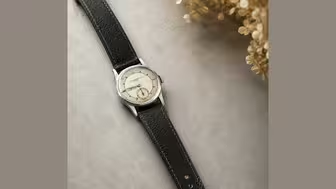
The stainless steel Patek Philippe “Calatrava” watch from the 1930s sold for nearly $80,000 at a recent Hansons Cornwall auction.

Engagement rings are important but don’t ignore the customers who are buying jewelry “just because,” Emmanuel Raheb writes.
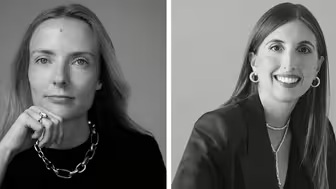
Former Pomellato CEO Sabina Belli has been named president of Kering Italia amid a shakeup of Kering's new Jewelry division.

The veteran luxury packaging executive was appointed to help the company grow its North American business.


Once the property of an Egyptian queen, the necklace was part of a larger exhibition of VCA jewelry at the Museum of Applied Arts (MAK).
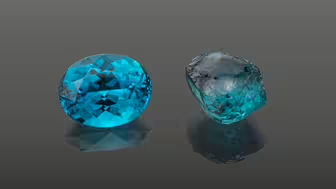
The labs’ separate investigations each determined that the East African country is producing copper-bearing tourmaline.
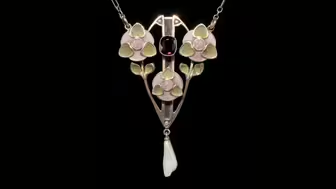
“Chicago Collects: Jewelry in Perspective” at the Oshkosh Public Museum will feature works by Fabergé, Lalique, and Louis Comfort Tiffany.
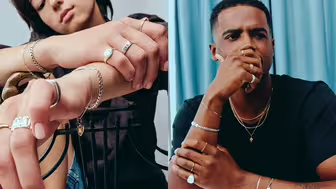
The “Worn Well” collection is Catbird's take on classic men's jewelry.
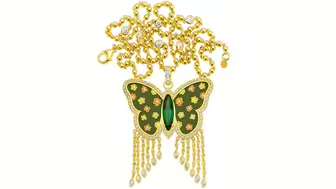
This Buddha Mama butterfly is our Piece of the Week honoring the legend, who embraced the beautiful insect as her symbol.



This site uses cookies to give you the best online experience. By continuing to use & browse this site, we assume you agree to our Privacy Policy