





SurveysOct 16, 2026
How Inflation, Gas Prices Will Affect Holiday Sales The NRF is expecting holiday sales to increase this year, but consumers and retailers alike are facing Grinch-like headwinds.




National Jeweler analyzes the price tag on the $1.4 billion deal between Signet Jewelers and Zale Corp., what it means for the jewelry industry as a whole and what the real “pickup” of the acquisition is for Signet.

New York--Flipping through National Jeweler’s last few State of the Majors lists tells a tale of an industry that is continuing to shrink.
Friedman’s, Whitehall Jewelers and Finlay Fine Jewelry, once mainstays on the list of $100 Million Supersellers, have been out of the game for several years. Ultra Stores Inc. is now part of Signet Jewelers Ltd. while other players that remain on the list--think J.C. Penney and Sears/Kmart--are grappling with serious problems.
Now, the two largest U.S. jewelers in terms of store count, Signet and Zale Corp., are on track to become one, in what industry analyst and consultant Ben Janowski calls the culmination of a string of consolidations that began back in the 1980s.
“Who was going to buy them (Zale)? The only reasonable, logical buyer was Signet all along, and that’s been rumored for ages,” he said. “That’s the track that has been going on in terms of mall consolidation for a long time and this is the culmination. There’s not much left.”
Zale essentially was the second-place finisher in what, over the years, had become a one-horse race in the thinned-out field of mall jewelers.
The Signet-Zale situation is comparable to the rivalries between Bed, Bath & Beyond and Linens ‘n Things, or Circuit City and Best Buy. As retail evolved, there was only room for one big player in each of those respective markets.
The only difference is “Zale was smarter about it,” said Consensus Advisors President Chris Ellis, who has handled a number of transactions in the jewelry industry.
Aided by a $150 million lifeline extended by private equity firm Golden Gate Capital in 2010, Zale battled back from the brink of bankruptcy by shuttering failing stores, introducing fresh, proprietary brands such as Love by Vera Wang bridal, and forging a presence for itself on social media.
RELATED CONTENT: Zale gains liquidity, gets $150M from investors
While Linens ‘n Things ended up online-only and Circuit City is out of business entirely, Signet paid $21 per share in the deal announced Wednesday for Zale, a retailer whose shares had once traded below $2.
“That was a pretty impressive recovery. That’s (something) to give them credit for,” Ellis said.
For Signet, the merger essentially was the only way to the top in a mature industry where growth opportunities are minimal.
“They want to be the largest and most profitable jewelry retailer
By the numbers
The number $690 million was widely reported as the purchase price for Zale when news of the deal broke Wednesday morning. That figure later was revised upward to $900 million.
However, when factoring in the warrants owned by private equity firm Golden Gate Capital, which has a 22 percent stake in Zale, and Zale’s debt, the deal is valued at a total of $1.4 billion.
Janowski said when it’s broken down, the $1.4 billion price tag adds up to a deal for Signet.
The purchase price is well less than $1 million per store, especially when factoring in the online operations and accounting for the fact that Zale’s store count of 1,679 includes 624 Piercing Pagoda kiosks, which are not full-line jewelry stores.
He said when Sterling Jewelers was gobbling up smaller chains in the 1980s and 1990s, the typical price was $1 million a store, which would be much more in today’s dollars. “When you are buying something like this and it’s, give or take, $1 million a store, you are paying as much as you did with much better dollars than you did 25 years ago.
“This whole business has not gone very far. In fact, it’s gone down. It’s an indication that Zale finally had to make some kind of move. They were not getting out of the morass that they were in.”
Before the merger is final, the deal has to be approved by regulators and Zale’s shareholders.
If it goes through, the transaction will merge the two largest jewelry chains in the United States, creating a chain of more than 3,600 stores in the U.S., Canada and the United Kingdom that generate more than $6 billion in annual sales and employ close to 30,000. Stores operating under this umbrella will include well-known brands such as Zales, Piercing Pagoda, Kay Jewelers, Jared the Galleria of Jewelry and Peoples Jewellers in Canada.
In a presentation given Wednesday morning, Signet said the combination creates a “more diversified” retailer with a total of 3,653 stores in three countries. It said it plans to invest in and grow Zales’ brands, while operating them as a standalone portfolio within Signet, with CEO Theo Killion still at the helm.
Analysts, however, say that the chain won’t remain at 3,653 stores for the long term.
Ellis says eventually there will be consolidation in markets where there is duplication.
In some cases, the company may opt to keep multiple stores open in the same market because it works. “(But) it doesn’t work everywhere,” he said. “If there was no consolidation, there would be no point in making the acquisition, would there?
“I think it’s a pretty safe to assume you are not going to have Kay and Zales in the same mall.”
Janowski agrees, adding that while the further consolidation of the mall jewelry business could have a positive impact on other mall jewelers that may have one less competitor, it won’t mean much for independents, many of whom long ago abandoned the malls’ halls.
“You are not going to see duplication of efforts in the same market,” he said. “I think Canada is the big pickup (in this deal.)”
The potential acquisition of Zale gives Signet a foothold of 199 Peoples and Mappins stores in Canada, a market where it previously had no stores, as well as approximately 125 Zales Outlet stores in the U.S. and Puerto Rico, a space in which Signet has been keen on expanding recently.
RELATED STORY: Sterling completes $57M Ultra acquisition
The company’s last big acquisition, completed in November 2012, was of Ultra Stores Inc., operator of Ultra Diamonds outlets, which it is converting into Kay Outlet stores.
Who’s next?
Signet’s 2012 acquisition of the Ultra stores was followed by Swatch Group’s $1 billion purchase of the Harry Winston name and retail chain from Harry Winston Diamond Corp. in 2013. The company formerly known as Harry Winston Diamond Corp. is now Dominion Diamond Corp. and its sole business is diamond mining.
RELATED CONTENT: Swatch buys Harry Winston retail
While there has been plenty of consolidation at the manufacturing end of the business, neither Janowski nor Ellis could give a solid prediction as to what the next major retail merger might be in the U.S. market.
“I don’t think in retail there is anything that leaps off the page at me,” Ellis said. “I think there will be a lot of activity further up the supply chain.”
New York-based retailer Tiffany & Co. has been mentioned as a prime acquisition target for one of the world’s luxury goods conglomerates, such as LVMH Moët Hennessy Louis Vuitton, which snapped up Bulgari in 2011, or Kering (formerly PPR), which bought a majority stake in Pomellato last year.
Janowski said the brand recognition the 177-year-old retailer garners is enough to make the conglomerates “salivate” at the thought of acquiring Tiffany. None of the other big jewelry stores lining the tony stretch of Fifth Avenue just south of Central Park--Bulgari, Wempe, Cartier, Van Cleef & Arpels--have the same draw as the Tiffany store, he said.
“Who knows?” if Tiffany will be acquired one day, Janowski said. “It’s almost impossible to predict that. Certainly they have said no to all those possible inquiries that have come up in the past.”
But that doesn’t mean, at some point, a company won’t make the venerable retailer an offer it simply can’t refuse, he added. “There’s no way to know that."

The NRF is expecting holiday sales to increase this year, but consumers and retailers alike are facing Grinch-like headwinds.
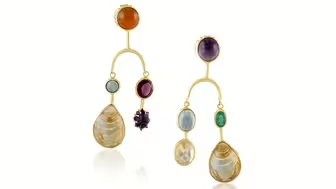
Our Piece of the Week gathers the planets, represented by a variety of colored gemstones, in a pair of 14-karat yellow gold earrings.
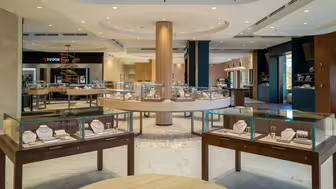
The New York-based jeweler is moving its Amherst flagship store to a larger location in nearby Snyder.

Experience gemstones with greater precision and comfort than ever before.


For 40 years, sisters Amy and Elise Greenberg have helmed their 126-year-old family business, leading with appreciation and integrity.

It’s a term Smith coined and felt compelled to share following a bad experience with an aborted flight and an unfeeling flight attendant.
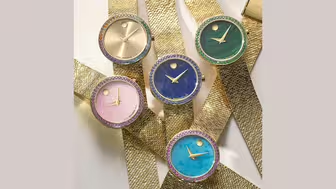
Movado teamed up with the New York-based fine jewelry designer on a new collection of Movado Museum Velura watches.
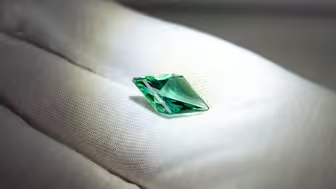
Submit your pieces for a chance to win in this year's competition.

The two companies are reportedly in talks to join the Global Diamond Consortium, led by former De Beers CEO Gareth Penny, as per Bloomberg.
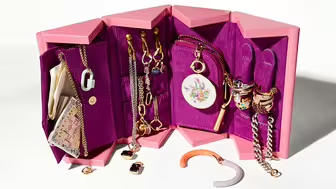
The “Some of the Things” box follows the two larger “Everything” box designs with the look and function of antique sewing and toolboxes.

Fourth-generation jewelers Coleman and Mitchell Clark exemplify the best qualities of their predecessors: humility, modesty, and confidence.

The gem hunter, whose 70-year career was defined by adventure and exploration, is remembered for his steadfast faith and sense of wonder.

Tiffany & Co. continued its full-scale store renovation project while Bulgari’s high jewelry collection generated “record-breaking revenue.”

This year’s sessions feature leading voices from human rights, legal, and conservation organizations.

The jewelry designer has partnered with Sofer Jewelry to distribute her 85-piece lab-grown diamond collection.

Dunn, this year’s Single-Store Independent inductee, is passionate about innovation and telling the story of natural diamonds.

The 24-carat fancy intense pink diamond ring could fetch up to $18 million at the November sale.

The “Island Jewel” candle honors New York City and Puerto Rico and raises money for the island’s water relief efforts.
The partnership will give JA members access to preferred pricing, exclusive benefits, technology solutions, education, and resources.

Stores should expect to see the most customers on Nov. 27, and Christmas week is expected to be hectic too, as Dec. 25 falls on a Friday.

The charm, our Piece of the Week, features brown diamond frozen hot chocolate topped with white diamond whipped cream and a ruby straw.

The top lot of Elmwood’s recent fine jewelry sale in London was a 1.84-carat, D color Tiffany & Co. solitaire diamond ring.

The watch company agreed to sell a 95 percent interest to a group comprised of F.P. Journe, Chanel, and Swiss watch exec Pierre Jacques.

This round of tariff refunds is for importers that have sued over IEEPA tariffs in the Court of International Trade and won.

It revisits the brand’s most requested silhouettes, from "Pillow"-set necklaces and bracelets to "Signature"-set rings and earrings.

The trade-only event includes buying opportunities as well as educational sessions on artisanal mining, the new Paraíba source, and more.

Ara Chanakian, a jeweler at Pattons, took home top honors in every category at Jewelers of Louisiana’s annual jewelry design competition.



This site uses cookies to give you the best online experience. By continuing to use & browse this site, we assume you agree to our Privacy Policy