








TrendsSep 08, 2026
Amanda’s Style File: A Hot Take on September’s Birthstone With high durability and a wide range of colors to choose from, sapphires may be the ultimate birthstone, Gizzi claims.





A former Israeli Defense expert who now heads a jewelry-focused security firm runs down the main missteps exhibitors make that lead to losses.

New York--A little more than a month from now, the industry will converge on Las Vegas for five days of buying and selling and, most likely, monetary losses due to stone swaps, snatch-and-grabs and case cutting.
Jewelers’ Security Alliance statistics show that in 2014, trade shows ranked behind only highways/streets and parking lots as the most frequent scenes for off-premises crimes last year--and those are just the losses that were reported to the JSA.
At a meeting held Thursday in New York, Itay Hendel, head of ISPS-USA Security Consultants LLC, a firm with offices in Israel and New York that does security training for the jewelry industry, used security footage shot in booths at trade shows worldwide and clips from local newscasts to highlight the main mistakes exhibitors and traveling salespeople make that lead to losses.
His overriding message to those who attended his lecture, which was sponsored by Jewelers Mutual Insurance Co., was this: Ultimately, exhibitors have to be the ones in control of what’s going on in their booths at all times, who’s coming in, who’s going out, and how they’re behaving when inside.
“It’s about control,” he said. “No one will step to our booth without our permission.”
1) Not watching smartphones carefully enough. Probably one of the biggest security conundrums confronting both retailers and exhibitors these days is the ubiquity of smartphones. People and their phones are seemingly inseparable --they use them to take pictures, text and share on social media constantly.
While Hendel said that exhibitors don’t need to ban the use of smartphones in their booth entirely, they need to watch people who have them in hand. It’s fine if they want to use the phone to take a picture of a stone but they don’t need to keep it in their hand while handling loose diamonds, he said. Hendel there have been a number of incidences at trade shows recently where the perpetrators used a smartphone to help them pull off a stone swap.
2) Letting surfaces get cluttered. Don’t let visitors to the booth, or to a retail store for that matter, clutter the table or the showcase with show maps, shopping bags or random pieces of paper. As Hendel showed in a video, thieves often use maps and the like to distract from theft, and jewelry easily can be slipped into shopping bags.
3) Thinking it’s just a coincidence.
4) Not controlling booth traffic. Hendel said exhibitors shouldn’t let people “just stand around” in their booth. If no one is available to offer that person one-on-one help, ask them to come back in 15 minutes. Don’t let visitors outnumber salespeople. Hendel also recommended appointing one person per booth to be in charge of security. “They don’t need to be focused on sales only,” Hendel said.
5) Not taking precautions with new clients. Have another salesperson there if a visitor to the booth is unknown to the business, and have one of the salespeople stand next to them. Also, ask this prospective new client for a business card.
6) Leaving the showcase unlocked, even for a second. This might seem like common sense, but thieves have snatched many an item from an open showcase. Open it, get what’s needed, lock it, and take the keys out and put them in your pocket, Hendel said.
7) Lacking an emergency communication plan. Pick a phrase like “It’s too hot” or “It’s too cold” to act as a secret message that alerts other employees in the booth to potential danger. Also, have phone numbers for the shipping company, insurance company and show security on hand.

With high durability and a wide range of colors to choose from, sapphires may be the ultimate birthstone, Gizzi claims.

Laughter is often considered a distraction in the workplace, but it has benefits for both staff and management, Peter Smith writes.

The California jeweler is renovating its store in Fresno, with plans to show off the new space in December.
Submit your pieces for a chance to win in this year's competition.


A lifelong practitioner of Pilates, Gabrielle looked to the springs’ tension and suspension when creating this ring, our Piece of the Week.


The auction house has promoted Remi Guillemin, formerly its head of watches for the Americas and EMEA, to the role.

Zaven Ghanimian discussed the value of human craftsmanship and where the implementation of artificial intelligence does work.

Retailers are seeking new ways to attract customers, increase traffic, and create revenue – Estate buying events are a popular solution.


The British actor, known for his roles in “Twilight” and “The Odyssey,” will star in a campaign for the Master Control Chronometre.

The “Confetti Disco,” “Champagne Cheers,” “Tuxedo,” and “Classic Punk” jewelry collections each capture a distinct spirit of celebration.

Nelson Holdo of Newport Beach pleaded guilty to multiple counts of felony grand theft and writing bad checks and was sentenced Monday.

Cat ladies of the jewelry world, unite. Sandy Lerner’s “significant” collection of cat jewelry and other objects is going up for auction.

Arnaud Michon, the former Omega USA President, will now lead Messika’s Americas region during its international development.

The branding references the back-to-back jewelry shows that new parent company Forge will host in Miami's Coconut Grove this November.

The stainless steel Patek Philippe “Calatrava” watch from the 1930s sold for nearly $80,000 at a recent Hansons Cornwall auction.

Engagement rings are important but don’t ignore the customers who are buying jewelry “just because,” Emmanuel Raheb writes.

Former Pomellato CEO Sabina Belli has been named president of Kering Italia amid a shakeup of Kering's new Jewelry division.

The veteran luxury packaging executive was appointed to help the company grow its North American business.


Once the property of an Egyptian queen, the necklace was part of a larger exhibition of VCA jewelry at the Museum of Applied Arts (MAK).

The labs’ separate investigations each determined that the East African country is producing copper-bearing tourmaline.
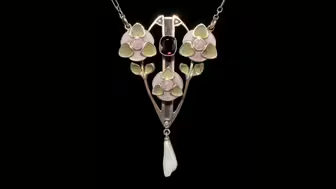
“Chicago Collects: Jewelry in Perspective” at the Oshkosh Public Museum will feature works by Fabergé, Lalique, and Louis Comfort Tiffany.

The “Worn Well” collection is Catbird's take on classic men's jewelry.
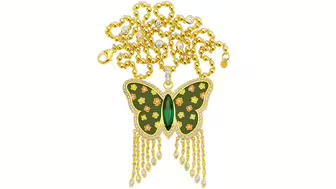
This Buddha Mama butterfly is our Piece of the Week honoring the legend, who embraced the beautiful insect as her symbol.

The former De Beers CEO, and perhaps its next owner, will be a featured speaker at the event, slated for Sept. 4-7 in Italy.

The employee-owned jeweler was named a “Best Place to Work” in Maine, New Hampshire, and for women.

The second iteration of the jewelry collection was inspired by the zodiac and the four elements: earth, water, air and fire.

General License 104B supersedes General License 104A, which was set to expire on Sept. 1.



This site uses cookies to give you the best online experience. By continuing to use & browse this site, we assume you agree to our Privacy Policy