




A ring set with “hogback” diamonds, an early stone cut dating to around the 16th century, sold for more than $20,000 at a U.K. auction.
Beautiful, Innovative Italian Jewels on Display at JCK Las Vegas
The breadth and depth of Italian design, craftsmanship and manufacturing technology was on full display at the 2019 JCK Las Vegas.

Brought To You By The Italian Trade Agency
When it comes to producing jewels, the Italians display a level of skill, expertise and creativity that is unmatched anywhere in the world. Walking through the halls of the Bella Italia pavilion confirmed this. While beautiful jewels are made throughout Italy, there are three areas that are known throughout the world for producing exceptional gold jewels: Vicenza, Valenza and Arezzo. In the southern part of the country there’s Torre del Greco, the world’s center for coral and cameo jewels. Nearly all businesses featured in this story are from these regions.
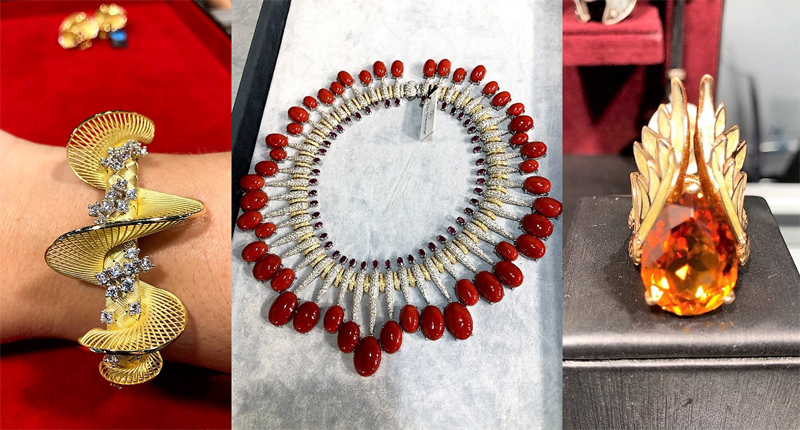
When discussing Italian jewels, craftsmanship and design are always on the forefront. However, the one thing that’s often overlooked is the innovations and advance technologies that are behind the items being created. For example, Barbara Pastorello of OroSoffiato in Vicenza explains that the stylish gold jewels her company produces are created through an in-house developed electroforming process. Electroforming is a way to produce a thick skin of metal, usually over an object. This process is mostly done with copper because it is easier and inexpensive. OroSoffiato developed a process in-house using gold. The result is seven collections of fashionable yellow gold jewels that are centered on large, light earrings of varying shapes, from rough organic in appearance to geometric structures. The thickness of the earrings in each collection varies as well. For a few of the collections, necklaces, rings and bracelets complement the earring motifs.
Another example of technological innovations is practiced by Nuovi Gioielli of Vicenza, which used JCK Las Vegas to introduce its 3D printed gold jewelry. Most companies use 3D printing technology to print waxes and then cast the precious metal from those waxes. Nuovi Gioielli is one of the few companies in the world to directly print the gold jewels. The process to get this innovation to market took six years, said Cristina Delucca, Nuovi Gioielli Vice President. The results are stunning
To demonstrate the diversity of Italian jewels, we now travel from the north to the southern seaside city of Torre del Greco, near Naples. The city has been world’s leading producer of coral jewelry and cameo brooches since the 17th Century. The jewels are still produced using traditional hand-crafted methods. One of the older and better-known companies in the region is De Simone Fratelli. Michele De Simone says one-of-a-kind pieces make up 80% of its inventory. The company has been selling in the U.S. since the 1980s and their products are available at luxury department stores throughout the country. He says the coral the company uses is “totally sustainable” and has a rarity that makes their products a “true luxury item.” Pieces on view included a traditional red coral necklace paired with pavé diamond and gold (pictured center), and necklaces made of large “angel skin” coral, which reveal a pink color.
Next is men’s jewelry, where designer Giuseppe Donato operates under two brands, Spartan Ring and Donato Jewels out of Alessandria, near Valenza. He says his pieces are contemporary fashion jewels primarily for men, but there are pieces for women and some that are unisex. He describes his pieces as “jewels for brave souls.” Although contemporary, many of the collections and the overall style of the brand are based on ancient, medieval and gothic themes. For example, his Spartan Rings depict helmets worn by the Spartan soldiers of ancient Greece (pictured right). His pieces range in price from $250 to more than $100,000 depending on its size and materials used. His well-crafted jewels are big and bold and make a statement. He creates his elaborate designs with variety of metals often complemented by colorful gems.
Songa, based in Milan, is one of the largest jewelry wholesalers in Italy and sells its pieces all over the world, including approximately 20 clients in the U.S., says Mara Constanza Ruggieri. The company offers jewels in a range of price points and styles from 8k to 18k gold. They purchases jewels from about 300 factories throughout Italy and have a 3,200-square-foot showroom in Milan that is stocked with upwards of 35,000 items at any given time for buyers from the jewelry trade. They say “[Buyers] can come in and select whatever they want whenever they need it.” Customer fulfillment is done seamlessly online through the company’s B2B website. It’s difficult to believe the company was founded in 1935 by Antonio Songa, a goldsmith, who decided to transform his jewelry manufacturing firm into a wholesale business. “It was the right commercial approach,” Ruggieri said. It sure was
.
There’s a great deal of variety in the design from pieces that are larger sculptural to delicate and small. The company says it uses certified conflict-free diamonds and sustainably sourced colored gems.
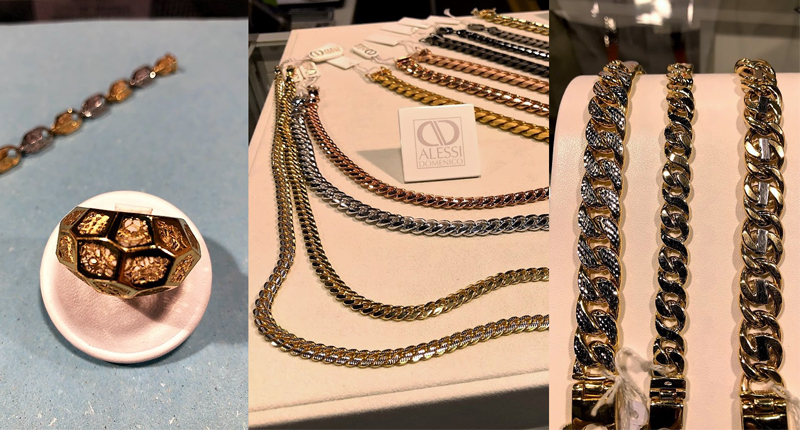
Neonero is another company on the cutting edge of innovative manufacturing. It specializes in 14k to 22k gold jewels in distinct openworked designs created by laser cutting. This modern technique produces jewels that have the appearance of traditional handcrafted styles (pictured left). High polished finishes give these pieces a modern appeal. The designs from laser cuts create a number of shapes that range from honeycomb to floral arrangements. Cristiano Marini, Neonero export manager, said it’s the company’s first time exhibiting at JCK Las Vegas. She states, “We met many people and we hope to have new customers and new business in the U.S.”
Gold and silver chains sounds simple enough but to create them on a high level they must come in an endless number of designs, be produced in an efficient operational environment and ensure that the pieces adhere to the most precise use of precious materials. To do this requires what are arguably the most advanced manufacturing techniques in the jewelry world. Examples of companies exhibiting at JCK Las Vegas that specialize in the production of chains are Alessi Domenico and Multiform.
Alessi Domenico “works on products that are strong and beautiful,” said Alice Alessi, Sales and Marketing Director, also noting that the company is the second largest chain provider in Vicenza. “We have the capability to produce two tons of chains every three weeks,” she said. The U.S. is the company’s biggest market. One of the ways its chains maintain strength is by employing a Galvanic process, which uses electrolysis to cover the surface with a metallic layer. One of the main products the company was promoting using this technique was its Miami Cuban Doubleface gold chains, which come in a range of colors, including black (pictured center).
Meanwhile, Multiform combines hand-crafted techniques with modern manufacturing innovations to produce a variety of sturdy gold chains from 10k to 18k, primarily for men (pictured right). The company also produces gold bracelets and rings.
The Latest

The rainbow version of the ring, our Piece of the Week, features angel-cut, octahedral lab-grown sapphires designed to be worn as armor.

The new initiative donates a portion of the proceeds from select charms to charitable causes.

Colored gemstones, artisan finishes, mixed metals, and meaningful details are shaping demand in bridal jewelry.

The Brooklyn-based jeweler created a limited-edition version of its “Aura” eternity band, set with gemstones in the team’s colors.


Dallow will lead the International Colored Gemstone Association, effective July 6.

Senior Editor Lenore Fedow headed to Savannah to learn more about the 10-year, $10 million partnership between JM and the art school.

DCA is preparing the next generation of professionals by supporting workforce development, leadership growth, and career advancement.

Its new capsule jewelry collection features gold-finished stainless steel pieces designed for a maximalist look without a luxury price tag.

The three industry leaders bring financial, communications, and legal expertise to the nonprofit’s board of directors.

Jewelers are missing out by not offering this one key add-on at the online point of sale, Emmanuel Raheb writes.

The fourth collaborative collection from the retailer and jewelry content creator focuses on gemstone charms and strands of colorful beads.

The collection features traceable alexandrite from Brazil in calibrated sizes that is sorted by grade.

Dhaval Raja has been appointed to the role.

The capsule collection looks to vintage trunk pins that echo the spirit of speed, freedom, and the mythology of the American road trip.

SSEF issued a notice about the potential new source of the sought-after gemstone, citing “credible reports” from trade sources.

As Amazon Prime Day kicks off, Etsy is encouraging shoppers to support small businesses.

Cole Winward is the recipient of 2026 AGA Gemological Scholarship.

Whether they evoked nostalgia, wonder, or laughter, these jewels put a smile on our faces.

Scheduled for April 2027, Basilia will be the first watch and jewelry trade show held in Basel since the collapse of Baselworld in 2020.

Submissions for the milestone 25th annual Gem Awards will be accepted across three categories from now through July 31.

The beloved beagle dons his aviator outfit for the new Engineer Master II Snoopy Flying Ace timepiece.

The recent high jewelry auction, which also featured the sale of a 10-carat blue diamond, was “a celebration of color.”

She wore the “Le Cauri Endiamanté” earrings, our Piece of the Week, in the Obamas’ first dual portrait for the Obama Presidential Center.

Couture’s Michelle Orman joins Amanda Gizzi and Michelle Graff for this special post-Market Week episode of My Next Question.

The lab is seeing emeralds with filler added post-testing enter the market, accompanied by reports that indicate little to no treatment.

The third generation of the Stern family to head Patek Philippe, he navigated the “quartz crisis” and preserved the brand’s independence.