




MajorsSep 08, 2026
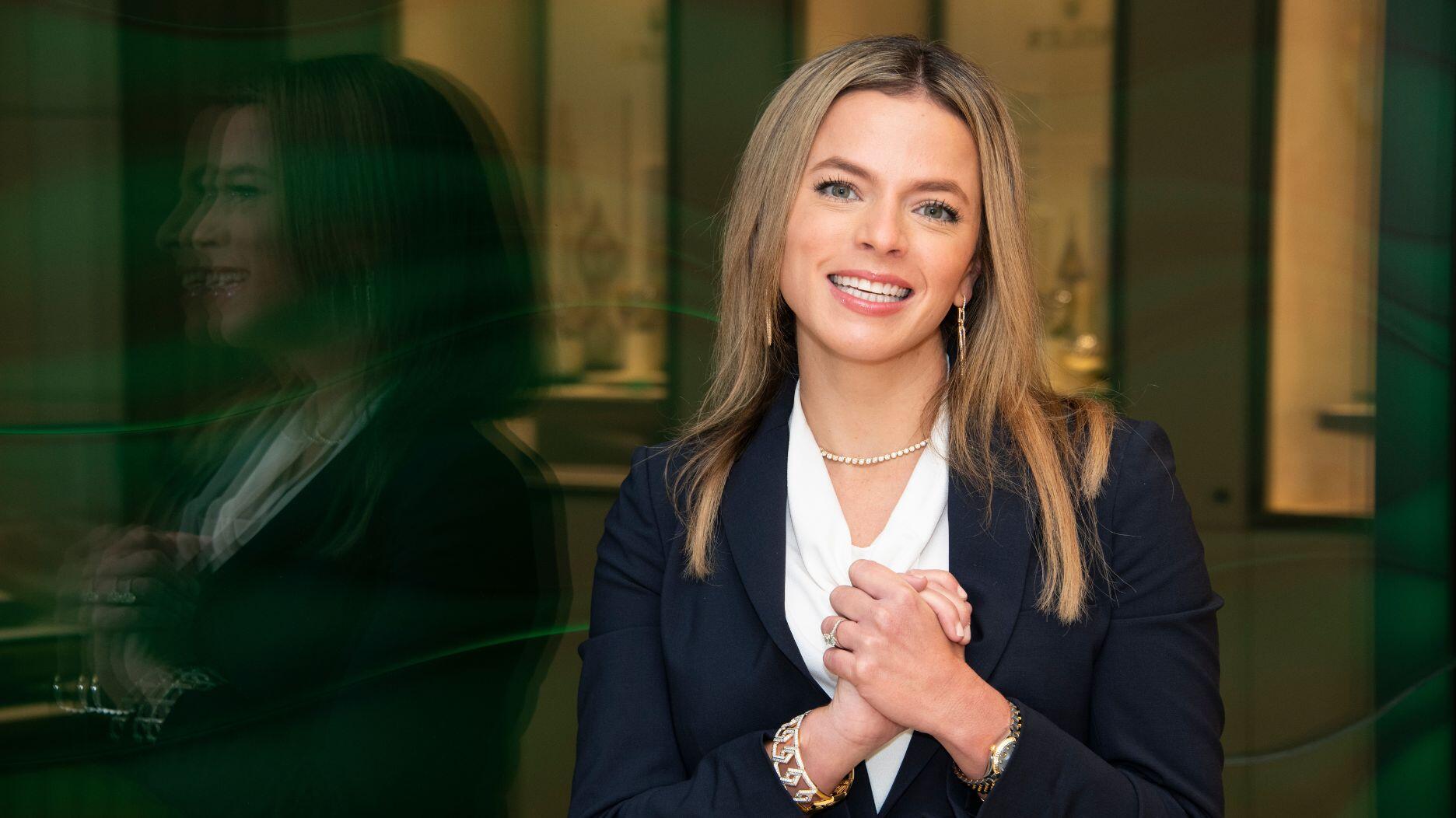
Former Tiffany & Co. Exec Joins Exemplar Luxury GroupGretchen Koback Pursel is the new chief people officer at the company formerly known as Saks Global.





I was surprised by Tuesday’s announcement that Pandora’s CEO was stepping down and the company retooling in the face of sliding sales and poor execution in both marketing and operations. The announcement raised a number of questions for me about...

I was surprised by Tuesday’s announcement that Pandora’s CEO was stepping down and the company retooling in the face of sliding sales and poor execution in both marketing and operations.
The announcement raised a number of questions for me about a brand that I have perceived as being über-successful within the industry, kicking off a craze for a charm bracelets with a modern twist and helping many jewelers make it through the recession when nothing else--save bridal--was selling.
Has Pandora simply saturated the market? One of the thoughts that first came to mind when I read the Pandora announcement was that they had simply reached a point where the majority of people who wanted their product had what they wanted and didn’t need or want to buy anymore.
Industry analyst Jeff Taraschi said that’s not necessarily the case. There are consumers out there still wanting to buy Pandora-type products, they’re just buying it from other companies that are selling it for less.
“When you’re successful it brings a lot of competition and it brings a lot of competition at lower price points,” he said. “People that like the [Pandora] look are buying the look from the competition rather than buying it from Pandora.”
He added that Pandora might be feeling some heat from recently announced partnership between competitor Chamilia and Swarovski, a strong brand.
“There probably would be concern at the executive level in the boardroom ... about this Chamilia-Swarovski relationship. It’s direct competition,” Taraschi notes.
Is Pandora a fad that’s fading? In conducting interviews with retailers over the past couple of years, I’ve come to discover that Pandora is a deeply dividing topic. Some jewelers refuse to carry Pandora, or any similar lines, because they feel it doesn’t belong in a fine jewelry store and is a fad that will disappear over time. As one retailer Tweeted to me the other day, “It’s not real jewelry!”
On the other hand, there are jewelers who have hired extra people just to man the Pandora counter and swear by the product as a way to generate traffic in their stores and sales among today’s price-conscious consumers.
So, are Pandora’s recent weak financials and ousting of the CEO are a sign that the former were correct, that Pandora is a fad that’s losing steam? Taraschi and Ken Gassman, another analyst that follows the industry closely, say no.
Gassman
Despite the problems, he said jewelers tell him that Pandora continues to sell well, and he said he’s heard nothing about price resistance from jewelers or consumers (though price is evidently a problem, as discussed below).
He also said he thinks beads--the backbone of Pandora’s business--have staying power as a category due to their low price point.
“Beads won’t ever be a major jewelry category, but it is viable (just as charm bracelets always seem to sell, and diamond engagement rings always seem to sell)” Gassman said.
Taraschi said beads aren’t like gold hoops or diamond line bracelets--jewelry staples that will be with the industry forever--but companies such as Pandora will continue to exist. Their success will ebb and flow, according to how innovative they are with their product.
So then, what is the main problem? The issue that came up time and again in Pandora’s hour-and-a-half long conference call on Tuesday: price.
As the prices of gold and silver have soared, so have Pandora’s prices. And that hasn’t sat well with their core customers, executives acknowledged during the call.
“Every business has a certain amount of price elasticity,” Taraschi said. “They might have crossed a boundary where consumers are no longer willing to pay at that level.”
Rather than being creative and re-engineering their product to create something more affordable, the feeling must have been that the brand was strong enough to be insulated from consumer backlash due to increasing prices. “The results would say that was a flawed strategy. That’s why you eliminate the CEO, for misjudging price elasticity, for not working to engineer product so the same basic look and feel could be presented without the price increases,” Taraschi said.
During Tuesday’s call, Pandora executives said that the average selling price in the United States has risen 40 percent over the past 18 months.
The company said it won’t raise prices for the remainder of 2011 or in 2012, a pretty bold statement considering the way the cost of metals continues to rise. Executives acknowledged that this obviously means they will be taking a hit on margins. Pandora’s second quarter margins were 74 percent.
Lastly, here are a few notes from the conference call that I found interesting.

Gretchen Koback Pursel is the new chief people officer at the company formerly known as Saks Global.

Bromberg is remembered as a Southern gentleman who always wore a suit and tie and treated others with kindness.

With high durability and a wide range of colors to choose from, sapphires may be the ultimate birthstone, Gizzi claims.
Submit your pieces for a chance to win in this year's competition.


Laughter is often considered a distraction in the workplace, but it has benefits for both staff and management, Peter Smith writes.


The California jeweler is renovating its store in Fresno, with plans to show off the new space in December.

A lifelong practitioner of Pilates, Gabrielle looked to the springs’ tension and suspension when creating this ring, our Piece of the Week.

Retailers are seeking new ways to attract customers, increase traffic, and create revenue – Estate buying events are a popular solution.


The deadline to apply is Nov. 13.

The auction house has promoted Remi Guillemin, formerly its head of watches for the Americas and EMEA, to the role.

Jewelers of America also revealed the recipients of the Seymour & Evelyn Holtzman Bench Scholarship and its own scholarship programs.

The British actor, known for his roles in “Twilight” and “The Odyssey,” will star in a campaign for the Master Control Chronometre.

The “Confetti Disco,” “Champagne Cheers,” “Tuxedo,” and “Classic Punk” jewelry collections each capture a distinct spirit of celebration.

Nelson Holdo of Newport Beach pleaded guilty to multiple counts of felony grand theft and writing bad checks and was sentenced Monday.

Cat ladies of the jewelry world, unite. Sandy Lerner’s “significant” collection of cat jewelry and other objects is going up for auction.

Arnaud Michon, the former Omega USA President, will now lead Messika’s Americas region during its international development.

The branding references the back-to-back jewelry shows that new parent company Forge will host in Miami's Coconut Grove this November.
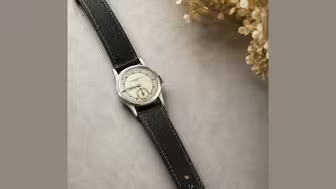
The stainless steel Patek Philippe “Calatrava” watch from the 1930s sold for nearly $80,000 at a recent Hansons Cornwall auction.

Engagement rings are important but don’t ignore the customers who are buying jewelry “just because,” Emmanuel Raheb writes.
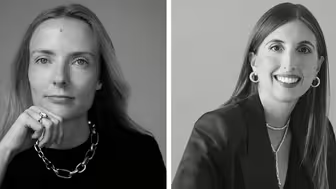
Former Pomellato CEO Sabina Belli has been named president of Kering Italia amid a shakeup of Kering's new Jewelry division.
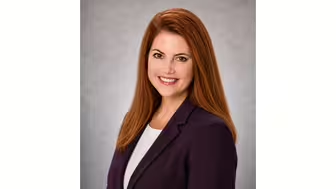
The veteran luxury packaging executive was appointed to help the company grow its North American business.


Once the property of an Egyptian queen, the necklace was part of a larger exhibition of VCA jewelry at the Museum of Applied Arts (MAK).
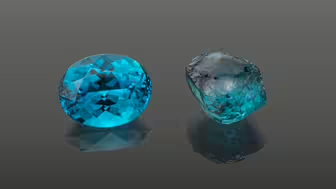
The labs’ separate investigations each determined that the East African country is producing copper-bearing tourmaline.
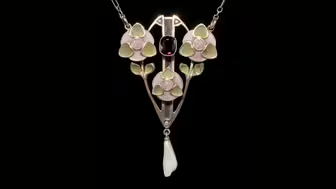
“Chicago Collects: Jewelry in Perspective” at the Oshkosh Public Museum will feature works by Fabergé, Lalique, and Louis Comfort Tiffany.
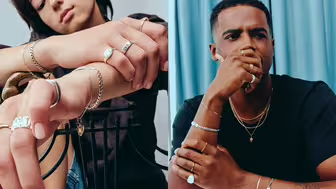
The “Worn Well” collection is Catbird's take on classic men's jewelry.
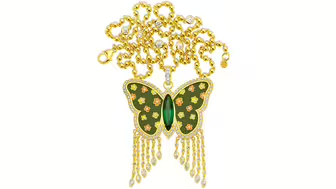
This Buddha Mama butterfly is our Piece of the Week honoring the legend, who embraced the beautiful insect as her symbol.

The former De Beers CEO, and perhaps its next owner, will be a featured speaker at the event, slated for Sept. 4-7 in Italy.



This site uses cookies to give you the best online experience. By continuing to use & browse this site, we assume you agree to our Privacy Policy