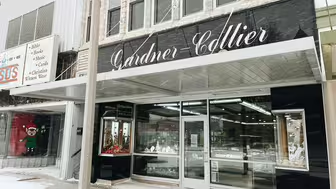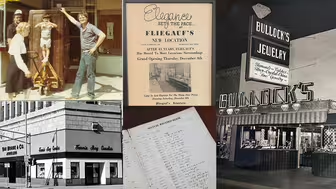

Jim Springer, owner of Dunkelberger’s Fine Jewelry, is heading into retirement.
Which Social Media Platforms Are Best for Jewelers?
Likeable Local’s Mike Farrell says that in order to find the answer, jewelers first need to ask themselves two other questions.

Whether you’re just starting out or are looking to expand your social presence, there quite a few routes you can take.
Many fall into the trap of trying to tackle every social network at once and wind up spreading their efforts too thin. Especially for small business owners, who are likely already wearing many others hat, using your time efficiently on social media is crucial.
So, on which platforms should you be focusing? In order to properly determine the answer, you first need to ask yourself two questions.
1. What kind of products do you sell? A high-end jeweler is going to have a much different target audience than a casual jewelry store. Different demographics have different frequencies on the various platforms and this will affect your social strategy. Also, consider your intended brand voice because each platform lends itself to a particular style of communication.
2. Additionally, it’s also important to consider what your store’s overall goals are before you begin investing time in social media. One of the biggest mistakes we see a lot of small businesses make on social is to move forward without any real plan in place. Determining the objectives of your marketing efforts helps you decide which platforms to focus on because each platform can best be used for different purposes. Are you trying to grow awareness for your brand online? Are you trying to promote specific offers/sales? Or are you trying to drive followers to your physical location?
Let’s begin with the social media juggernaut, Facebook.
By now, it is almost assumed that everyone has a Facebook profile. More importantly for you, it is also assumed that all businesses are now on Facebook. Maintaining an active presence on the platform is vital because it’s currently the most ubiquitous social network with more than 1.5 billion users.
Facebook has powerful advertising capabilities built right into the platform with the ability to create custom audiences and target by interests and demographics.
Facebook is also very useful because it allows for a variety of different functions such as short-form posting, long-form posting, and photo/video sharing. It encompasses most features of other social networks, making it a popular choice among marketers.
In addition, content on Facebook is less time-sensitive than other platforms such as Twitter and Instagram. However, it is largely pay-to-play if you want your followers to see your posts. Also important to consider with
Next, let’s move onto Instagram, which passed Twitter last year in terms of monthly active users.
The platform boasts one of the highest user engagement rates, making it an effective space to build a brand community. Instagram is an especially great platform for businesses that have products that lend themselves to being showcased visually. Restaurants, jewelers and clothing manufacturers are all examples of businesses with visually appealing products that are perfect for Instagram.
However, don’t limit yourself to just pictures or videos of your jewelry. As beautiful as your products are, the ‘Gram is also a great place to humanize your brand by showing off your company culture. This is especially important on Instagram because users on the platform tend to skew younger and these younger consumers value connecting with brands online. Office shenanigans and behind-the-scenes looks can go a long way in putting a face to your business.
One challenging aspect of Instagram for marketing purposes is that the platform does not support links within posts. You are only allowed one link within your bio, which can make it challenging to redirect followers to content on your website or blog. One way around this is to make use of Instagram ads that redirect to an external website. These ads were originally for larger brands, but have recently become more affordable for smaller businesses.
Twitter has recently been suffering an identity crisis of sorts and its user base has started to stagnate. However, this is not to say it’s alright to start ignoring the platform. Twitter remains a great place to receive small bursts of current information and to connect with industry thought leaders. The platforms lends itself particularly well to reaching out to people you may not fully know yet.
Here at Likeable, we connect with people on Twitter all the time and frequently are able to take conversations with prospects into email or Skype.
Twitter is particularly useful for redirecting to external content and you can insert multiple links into a single tweet. The network also has powerful advertising capabilities with the added bonus of the promoted tweets looking very similar to normal tweets.
If you want to maximize your reach on Twitter, it’s recommended that you make use of ads because the lifespan of tweets is so short. Ads will boost your reach, and the platform even gives you estimates of how many link clicks you will receive based on your ad spend.
Similar to Instagram, Twitter is great for fostering an engaged community around your products. It’s a helpful place to find out what people are saying about your business, your competitors and your industry in general. There are also listening tools to help you gather these insights to make better informed decisions moving forward. Finally, Twitter is often used as a customer service platform because of its real-time nature, so make sure you are responsive.
LinkedIn is an interesting network because its audience is more easily defined than other platforms. Billed as the “network for professionals,” LinkedIn can serve a variety of purposes for both businesses and individuals alike.
One of the most powerful aspects of the platform is its networking capabilities. On LinkedIn it’s possible to connect with and recruit users based on industry and common connections. It’s an especially powerful resource for business-to-business companies and can also be used to establish your thought leadership within an industry.
Similar to Facebook, LinkedIn also has a helpful groups feature that can allow you to have private conversations with thought leaders on trending jewelry topics.
If you are not a business-to-business jeweler, you can still certainly find use for the platform as an individual, but as a business-to-consumer jeweler it might be better to initially stick to other the other platforms previously mentioned.
Snapchat
I’ve already outlined my thoughts on Snapchat, but let’s recap (because it’s my still my favorite platform.)
The platform has quickly moved from the fringe of social media relevance to a legitimate platform where the likes of BMW and Hasbro now frequently advertise. Snapchat has deftly figured a way to include paid advertisements within in its app without disrupting the user experience.
Now, for small business purposes the paid advertisements are not within the realm of financial feasibility. However, this is not to say that small businesses cannot find use for the app.
As of last year, more than 400 million snaps were sent daily. With over 25 million users in the United States alone, there is a good possibility that you may have some potential customers frequently using the app (even more likely if your target demographic is skewed younger.)
Especially with the inclusion of the story and chat features, companies are starting to figure out ways to effectively use Snapchat’s organic reach potential.
Snapchat differs greatly from some of the other platforms here because of its innate casual and time-sensitive nature. More so than any other network Snapchat really allows you to be your authentic self.
Snapchat will be most effective for your business if you have a product that’s interesting to show off visually--which all jewelers do--and if you have a younger customer base.
So, which of these social media platforms have you found most useful as a jeweler and why? Let us know in the comments below or tweet us @LikeableLocal.
Mike Farrell is the community manager at Likeable Local’s New York office. He is an avid reader, writer and listener of hip-hop. Connect with him on Twitter, @mikefarrelldude.
The Latest

When conducting its May consumer confidence survey, The Conference Board asked extra questions about consumers’ budgeting strategies.

The “Tunnel” charm, our Piece of the Week, celebrates Pride Month with its design inspired by hope and the light at the end of the tunnel.

As gold prices rise, today’s retailers are looking for alternatives at prices that will appeal to wider audiences.

The jewelry industry is reassessing its positioning as Gen Z reshapes the retail landscape and lab grown continues to gain market share.


Up for auction at Sotheby’s, the collection of Tempelsman’s personal effects includes a Cartier Tank watch Jackie O. gifted him.

The Miami-based fine jewelry brand will host its first summer residency in the Colorado mountain town from June 5 to Aug. 23.

With the trade and customer trust in mind, GIA® developed NextGem™ – on-demand training designed specifically for retail.

The organization also announced its international board of directors for the 2026-2027 term.

Saks Global confirmed the closure this week, spelling the end for a store that’s been part of downtown Dallas for more than 100 years.

Smith discusses how managers should handle a top performer's exit, warning that a poor response could have a lasting impact.

The Gemological Institute of America is now a 30 percent stakeholder in Tracr, the De Beers-backed blockchain for diamonds.

The retailer is bringing Rolex Certified Pre-Owned watches to five U.S. cities in 2026 for collectors to see, try on, and purchase.

The actress and entrepreneur stars in the jeweler’s new campaign that celebrates life’s quiet moments.

The price of gold has risen, affecting the number of pieces designers make, the materials they use, and how they position themselves.

The jewelry retailer is zeroing in on Zales, Jared, Kay Jewelers, and Blue Nile as it looks to create unique brand identities for each.

Dr. Akinwumi Adesina, a development economist, will head the fund created to help Botswana diversify its economy.

Sotheby’s has appointed the former Phillips executive as its global head of private sales and retail in its watches division.

A private collection of five Paraíba tourmalines also will be up for sale at Sotheby’s High Jewelry auction in New York, scheduled for June 16.

From Gen Z’s view of luxury to “doom spending,” these are the six consumer trends to note this year.

The show started by honoring Mildred Marcano, ended with a tearful Beth Anne Bonanno, and recognized a dozen-plus designers in between.

The revamped online diamond marketplace will feature pricing intelligence and data-driven tools for more efficient buying and selling.

The miner said demand for higher-quality emeralds is stable, but there is notable caution in the market.

The “River of Heaven” necklace, our Piece of the Week debuting at Couture, combines 26 salt and pepper diamonds spaced by Tahitian pearls.

This year’s inductees include second-, third-, and fourth-generation jewelers.

The author, speaker, and entrepreneur will give his presentation, “Spiritual Billionaire,” on Saturday morning.

Three-time Grammy award-winning artist Nelly is set to perform at the annual event at Tao Beach on Sunday night.